
Each year, grain producers in Idaho with Farm Service Agency (FSA) base acres face an important enrollment decision: Should they sign up for Agricultural Risk Coverage (ARC) or Price Loss Coverage (PLC)? The choice typically must be made in spring, but for the 2026 crop year the deadline has been postponed – likely to a point when yields are largely known, giving producers more of an edge in making the call.

ARC and PLC are both farm bill programs administered by the FSA, and they address two different types of risk. ARC-CO, the county-level option, protects against revenue losses, driven by lower yields, lower prices or both. It pays when actual county revenue falls below a set fraction of the benchmark revenue, which is the five-year Olympic average of county yields and prices. PLC, by contrast, pays only when the national market year average (MYA) price falls below the effective reference price (ERP), regardless of yields.
The newly enacted One Big Beautiful Bill Act (OBBBA) strengthened both programs for the 2026 through 2031 crop years, and the choice of program can have an important impact on farm income, depending on the crop, county and expected price and yield conditions. Importantly, it lifted a key restriction: Producers who elected the supplemental coverage option (SCO) under crop insurance previously could not choose ARC-CO, but they are now free to pair the two.
For ARC-CO, the OBBBA made two key changes. It raised the revenue guarantee from 86% to 90% of benchmark revenue, so ARC-CO now triggers payment sooner when county revenues fall below their historical average. Second, it raised the payment cap from 10% to 12% of benchmark revenue, so the maximum payment per acre is larger when losses are severe.
For PLC, the OBBBA increased the statutory reference prices for all covered commodities. For wheat, the statutory reference price rose from $5.50 per bushel to $6.35 per bushel; for barley, it rose from $4.95 per bushel to $5.45 per bushel. These higher price floors make PLC payments more likely to trigger and increase payment rates in years when market prices fall below the new thresholds.
How did payments compare historically? A Nez Perce County example
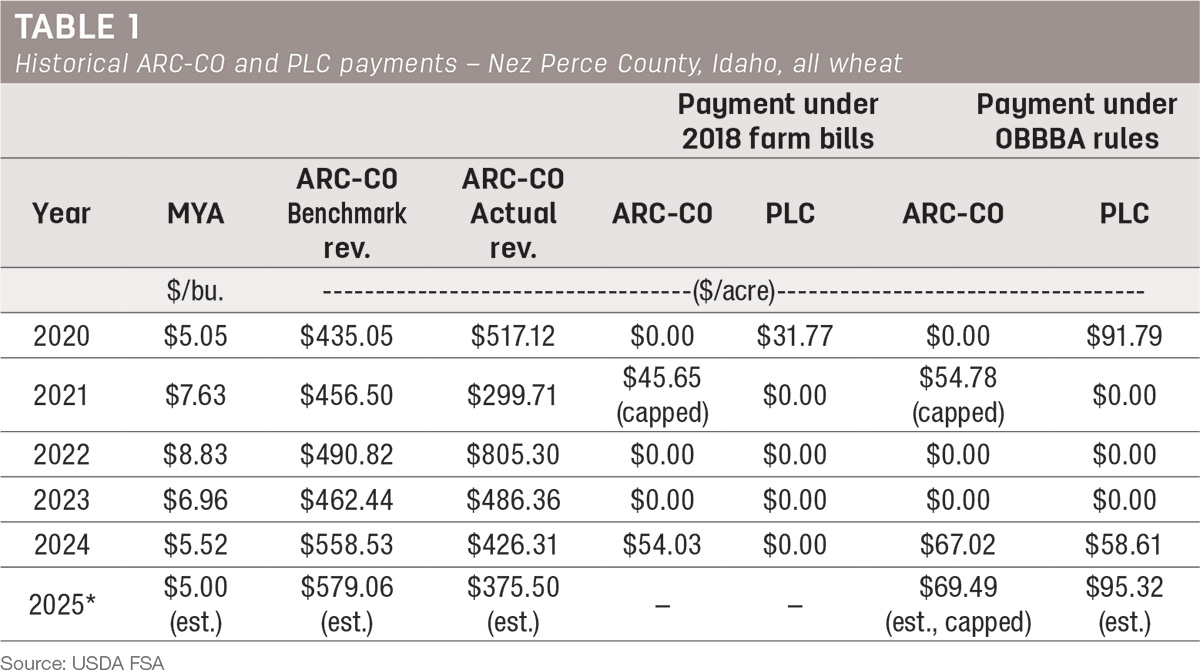
How would the OBBBA have changed ARC-CO and PLC payments? Table 1 shows payments for both programs on Nez Perce County all wheat from 2020 to 2025 under the 2018 Farm Bill and OBBBA rules. For PLC, the payment is calculated as the difference between the ERP and the MYA price, multiplied by a representative county-level PLC yield, which differs from the PLC yield assigned to individual farms. For ARC-CO, the payment is based on the shortfall between actual county revenue and a guaranteed level of county revenue derived from recent historical yields and prices, subject to a payment cap.
In 2020, PLC was the preferred program because wheat prices fell below the ERP. The higher statutory reference price under OBBBA would have nearly tripled the PLC payment, increasing it from about $32 per acre to nearly $92 per acre. ARC-CO paid nothing under either set of rules, as actual county revenue ($517.12 per acre) was above the guarantee.
The ARC-CO triggered payment in 2021, when a severe yield decline – the FSA actual county fell to just 39.28 bushels per acre – drove actual revenue down to $299.71 per acre, well below the program guarantee. The payment was $45.65 per acre (capped) under the 2018 Farm Bill and $54.78 per acre (capped) under OBBBA. In contrast, strong commodity prices in 2022 and 2023 kept actual county revenue above program guarantees, resulting in no payments from either program under either set of rules.
The differences between the programs become especially apparent in 2024. Under the 2018 Farm Bill, neither program generated a payment. The MYA price ($5.52 per bushel) remained just above the 2018 Farm Bill ERP ($5.50 per bushel), while actual county revenue ($426.31 per acre) was above the ARC-CO guarantee. Under OBBBA, however, both programs triggered payments because of higher support levels. ARC-CO provided the larger benefit at $67.02 per acre compared with $58.61 per acre from PLC.
For 2025, the wheat MYA price is nearly finalized at $5 per bushel, and the estimated Nez Perce County wheat yield is 75.1 bushels per acre based on NASS data. This puts estimated actual revenue at $375.50 per acre, well below the OBBBA guarantee. As a result, both ARC-CO and PLC trigger payments. ARC-CO is estimated to pay $69.49 per acre, capped at 12% of benchmark revenue, while PLC is estimated to pay $95.32 per acre assuming the representative county yield. Because 2025 payments are automatically based on the higher of the two program payments regardless of election, Nez Perce County wheat producers with base acres will likely receive $95.32 per acre under PLC. Actual payments, however, are applied to base acres at an 85% payment factor, so the effective per-acre payments will be lower than the figures shown.

2026 ARC-CO payment scenarios for Nez Perce County
Wheat prices rallied this spring. The May 2026 WASDE report projected the 2026-27 wheat MYA price at $6.50 per bushel. At that price, PLC would not trigger a payment because the projected MYA price exceeds the OBBBA ERP of $6.35 per bushel.
ARC-CO, however, can still trigger if county yields fall far enough. Table 2 shows projected ARC-CO payment scenarios for Nez Perce County all wheat across a range of county yield levels. With a benchmark revenue of $563.70 per acre, calculated using an Olympic average yield of 80.76 bushels per acre and an Olympic average benchmark price of $6.98 per bushel, the OBBBA guarantee is $507.33 per acre. At the projected MYA price of $6.50, ARC-CO would begin paying only if county yields fall below about 78.05 bushels per acre, or 96.6% of the benchmark yield.
2026 enrollment decision for wheat producers
At current projected MYA prices, ARC-CO is the only program that may trigger payment for wheat in 2026, but only if county yields decline meaningfully. However, it is important to remember that prices can change dramatically, as we have seen over the last few years. The 2026-27 MYA price will not be finalized until summer 2027, and prices can move substantially between now and then. If the MYA price ultimately settles below $6.35 ERP, PLC would trigger after all.
Over the longer run, the better choice depends on a county’s risk profiles. Producers in counties with historically stable irrigated yields may find PLC the better fit. Producers in counties with higher yield variability, or those concerned about combined price and yield risk, may prefer ARC-CO.
To support this enrollment decision, we developed the ARC/PLC comparison tool, a free interactive web application covering Idaho, Oregon, Utah and Washington. The tool lets producers compare ARC-CO and PLC payments for their specific county, crop and irrigation type, explore historical payment records back to 2014 and run price scenario analyses.
Jungkeon Jo, a postdoctoral fellow at University of Idaho, also contributed to this report.