This article is meant to provide general information only, not specific legal, financial or otherwise specialized advice. Always consult with your accountant, attorney or extension specialist about your specific situation and how any policies or practices will apply to you and your operation.

On July 4, the One Big Beautiful Bill Act (OBBBA), a reconciliation measure passed by Congress, was signed into law. Unlike the step-by-step changes farmers have grown accustomed to, this bill arrived as a comprehensive package – reshaping estate planning, income tax, business deductions and family credits in ways that ripple through farm succession plans and household budgets.
For agriculture, the bill represents relief and complexity, requiring careful planning to navigate its provisions, says Kelly Wilfert, J.D., farm law outreach specialist with the University of Wisconsin – Madison Extension.
Federal budget process
Wilfert explains that the OBBBA emerged from the federal budget process, which unfolds in three stages: resolution, reconciliation and appropriations.
“Congress first sets spending targets, then rewrites laws to meet those goals and finally authorizes agencies to spend,” says Wilfert. “OBBBA was the reconciliation bill, but appropriations stalled, leading to a government shutdown in October despite the law’s passage.”
This illustrates the multiple layers of federal policymaking – farmers must track not only the laws themselves but also the funding mechanisms that bring the laws front and center.
On Nov. 12, the U.S. Congress passed a new continuing resolution, funding the government through Jan. 30, 2026. This included three full-year appropriations bills and extended the 2018 Farm Bill to Sept. 30, 2026.
Estate and gift tax exemption
Wilfert adds that perhaps one of the most significant changes for farm succession is the estate and gift tax exemption.
“Beginning in 2026, the exemption increases to 15 million dollars per person, 30 million dollars per couple,” says Wilfert. “That’s a dramatic shift from the early 2000s, when the exemption stood at just 1 million dollars – a figure that made estate taxes a constant concern in farm succession planning.”
Currently, only a fraction of estates face federal estate tax. A USDA Economic Research Service report estimated that at the 2025 exemption level of $13.95 million, only 3% of farm estates – about 141 annually – would owe tax.
For most families, estate tax is no longer the driving factor in succession planning. Still, portability rules require careful attention to preserve a deceased’s unused exemption; families must file an estate tax return within five years.
Income tax changes
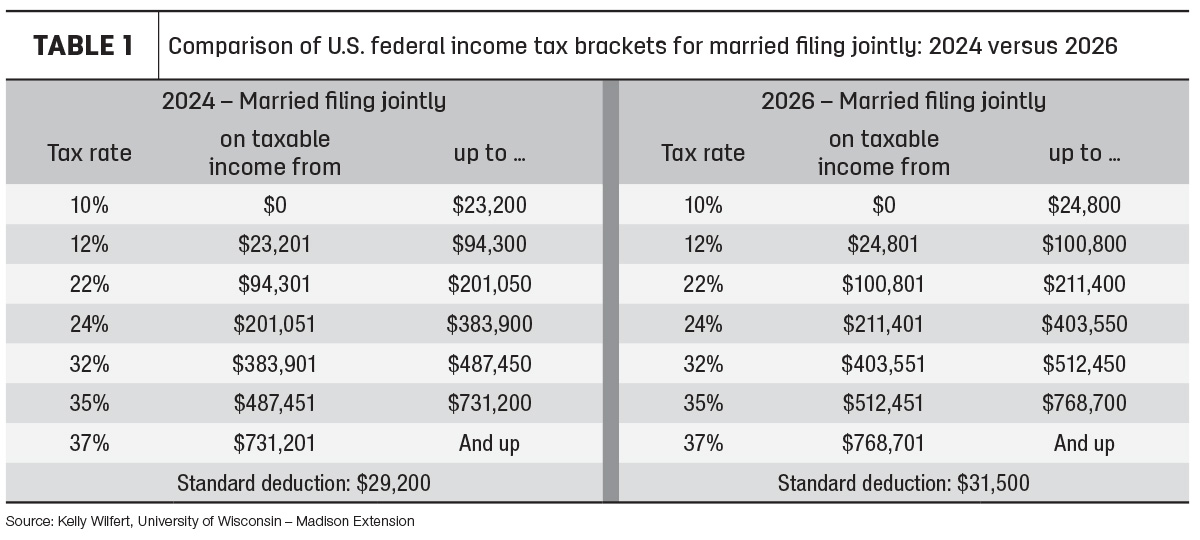
OBBBA made permanent the lowered tax brackets and higher standard deductions introduced under the Tax Cuts and Jobs Act. For married couples filing jointly, the standard deduction increases to $31,500 in 2026 – protecting more income from tax and ensuring what remains is taxed at lower rates (Table 1).
The law also temporarily increased the state and local tax (SALT) deduction, increasing the cap from $10,000 to $40,000 in 2025, with gradual increases through 2029 before reverting to $10,000 in 2030.
“There are opportunities to take advantage of the SALT deduction in the next four to six years,” says Wilfert. “But in 2030 the cap drops back to 10,000 dollars. And remember – it only applies if you’re itemizing, which most folks won’t do unless their deductions exceed that higher standard deduction.”
A new personal car loan interest deduction applies from 2025 to 2028, capped at $10,000 and limited to new vehicles assembled in the U.S.
Charitable deductions were broadened, allowing non-itemizers to claim up to $2,000 for married couples filing jointly beginning in 2026, while itemizers face a new 0.5% floor.
Employment and off-farm income
Two temporary deductions were introduced for workers in cash-tipped and overtime occupations.
- Qualified tips: From 2025 to 2028, individuals in occupations customarily receiving tips such as – wait staff, bartenders, hotel staff, ushers, home, maintenance workers, photographers, event planners, babysitters, tutors, massage artists, hairdressers, tattoo artists, tour guides, etc., – may deduct up to $25,000.
- Qualified overtime: Also temporary, this deduction allows up to $25,000 for married couples filing jointly; however, agriculture is exempt from overtime under the Fair Labor Standards Act, meaning most farm employees will not benefit.
“Because agriculture is exempt from overtime under the Fair Labor Standards Act, most farm employees won’t benefit directly,” says Wilfert. “But for households with off‑farm income – whether in landscaping or even bartending – this provision offers meaningful relief.”
Farm and business provisions
For farm businesses, Wilfert reviewed several permanent changes that OBBBA delivered, including:
- Qualified business income (QBI) deduction: The 20% deduction for sole proprietors and pass-through businesses, including agricultural cooperatives, was made permanent. A new minimum $400 deduction applies beginning in 2026 for taxpayers with at least $1,000 in active business income.
- Section 179 expense enhancements: Limits were raised to $2.5 million with a $4 million investment cap, effective for property placed in service in taxable years starting after 2024.
- Bonus depreciation: Restored permanently at 100% for property acquired after Jan. 19, 2025, including trees and vines.
- Qualified production property: A new elective 100% depreciation allowance applies to nonresidential real property used in agricultural or chemical production, subject to strict timing and use requirements.
- Business interest deduction: Permanently restored to allow depreciation, amortization and depletion to be added back to adjusted taxable income, increasing allowable deductions.
- Research and experimental expenses: Immediate deductibility was restored for domestic research beginning in 2025, while foreign research must still be amortized over 15 years.
Reporting and compliance
OBBBA also adjusted information reporting:
- 1099-K requirements: Third-party reporting required only if transactions exceed $20,000 and 200 transactions.
- 1099-Miscellaneous/nonemployee compensation requirements: Increased from $600 to $2,000 per payee beginning in 2026.
“Under current law, businesses must file an information return if payments to any person total $600 or more in a year – for example, rent payments. Beginning in 2026, OBBBA raises that threshold to $2,000,” explains Wilfert. “Depending on rental rates and land agreements, this change may reduce the number of 1099s sent or received, though larger leases will still fall under the reporting rules.”
Exclusion of interest on agricultural loans
Financial institutions benefit from a new exclusion allowing them to exclude 25% of interest income derived from loans if the loans are secured by agricultural property.
“It's not something that a farmer is going to be taking advantage of,” says Wilfert. “But what this does is allow certain financial institutions to exclude 25% of interest income derived from loans if those loans are secured by real property.”
More directly, sellers of farmland to qualified farmers may elect to pay tax on capital gains in four equal installments. The calculation remains in year one, but payments are spread over time. Eligibility requires the land to have been farmed for 10 years prior to sale and restricted to agricultural use for 10 years after.
Childcare provisions
OBBBA enhanced several childcare and other dependent credits:
- Child tax credit: Permanently set at $2,200 per child younger than 17 beginning in 2025, with a $1,400 refundable portion and indexed for inflation.
- Credit for other dependents: Permanently set at $500.
- Trump accounts: A new tax-preferred savings account for children, structured like IRAs but without deductions. Contributions are capped at $5,000 annually, indexed for inflation, until the child turns 18 years old. A pilot program provides $1,000 deposits for children born between 2025 and 2028 if no account is established.
“We also saw some enhanced employer-provided childcare credit, adoption credit, dependent care assistance program and child and dependent care credit,” adds Wilfert.
To learn more
Farm families have several options to stay informed. The University of Wisconsin – Madison Extension Farm Management website offers resources on income tax considerations, and two other extension groups are working on this topic:
- Penn State Extension – hosting upcoming programs on farm taxes, basic filing requirements, how taxes are calculated and how business entities are taxed.
- Iowa State University Center for Agricultural Law and Taxation – providing extensive written material on agricultural tax law and succession planning.
Because federal tax rules apply across the country, these resources are valuable no matter where your farm is located.