Hay harvest is one of the busiest and most demanding times of the year for livestock producers. While modern equipment has significantly reduced the labor required to harvest and store hay, it has also introduced potential safety hazards that can result in serious injury or even death.
Farm safety incidents occur every year during hay harvest season. Long hours, hot weather, fatigue, dust, machinery and roadway travel all contribute to increased risk. Taking time to prepare equipment, following recommended safety practices and remaining alert throughout the season can help reduce accidents and injuries.
The following are several important areas to consider for a safer hay harvest season.
Preharvest preparation
As with many farm hazards, familiarity with an operation can reduce the perceived risk below the actual level of danger. The speed at which equipment operates and the speed at which incidents occur are often underestimated. At the same time, operators may overestimate their ability to react.
For example, a power takeoff (PTO) shaft rotating at 540 rpm has a wrap rate of approximately 7 feet per second. A baler traveling just 3 miles per hour pulls forage in at a rate of about 4 feet per second. Belts, chains and pulleys on hay equipment can have pull-in rates exceeding 66 feet per second. A person can never win a race against a machine.
Review the operators manual and follow all maintenance guidelines. Reading the manufacturers manual at the beginning of each season and following recommended safety procedures can significantly reduce the likelihood of injury or equipment failure. Cleaning, lubricating and replacing worn parts can also reduce costly downtime during the season.
Roadway transportation of hay equipment
Before traveling to the field, ensure equipment is roadworthy. Check that lights, flashers and turn signals are functioning properly and that slow-moving vehicle (SMV) emblems are clean, visible and correctly positioned.
Make sure the widest parts of balers, mowers, rakes and other equipment are marked with reflectors or reflective tape to alert motorists. Always return equipment such as balers, hay rakes and mower-conditioners to the transport position before leaving the field. This minimizes equipment width and improves safety when meeting traffic or pulling aside to allow vehicles to pass.
When transporting large or wide equipment, consider using an escort vehicle.
Avoid traveling at dawn, dusk or during periods of limited visibility. Plan routes to avoid peak traffic periods whenever possible. Choosing a safer route – even if it adds a few miles or minutes to the trip – is often worthwhile. Always obey traffic laws and road signs.
Mowing and conditioning
Hay harvest begins with cutting fresh forage. Before starting the season, inspect fields for storm debris, rocks, stumps or other obstacles that could damage equipment or create hazards.
Crop density, moisture content, field conditions and operating speed all affect mower performance. Heavy crops, poor drying conditions and excessive ground speed can lead to plugging and clogging. Each time an operator leaves the seat to address a clog, there is potential exposure to injury.
Cutterbar incidents can result in severe lacerations or amputations, particularly to fingers and toes. These incidents often occur when operators attempt to clear clogs or service equipment without following proper safety procedures. Always disengage the PTO, shut off the tractor, remove the key and wait for all motion to stop before servicing equipment.
Disc mowers, conditioners and mower-conditioners present thrown-object hazards. Never allow anyone to stand near the rear of these machines during operation. They also pose pull-in and crushing hazards. Never operate equipment when bystanders are present.
Safety curtains and shields are critical for reducing thrown-object risks. Read the operators manual, review safety decals and follow all recommended precautions.
Baler operation
Operators should have a thorough understanding of both the tractor and baler they are using. Hay balers are complex machines with numerous moving parts that create entanglement, pull-in, wrap, pinch and crush hazards.
Ensure all shields and guards are in place and functioning properly. Never attempt to clean, lubricate, adjust or service a baler unless the tractor engine is shut off, the ignition key is removed, the PTO is disengaged, and all moving parts have come to a complete stop.
Never attempt to unplug or clean out a baler while it is operating. Severe injury or death can result. Always wait until all machine motion has stopped before approaching the equipment.
Do not attempt to feed material into a baler by hand. Ensure hay is adequately cured before baling, as wet forage increases the likelihood of plugging.
When raising or lowering the rear gate or ejecting round bales, make certain no bystanders are nearby. Never eject round bales on slopes where they may roll and create a hazard. Discharge bales only on level ground whenever possible.
Never stand beneath a raised rear gate or bale chamber door. Always ensure the safety lock is engaged before inspecting or servicing a baler with the gate raised.
Be prepared for fire. Hot, dry conditions combined with friction from chains, belts, bearings and combustible hay can create ideal conditions for a baler fire. Keep a fully charged Class ABC dry chemical fire extinguisher readily accessible.
Handling round bales
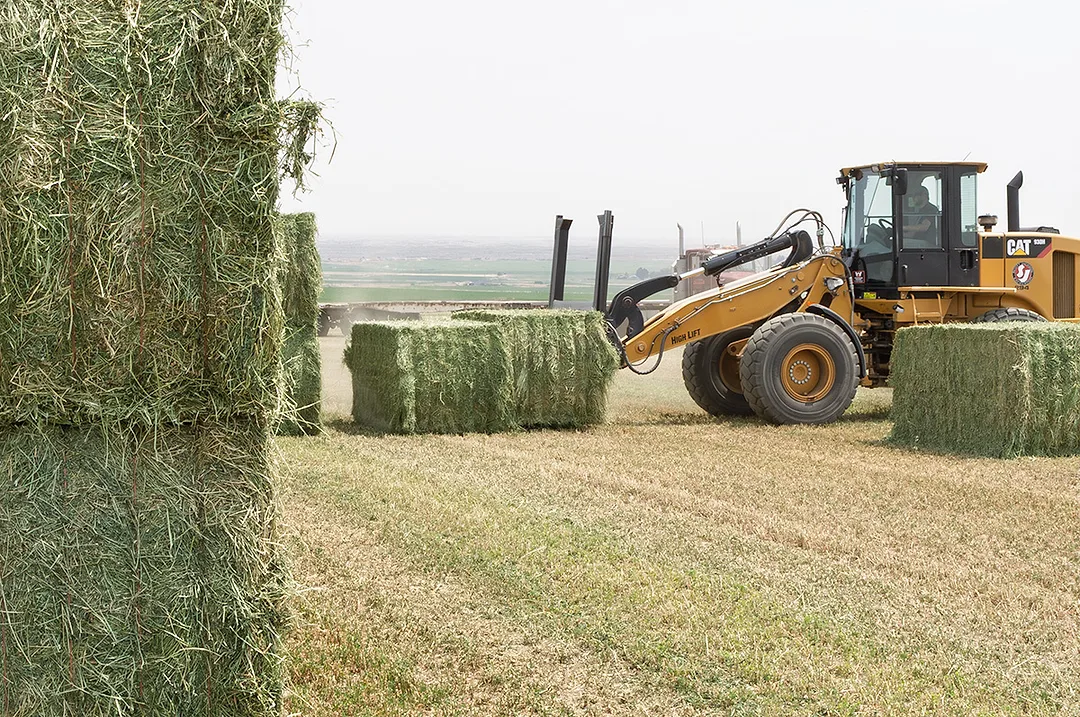
Large round bales are commonly moved using a front-end loader. Use equipment specifically designed for handling round bales, such as bale spears or grapple attachments. Proper attachments help reduce the likelihood of bales rolling back toward the operator. Be aware of pinch points and crush hazards when operating front-end loaders. Never walk or work beneath a raised loader.
Watch carefully for overhead power lines when handling or stacking bales. Raising the bale also raises the tractor’s center of gravity, increasing the risk of overturns. Use proper counterweights to improve stability and always remember the watchwords: Go slow and keep the load low.
Hauling round bales
Many producers must transport hay from distant fields to storage areas. Use a tractor, truck or towing vehicle that is properly sized for the weight of the load and capable of stopping it safely. Ensure hitch pins and safety chains are correctly sized and securely attached. When transporting on public roads, follow all traffic laws regarding wide loads and ensure loads are properly secured.
Make certain SMV emblems are clearly visible and consider using an escort vehicle when transporting oversized loads.
Operator safety
Hay season can be one of the most demanding times of the year. Long hours spent in heat, sunlight, dust and noise can quickly lead to fatigue.
Wearing appropriate personal protective equipment (PPE) can help protect against common hazards associated with hay production. Examples include long-sleeved shirts, long pants, sunglasses, broad-brimmed hats, sunscreen, dust masks and hearing protection, particularly when operating open-station tractors.
Get adequate rest, maintain a healthy diet, stay hydrated and take regular breaks. Fatigue and heat stress can significantly reduce reaction time and increase the likelihood of mistakes.
If working alone, let someone know your location and expected schedule. Maintain a positive attitude, stay focused on the task at hand, avoid distractions, and remain aware of potential hazards. Do not take shortcuts. As the old saying goes, haste makes waste – and in farming, it can also lead to injury.