We use cookies to provide you with a better experience. By continuing to browse the site you are agreeing to our use of cookies in accordance with our Cookie Policy.
  • Sign In
  • Create Account
  • Sign Out
  • My Account
subscribe / renew
  • Topics
    • All recent articles
    • Animal Welfare
      • Animal Handling
      • Cow Behavior
      • Welfare Standards
    • Barns
      • Barn Design
      • Bedding
      • Bird Control
      • Cow Comfort
      • Cow Cooling
      • Cow Flow
      • Expansion
      • Flooring
      • Fly Control
      • Lighting
      • Pen Design
      • Stalls
      • Ventilation
    • Calves & Heifers
      • Calf & Heifer Health
      • Calf & Heifer Nutrition
      • Calf Housing
      • Colostrum
      • Heifers
    • Feed Ingredients
      • Additives
      • Byproduct Feeds
      • Carbohydrates
      • Fiber
      • Minerals
      • Protein
      • Supplemental Fats
      • Trace Minerals
      • Vitamins
    • Feed Management
      • Bunk Management
      • Feed Evaluation
      • Feed Storage
    • Forage Types
      • Alfalfa
      • Alternative Forages
      • Grasses & Grazing
      • Silage
    • Genetics
      • Breeding Protocols
      • Breeding Strategy
      • Crossbreds
      • Indexes
      • Purebreds
      • Traits
    • Herd Health
      • Animal Monitoring
      • Antibiotics
      • Diagnostic Tests
      • Digestive Issues
      • Dry Cows
      • Fresh Cows
      • Infectious Disease
      • Mastitis
      • Metabolic Disease
      • Vaccination
    • Hoof Health
      • Digital Dermatitis
      • Hoof Care
      • Lameness
      • Lesions
    • Manure
      • Carcass Disposal
      • Greenhouse Gases
      • Manure Analysis
      • Manure Application
      • Manure Handling
      • Manure Solids
      • Manure Storage
      • Nutrient Management
      • Renewable Energy
      • Solid-Liquid Separation
    • Milking Equipment
      • Milk Storage
      • Milking Robots
      • Milking Sanitation
      • Milking Systems
      • Parlor Types
      • Teat Prep Equipment
    • Milk Quality
      • Udder Hygiene
      • Parlor Hygiene
      • Milk Production
      • Milk Components
    • Ration Formulation
      • Digestion
      • Dry & Transition Cow Diets
      • Lactating Cow Diets
    • Reproduction
      • Breeding Equipment
      • Repro Management
      • Repro Technology
    • Technology
      • Management Software
    • Business Management
      • Consultants
      • Employees
      • Finances
      • Profitability
      • Risk Management
      • Succession Planning
      • Training Tools
      • Working with Family
    • Dairy Farm Features
    • Special Topics
      • Christmas
      • Dairy Activities
      • June Dairy Month
      • Niche Marketing
      • State of the Dairy Industry
      • Women in Dairy
  • News
    • Dairy Demand
    • Dairy Foods
    • Dairy Industry Issues
    • Dairy Trade
    • Events
    • Milk Marketing
    • Milk Processing
  • Blogs
    • From the Editor
    • Guest Blogs
    • Faber’s Food for Thought
    • HERd Management
    • Just Dropping By
    • Life on the Family Farm
    • The Milk House
    • Tim the Dairy Farmer
  • Podcasts
  • Buyers Guide
  • Magazine
    • Current Issue
    • Past Issues
  • Ask AgProud
UsCa

Progressive Dairy

Progressive Dairy Canada

PD Canada en Francais

Progressive Cattle

Progressive Cattle Canada

Progressive Forage

Agproud Idaho

Home

Home » Topics » Progressive Dairy » Feed Management

Feed Management
Feed Management RSS Feed RSS

0407 PD: Creating space in dairy rations

April 3, 2007
If you find yourself reading the title of this [article] twice, wondering what “space” has to do with the diet of a dairy cow, you are not alone. Nutritionists and producers regularly discuss terms like pounds of dry matter intake (DMI) or percent protein or how many megacalories of energy or grams of calcium or what is the ratio of calcium-to-phosphorus. None of these discussions even comes close to mentioning space as an important consideration when planning or troubleshooting a milking cow’s diet.
Read More

0407 PD: Mixing and uniformity issues in ruminant diets

April 3, 2007
The basic premise used by all nutritionists when formulating rations is that each mouthful of the diet is balanced with respect to the known nutrient requirement of the target animal. The diet must contain the necessary nutrients to support maintenance, growth, production and health. Feed additives should be present to provide the appropriate level of protection from disease and other maladies. In all cases, the levels must be controlled so as to be neither deficient nor toxic.
Read More

0307 PD: Trace minerals: Form and function

March 6, 2007
The science surrounding protein and energy nutrition, no matter the livestock species, is a couple of generations ahead of mineral nutrition – particularly trace mineral nutrition. Yet finally there are signs that mineral nutrition science might one day catch up. One sign of progress is industry and academic interests using ‘organic’ minerals in lieu of inorganic forms of zinc, manganese, copper and selenium. The initial focus is on reproductive issues and on enhancing immune response and milk quality – areas where trace mineral availability may be limiting. Another issue is environmental accumulation of minerals in manure spread on cropland.
Read More

0207 PD: Feed efficiency is an important management tool for dairy producers

February 6, 2007
The ability of dairy cows to convert feedstuffs into products for human consumption is generally referred to as feed efficiency and is expressed as pounds of milk produced per pound of dry matter (DM) consumed. This expression represents a gross measure of feed efficiency and does not account for nutrients partitioned to reproduction, growth and tissue deposition. Thus, interpretation of the value obtained should consider stage of lactation, age and stage of gestation for the herd in question.
Read More

0107 PD: Never satisfied

January 10, 2007
Nutritionist Jess Argyle of Jerome, Idaho, says despite higher prices for rolled corn and regionally imported ration components, dairy producers should push for more milk and higher components, being careful not to lose milk production while looking for good buys on commodities. “Don’t short-change the cows. Push for production,” Argyle says. “I’ve never been able to cut out or cut back on feed and save money. We always lose more in production than what we can save in cutting back on feed.”
Read More

0107 PD: Protein cost and MUN

January 10, 2007
Are your feed costs high? The most expensive feeds are those with high levels of protein (greater than 20 percent protein). Testing for MUN (milk urea nitrogen) in the milk can help you determine the correct level of protein in the feed. There are other reasons for testing for MUN:
Read More

0107 PD: Feed conversion monitoring: Key to increased profits

January 10, 2007
For dairy producers wishing to improve their profitability, the first feed investment that needs to be made in improving milk production is dry matter intake (DMI) conversions, says Marvin Hoekema, president of Dairy Decisions Consulting, LLC, in Visalia, California. The reason is these conversions are 40 to 50 percent of a dairy operation’s budget, “meaning there is real money on the table.”
Read More

0107 PD: Milk fat depression in dairy cows

January 10, 2007
Milk fat depression (MFD) syndrome is a prevalent problem in many dairy herds feeding high-yielding dairy cows. A significant increase in understanding of MFD syndrome occurred in the last several years, and, clearly, different factors may be acting individually or together to result in a lower milk fat content. This article is focused on some of the possible dietary factors involved with MFD. One of the first steps nutritionists evaluate when they face a MFD problem is the dietary effective neutral detergent fiber (efNDF). Penn State University developed a method to evaluate the dietary efNDF which is based on the particle size of the forages or the total mixed ration. A minimum dietary efNDF guideline of 22 percent is required to provide a healthy rumen environment and maximize a cow’s intake, milk yield and composition.
Read More

0107 PD: Dynamics of selenium nutrition of animals

January 10, 2007
Selenium (Se), like the other trace minerals, is necessary to sustain life and is essential for basic physiological functions in both animals and humans. While the daily requirement for these minerals is obviously small, their importance to and impact on the health and well-being of livestock and humans are well documented in research. Fortunately, the difference between deficiency and toxicity with most of these trace minerals is believed to be fairly broad, allowing for the wide range of supplemental regimes used around the world.
Read More

0107 PD: Mycotoxin levels in feed

January 10, 2007
With drought and heat-stressed corn [...], mycotoxin levels could be elevated leading to animal health risks. Corn grain may exhibit signs of fungi growth and kernel damage. Mycotoxins are toxic byproducts produced by fungi that infect feed crops due to insect damage or stressed plants. These fungi produce mycotoxins that can include aflatoxin, zearalenone, T-2 and DON (deoxynivalenol) that can impact dairy cattle performance for several reasons, including:

Read More
Previous 1 2 … 111 112 113 114 115 116 117 118 119 Next
  • Progressive Dairy
  • 1026pd-digital-edition-feature-spot.jpg

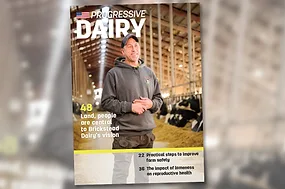
    June 12, 2026 Progressive Dairy digital magazine

    June 12, 2026
  • 63471-coyne-63471E.jpg

    Brickstead Dairy at forefront of industry progress

    June 12, 2026
    • The Courage to Evolve: Mothers

      June 12, 2026

FREE NEWSLETTERS

Award-winning coverage of in-depth news and analysis to make your business more profitable.

SIGNUP TODAY
Advertisement
THE GUIDE

How do I get my company listed in your Buyers Guide? 
Submit a request to be listed for FREE in the Buyers Guide here. 

Why can I only see so many articles before I have to register for the site? 
Find out why here.

How do I listen to the Progressive Dairy podcast?
Listen here.

How do I submit an idea for an article? 
Click here.

SUBSCRIBE OR RENEW Your Subscription to Leading Industry Magazines

Award-winning coverage of in-depth news and analysis to make your business more profitable.

Subscribe or Renew Today
  • INDUSTRY NEWS
  • Dairy News
    Dairy Industry News

    U.S. dairy exports soar in April

    June 11, 2026
  • Dairy Industry News

    QualiTru Sampling Systems launches customized food safety and quality training program for commercial dairy industry

    June 11, 2026
  • Dairy Industry News
    People

    Progressive Publishing hires Lauren Wangsness as summer editorial intern

    June 10, 2026
Advertisement

I'm looking for ________

Find the right products and services for your farm, ranch or operation.

CHECK OUT OUR BUYERS GUIDE
Advertisement
  • FEATURED PODCASTS
  • [Podcast] Changing the Rules of Pre-Fresh Dairy Cows

    Progressive Dairy
    Podcasts
    SPONSORED BY Applied Biotechnologies Inc.
  • [Podcast] Performance By Design: Science-driven solutions for today’s calf raisers

    Progressive Dairy
    Podcasts
    SPONSORED BY IFF Animal Nutrition & Health
PERSONALIZED CONTENT
Create an account and see website content tailored to your operation.  It only takes a few seconds!
SEE RECOMMENDATIONS NOW!
Copyright © 2026 Progressive Publishing

MORE INFORMATION
  • About Us
  • Terms & Conditions
  • Privacy Policy
  • FAQs
  • Advertise
  • Shop
  • Stats Posters

OUR MAGAZINES
  • Progressive Dairy
    • Facebook
    • Twitter
    • Linkedin
  • Progressive Dairy — Canada
    • Facebook
    • Twitter
    • Linkedin
  • Progressive Dairy — en français
    • Facebook
  • Progressive Cattle
    • Facebook
    • Twitter
    • Linkedin
  • Progressive Cattle — Canada
    • Facebook
    • Linkedin
  • Progressive Forage
    • Facebook
    • Twitter
  • AgProud — Idaho
    • Facebook
    • Linkedin

CONTACT INFORMATION

Progressive Publishing
238 West Nez Perce (physical)
PO Box 585 (mailing)
Jerome, ID 83338


info@progressivepublish.com
(800) 320-1424
(208) 324-7513 (Main)
(208) 324-1133 (Fax)