
“The greatest of all time.” Whether on a playground, a beauty salon or a coffee shop, that phrase sparks a debate. The greatest bubble gum of all time? That’s easy, it’s Hubba Bubba bubble gum. The beauty salon is foreign to me but no less contentious. High waisted or low rise? Darks or pastels? The fashion police are a real thing, but every woman has their own fashion police force.
The coffee shop is more my style. Greatest baseball team of all time … the 1976 Cincinnati Reds (that’s how much I dislike the Yankees). Greatest muscle car … the 1970 Dodge Charger G/T. Best tractor of all time is a John Deere 4430 with an open cab, and coincidentally, the last tractor I could tinker.
Best racehorse of all time. That’s easy, it’s Whitney, my 19-year-old palomino gelding. He was my second horse, and we never lost a race … against imaginary horses. Each of my superlatives sparks a contrary in your mindhat makes these debates fun.
Let’s jump in a time machine and return to school days. Do you remember English class, or are those memories erased? My first grade teacher explained superlatives. If you compare two items, one can be good and the other is better. One can be fast and the other is faster. One can be obsequious, and the other … more obsequious. Superlatives draw from a larger pool and the superlatives stand alone. Not just better, it’s the best, the fastest or the most obsequious.
In learning about superlatives, I told my teacher that my horse Whitney was the most fastest horse.
“Your horse can’t be the most fastest,” my teacher explained.
“But he is.” I’ve always been stubborn.
“No, I mean grammatically speaking, he can’t be the most fastest.”
“But hyperbolically speaking, he is the most fastest.” I’ve always had an expansive vocabulary. Imagine if I used that skill for the betterment of mankind.
Let’s stay in our English class, that’s a great way to kill my readership. What is the greatest essay of all time? I know what you’re thinking – I want to revisit my October column on pumpkin-spiced flatulence candles, but that column was just good, not greatest. A statistically insignificant number of readers are running through your list of favorite essays. For the rest of you, please read on; I will eventually get to a point.
What about the Book of John in the Bible? From a literary perspective, the Book of John is a brilliant combination of theological depth and applicable simplicity. When I make this case, the counterargument is “John” is a book, not an essay. When John wrote “John,” there were no books. They used scrolls. Shortly after John wrote “John,” the codex was invented and evolved into a book. So the “Book of John” couldn’t be a book, but rather an essay. But the Bible is the infallible Word of God and unfair to include the Book of John in a ranking with us mere mortals.
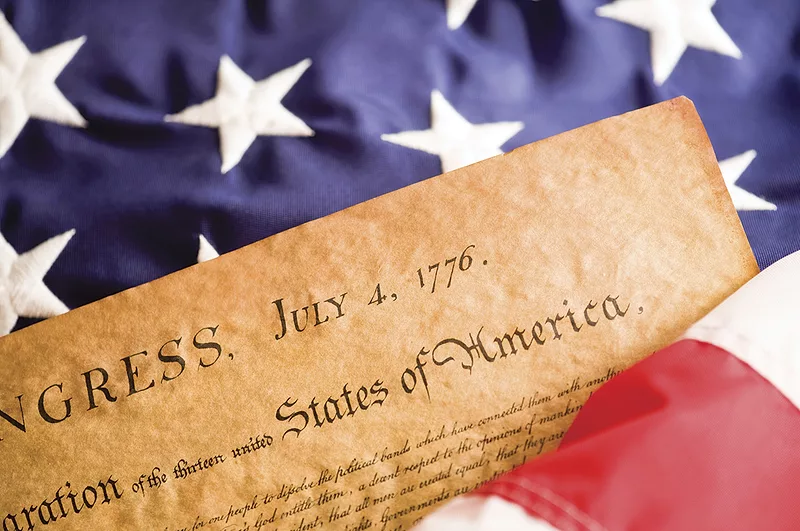
The greatest essay of all time was a late 18th century document written in a rented room in Philadelphia. From a committee of five, they didn’t pick the lawyers, the small businessman or the publisher. They chose a farmer to write this essay. It was written in a little over two weeks and is a concise 1,320 words. It was Thomas Jefferson who wrote the “Declaration of Independence.”
Like any great essayist, he relied on insights from John Locke, George Mason, Montesquieu and the Bible, with four direct references to God in his essay. This essay’s greatness isn’t what went into it, but rather what came out of it.
In 1775, societal advancement had plateaued. Explorers explored, merchants traded, thinkers thought, and the vast majority of Earth’s population lived in some form of indentured servitude. This was the state of the world for multiple millennia. Then this essay was unanimously accepted by the Continental Congress on July 4, 1776, and everything changed. The change wasn’t instantaneous, but from that inflection point, we became the freest, most prosperous society in the history of the planet. And the second-most prosperous society followed our lead. Within 100 years of this essay, slavery ended for the first time in human history, and in another 100 years, toil was virtually eliminated from labor. Today, we join gyms to avoid a sedentary lifestyle.
In 1775, the fastest vehicle was a horse. After 1776, we have trains, steam ships, automobiles, airplanes and now rocket ships to the moon and back. In 1775, the printing press was the media. Now we can post a stupid cat video that is viewed in Antarctica in a matter of minutes. In 1775, farming was to feed yourself and a few neighbors. Our primary exports were tobacco and cotton. By 1950, starvation was rare. When I grew up in the ’90s, hunger was virtually eliminated. Today, the American farmer contends with overproduction and how to manage our cornucopia of abundance.
Everything changed with that essay, but all the document did was unleash the prosperity that a free people can reap. On the 250th anniversary of our nation, we should read, appreciate and remember the Declaration of Independence and acknowledge the generations of Americans that, in pursuing freedom, have made the United States of America the greatest of all time.
.webp?t=1687979285&width=640)




.webp?height=auto&t=1783636475&width=285 "63802-Thomas-GPS-equipment--Automated-Magnum-Tractor--Matt-Skinner-photo(1).jpg")
