Before dairies had the capacity to mix rations, silos were often a primary source of feed – alongside premixed minerals or grains in a component feeding system. These silos served an important purpose in helping maintain the integrity of the stored feed, but when used alone weren’t capable of maximizing the total nutrient balance needs of a cow. Then along came the TMR mixer, an incredible tool allowing dairies to mix feed from multiple silos – i.e., grain, haylage or corn silage – in the right quantities to provide the cow a much more nutrient-balanced feed to satisfy her requirements.

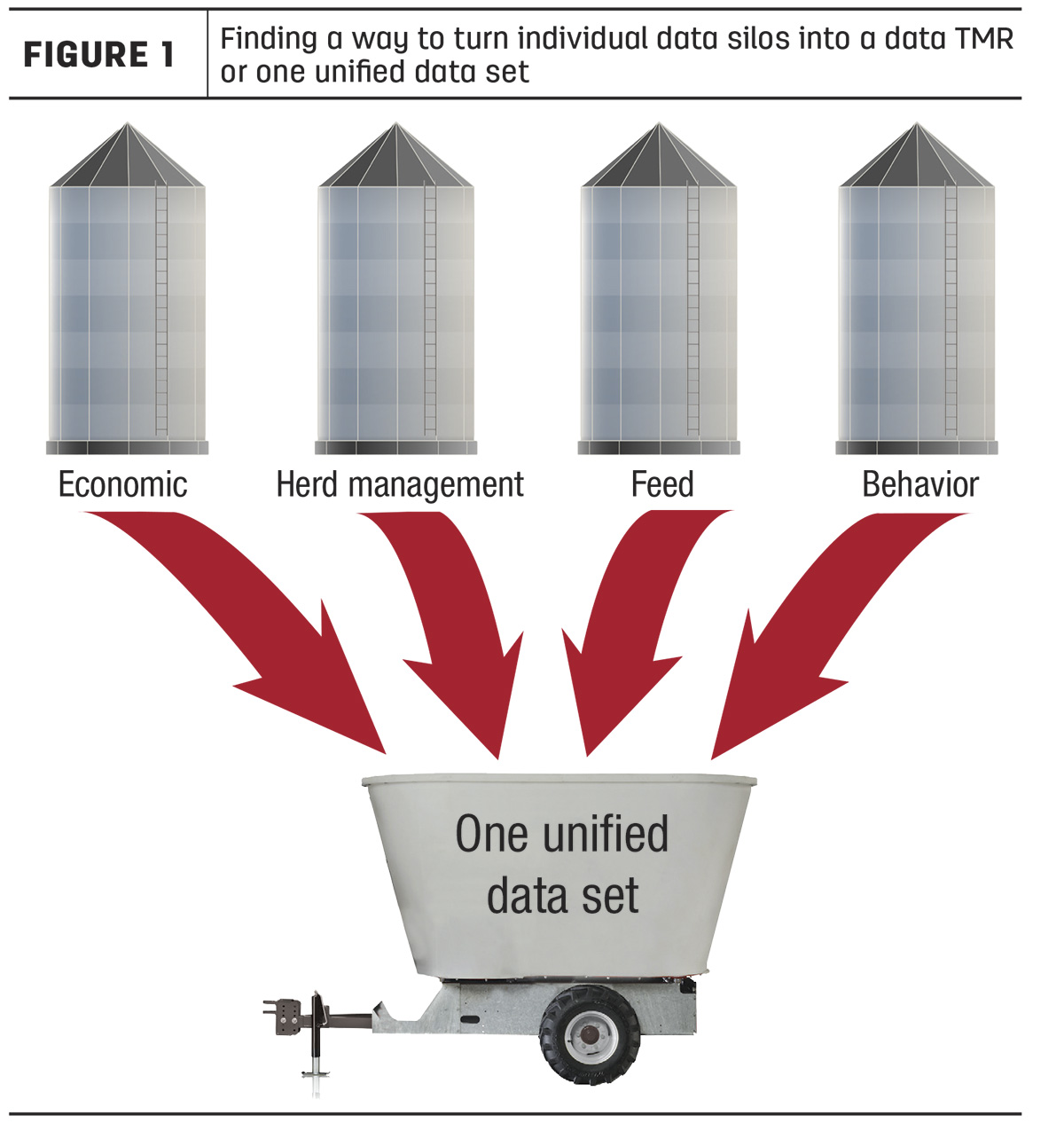
This same concept applies to data silos. Data silos are individual sources of data within an organization that are housed separately. For example, our herd management software has data in one silo, while our activity tracking data may be in another silo and our feed inventory in yet another silo. These data silos may even have completely different data structures, similar to how our feed in silos may have different nutrient content.
Similar to a TMR, when combined together these data silos can provide a more valuable and usable product than each offers individually. However, dairy doesn’t have a tool quite yet that folds all of these silos together into one complete product (Figure 1). Sure, there are some software platforms capable of bringing some of these silos together. However, a complete comprehensive solution still doesn’t exist. Comparable to how the TMR mixer completely revolutionized how we feed cows, data aggregation tools will certainly revolutionize how we make decisions on dairy farms.
Look at the nutritional analysis data collected from a silo. When a sample is sent to the lab, we receive the percentage of crude protein, starch, digestible fiber fractions, etc. – essentially the nutrient breakdown of the sample. This information is necessary in creating a balanced ration. If we can aggregate this with other data, such as harvest yield, crop management factors or even environmental conditions, we can now look at input per unit of digestible nutrients harvested. This can help guide decisions for future years and, when compiled with additional data silos, could provide comparisons of animal performance over several crop years. Better understanding of potential relationships aids decisions that can have greater influence on the bottom line.
Data held in individual silos pose several problems for businesses, including dairies. This data incarceration can limit potential collaboration between farm teams. Managing different programs and accessing different reports for each of these data silos not only increases training time, it may challenge the likelihood of optimal data utilization. These data silos may also require more resources to maintain and govern than if managed as one cohesive dataset. Individual datasets limit decision-making, as we often aren’t seeing the complete picture when troubleshooting or aiming for that next 5 pounds of milk. Unless we are combining every single dataset, the inference is still limited and could even mislead decisions. With advanced computing and AI technology on the horizon, these individual data silos limit the use capacity of these tools and, when used on incomplete datasets, can mislead decisions.
Efforts to overcome this solo practice are often time-consuming and require devoted manual effort. Data formatting, data cleanliness, software communication and natural data flow may all be hindrances to a data composite. For instance, much of our reproductive, production and health data is reported on a per-cow basis, whereas feed information is often reported on a percentage, per-ton or per-mixing-load basis. While connecting these data sources seems simple in theory, in practice translating this data isn’t always straightforward. However, resources shuttled in the direction of removing these silos will yield huge results in the decision-making potential that comes out of such datasets.
Just as feed handling and management have evolved greatly over the last 50 years, the same will be true about data management as we move into the future. Identifying all of the data silos on farms and working to integrate them into a singular dataset will empower dairies to make more informed decisions that yield more substantial results quicker. As we add technology on farms, dairies and their consults should also consider how these can be integrated with existing datasets to leverage the information to its full extent. The ultimate goal should be finding a way to turn our individual data silos into a data TMR.