In the early days of activity monitoring, I couldn’t help but imagine the possibility of a future where synchronization protocols became “old school.” It was exciting to think about the possible labor savings and simplicity of breeding based solely on monitoring technology. But the truth is, all cows aren’t the same. There continue to be exciting and promising advancements in monitoring technologies, but the proven success of synchronization remains a reliable tool for keeping valuable reproduction metrics at their best.

And so, unlike those promising early days of technology, we now know that a successful repro program can seamlessly leverage monitoring technology while joining forces with synchronization protocols. In tandem with the tremendous strides of genetics, we are pushing the boundaries of what we thought was possible. Let’s discuss the research and on-farm experiences leading to even greater reproductive advancements.
Targeted reproductive management (TRM) is the term many researchers use to describe an approach that capitalizes on natural heats and strategically uses synchronization protocols. The approach often leverages monitoring technology to identify natural heats during the voluntary waiting period. Many herds already use this approach, whether they call it TRM or not.
In its simplest form, TRM optimizes the use of monitoring technology and leverages its data to identify outlier cows unlikely to show traditional heat. These outliers are then placed on a synchronization protocol. Cows not pregnant at preg check are then put into a Resynch protocol, and with the help of monitoring technology, they are bred again. Multiple studies over the past five years have shown the success of this approach to enhance reproductive success.
I encourage you to read “Beyond heat detection: Combining technology and synchronization for reproductive success” written by my colleague, Dr. Glaucio Lopes, to learn more about the research outcomes of TRM.
Based on these research findings, TRM is starting to gain interest among dairy producers across the country. Each farm’s scenario is a bit different, yet there is one common thread: Breed based on activity as much as possible and synchronize groups that may not show a strong, traditional heat.
Why can't monitoring identify all cows in heat?
Health problems in early lactation can significantly impact reproduction. In a University of Florida study that evaluated the daily health of nearly 6,000 cows across several farms, 84% of healthy cows were cyclic in early lactation. But among cows that faced a disease instance in early lactation, only 80% cycled and only 71% of cows cycled after experiencing more than one disease incident in early lactation.
The lack of cycling due to health problems resulted in fewer confirmed pregnancies and a higher incidence of pregnancy loss.
In the same study, 54% of healthy cows were confirmed pregnant while just 34% of cows with more than one disease incident were confirmed pregnant during the same time frame. To add insult to injury, 15% of cows with greater than one disease instance eventually lost the pregnancy after being previously confirmed pregnant.
Cows like these are facing a rocky start to lactation, so we cannot entirely rely on monitoring technology for breeding. The same is true for first-lactation cows that may be adjusting to a new routine.
The real-life practice of TRM
One large U.S. dairy wanted to maximize its recent investment in monitoring technologies by reducing the labor and expense of hormones. The operation’s reproduction metrics were already strong, so it was important to avoid disrupting their existing success.
The farm adopted a TRM approach that included monitoring technology (in this case, collars) and synchronization protocols. The dairy began breeding based on activity rather than observed standing heats. When a strong heat could not be observed on a cow, they continued using Double Ovsynch. The most significant shot protocol shift was shortening the resynchronization cycle.
Previously, an extended double Resynch was used. All cows received GnRH 14 seven days prior to preg check. In the updated protocol, cows that were open at preg check received PGF and were bred based on activity monitoring over the course of just seven days. If they were not bred, they were reenrolled in the resynchronization protocol.
Table 1 summarizes results before and after the new TRM approach. Because of this shift in approach, a larger portion of the herd was bred based on activity monitoring rather than visual heat detection. Conception rates remained consistent for the portion of the herd placed on a Double Ovsynch protocol. They also reduced the number of cows bred based on a resynchronization protocol.
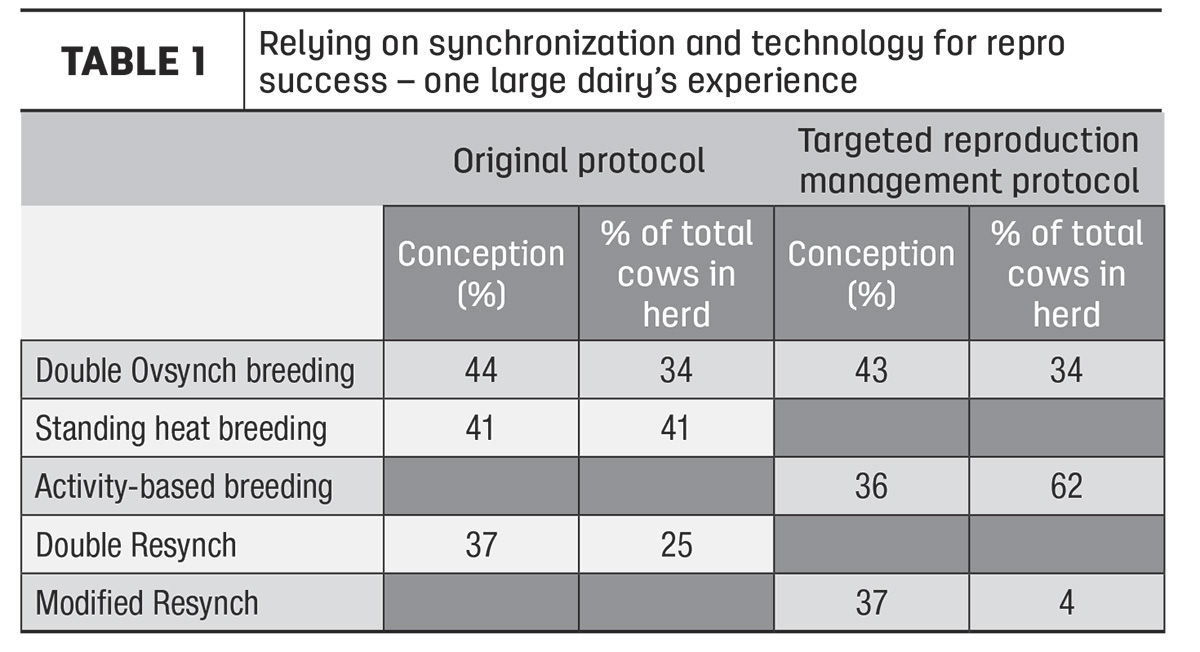
In addition to preserving their excellent reproduction results, the large dairy experienced significant cost savings with TRM. In just six months, the new resynchronization protocol meant that 2,000-plus fewer shots were given, resulting in both product and labor savings. In addition, because 62% of the herd was bred based on activity monitoring instead of standing heats, less labor was required to identify cows in heat. An important note: This herd also installed sorting gates along with the new monitoring collars. This saved employee time when sorting out cows to breed.
An additional benefit of this modified approach was the more efficient identification of cows to be bred. By using monitoring technologies to flag cows for breeding and shortening the resynchronization time frame, significantly more pregnancies occurred.
When evaluating the return on investment (ROI) of this protocol change, the dairy considered expenses – including hormones, supplies and the subscription price of monitoring technology – and the value of additional pregnancies. The value of additional pregnancies and resulting calves was a hefty contributor to the ROI equation. A drastic reduction in hormone purchases, combined with additional pregnancies, offset the entire cost of monitoring collars for this operation.
We've come so far
For repro aficionados like me, recalling the progress made in the last several decades is remarkable. While milk production per cow has exponentially grown, improved genetics and management have prevented high milk production from negatively impacting reproductive metrics.
According to the Council on Dairy Cattle Breeding, the early days of exponential milk production gains resulted in a steady decline in Daughter Pregnancy Rate (DPR). When producers began to be able to select bulls for DPR around 2000, things changed. DPR then turned around and has been making steady increases right alongside milk production, instead of being at odds.
The dairy industry is in an amazing position to harness advancements in technology. For reproduction, we can now improve production (including component yield) with less fear that it will hinder reproduction. Joining the success of monitoring technologies and synchronization protocols will carry us to new heights of reproductive success.
References are omitted but available upon request by sending an email to an editor.