


Salmonella are very contagious and pathogenic bacteria that can cause serious disease outbreaks with high morbidity and mortality in cattle. Salmonella can also cause severe illness in people. It is a leading cause of human food-borne disease, infecting approximately 1.35 million people in the U.S. each year.

There are more than 2,600 different serotypes (or kinds) of salmonella that can infect all mammals. Some serotypes can cause severe illness in cattle, while others cause milder symptoms. S. Dublin, S. Typhimurium, S. Cerro and S. Montevideo are isolated most frequently from adult cows and calves.
How is salmonella spread?
Cows infected with salmonella can shed organisms in their manure, colostrum, saliva, milk and vaginal and nasal secretions. The disease is commonly spread from one cow to another when she consumes the manure of an animal that is shedding the bacteria. Cows usually ingest this infected manure in their feed or water. Calves can become infected with salmonella when they consume substances contaminated with the bacteria. This can occur during the birthing process, in the maternity pen or calf holding pens, when drinking non-pasteurized colostrum or milk, when housed next to or with sick calves and possibly while in utero.
Cows at any stage of lactation can become infected with salmonella. Historically, transition cows (cows that are a couple of weeks before calving to a couple of weeks after calving) are most affected. Diarrhea and fever are the most widely recognized symptoms of salmonella infection in adult cows. Traditionally, cows with salmonellosis will have manure that is watery, foul-smelling and yellow. It may contain streaks of blood and chunks of fibrin. Rectal temperatures commonly reach 104.5ºF to 107ºF. Cows may abort their calf during the last half of gestation, and if the infection is severe enough, they might die.
Recently, the author has been made aware of multiple dairy farms across the U.S. where mainly mid- to late-lactation multiparous cows are afflicted with salmonellosis, not transition cows. Interestingly, the reported symptoms include loose manure (normal-colored, not yellow), indigestion, decreased milk yield and feed intake, and sometimes a mild fever (103.5ºF). Some cows abort their pregnancy, but deaths are rare. Cows may be culled due to a lack of response to treatment. Many of these cows were eventually diagnosed with S. Cerro or S. Montevideo.
The importance of stressors with salmonella
Stressors are important triggers of salmonellosis. Stressors can lead to the secretion of the hormone cortisol, which can lower immune function in cattle. It’s usually not just one stressor but the stacking of multiple stressors that brings about salmonellosis in most dairy cows. Common stressors include overcrowding, heat stress, calving, diet changes, transportation, pen moves, poor cow comfort, dry‑off, commingling of animals of different parities, concurrent infections with other bacterial or viral pathogens and recent anesthesia or surgery. It’s not uncommon to find a high percentage (55% to 90%) of cows on a farm subclinically infected with some serotypes of salmonella, like S. Cerro. Stressors are thought to play an important role in these infections becoming clinical.
Salmonella infections in dairy cows can occur all throughout the year, with cases often peaking in late summer to early fall (July to October). This is because there are more bacteria in the cow’s environment during this time. Salmonella live longer and reproduce better with warm temperatures and ample moisture, which increases the risk of infection.
Cows are also more likely to suffer from heat stress during these months, which can alter their overall gastrointestinal (GI) tract health. During heat stress, cows may eat erratically and engage in sorting and slug feeding their ration. Cows also drool more when heat stressed, which decreases the amount of saliva available to buffer the rumen. Both of these factors can increase the risk of cows developing subacute ruminal acidosis (SARA), alter their normal GI tract microbiome and increase gut permeability, which may predispose them to salmonella infections.
How is salmonella brought into herds?
Salmonella can be introduced into herds in a variety of ways. The most common practices that expose negative herds to salmonella or bring a new kind of salmonella into an already positive herd are:
- Purchasing animals from a salmonella-positive farm. This usually occurs during herd expansion or when buying replacement animals.
- Outsourcing heifer raising. When heifers are raised at an off-site facility, they are often commingled with animals from other farms. If those farms are infected with salmonella, their animals can shed organisms, thereby infecting their penmates. When the newly infected animals return to their home farms, they will spread the bacteria to the rest of the herd.
- Carrier animals like wild birds, rodents and flies. Wild geese, sparrows, starlings, blackbirds, waterfowl and rodents have been identified as reservoirs of salmonella and can spread it to cattle by contaminating pastures, standing crops in fields, stored feeds and total mixed rations (TMRs) with their fecal droppings. Flies and other insects also have been found to transmit salmonella. In one study, flies from 79% of surveyed farms carried salmonella organisms on their legs, feet and other body parts, demonstrating that insects that feed on cattle manure can play a critical role in spreading salmonella.
- Human movement in and out of farms. People and our vehicles can play a significant role in mechanically transmitting salmonella among herds when boots, tires, coveralls, equipment and hands have not been properly disinfected between farms.
- Manure slurry. Spreading manure on fields to be used for growing forages is a common practice in some parts of the country. If this manure contains salmonella, it is possible that this feed will transmit salmonella to the animals that eat it. Temperature, moisture and soil type all affect the survival of salmonella in manure. One study showed that salmonella survived for more than four months in an effluent lagoon and more than nine months in field soil. Salmonella can also be transmitted via aerosolization, such as when using flush water systems to wash manure from pens and alleyways.
Salmonella surveillance program
To survey dairy farms for the risk of salmonellosis, our company developed a systematic on-farm evaluation to check for the presence of salmonella bacteria. These evaluations include swabbing the dairy environment and assessing milk and serum samples for antibodies to S. Dublin.
Typically, six pens are assessed on each dairy. These pens usually include the fresh cow pen, high cow pen, pre-fresh pen, hospital (or sick cow) pen and the holding pen for the milking parlor. Other lactating cow pens, return alleyways and the far-off dry cow pen are also sometimes evaluated.
Swabbing sites within each pen are selected based on the presence of moisture and manure, such as around waterers, common walkways and where water and/or manure pool. After collection, swabs are sent to our diagnostic laboratory, where they are cultured for salmonella. Whole genome sequencing is used to determine the serotype of the salmonella isolates cultured. This process is used to determine the presence of every serotype of salmonella except S. Dublin.
S. Dublin is unique from other kinds of salmonella in that it is not routinely shed in manure; therefore, other ways to evaluate its presence on farms must be used. A common method is to measure antibodies to S. Dublin in milk and serum of cows and calves.
In the Salmonella Surveillance Program, a sample of every load of milk shipped from a dairy in a 24-hour period and serum samples from several 4- to 6-month-old calves are collected. These samples are sent to a licensed veterinary diagnostic laboratory for an S. Dublin Antibody ELISA test. This test measures antibodies to S. Dublin, which serve as an indicator of current or previous infection with the bacteria.
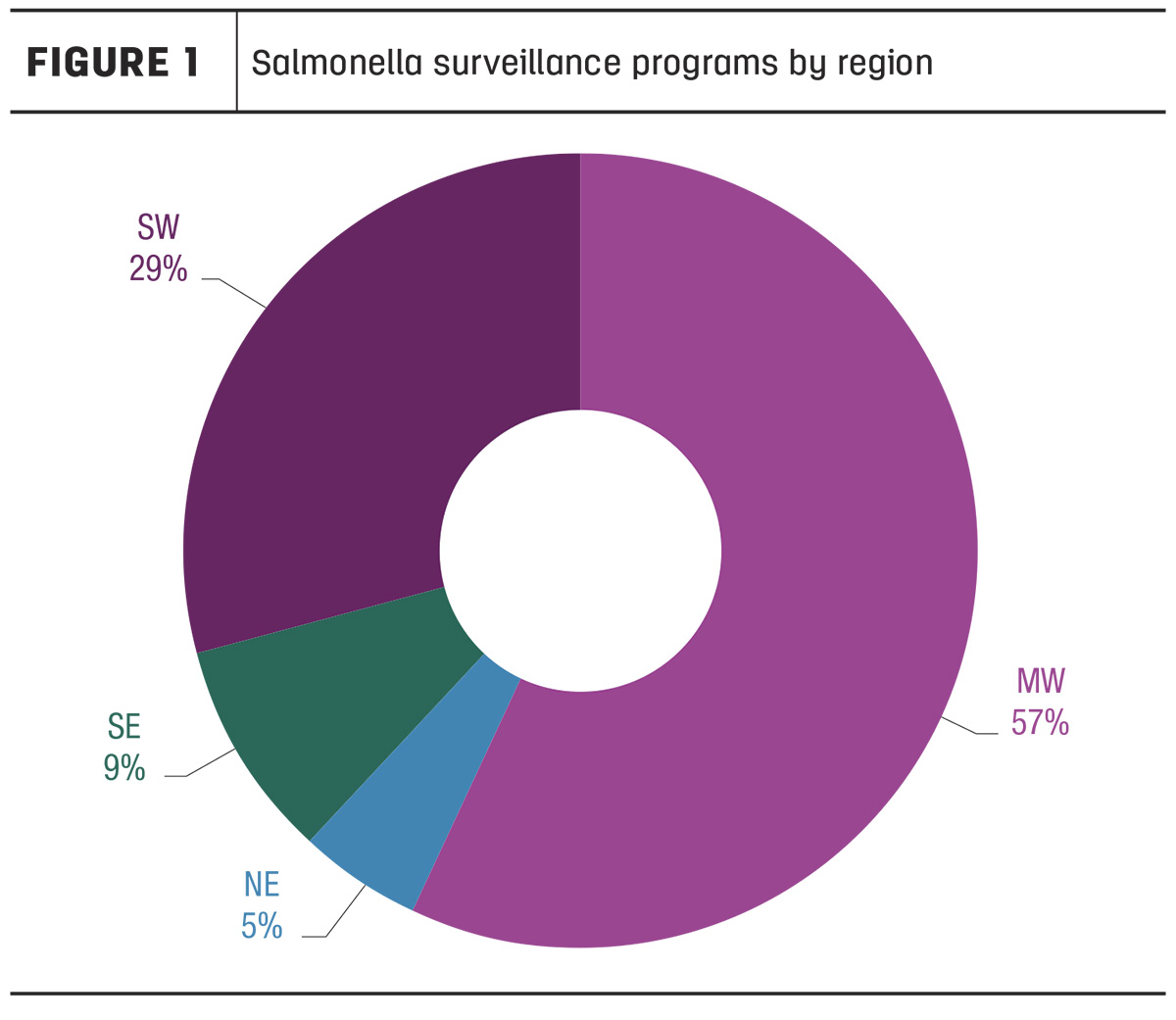
Over the last 18 months, we have performed 24 of these evaluations on U.S. dairy farms located in 10 different states (Figure 1). The majority have been conducted in the Midwest (Wisconsin, Michigan, Minnesota, Illinois, Indiana and Kansas), followed by the Southwest (California and Texas), Southeast (Florida) and Northeast (Maine).
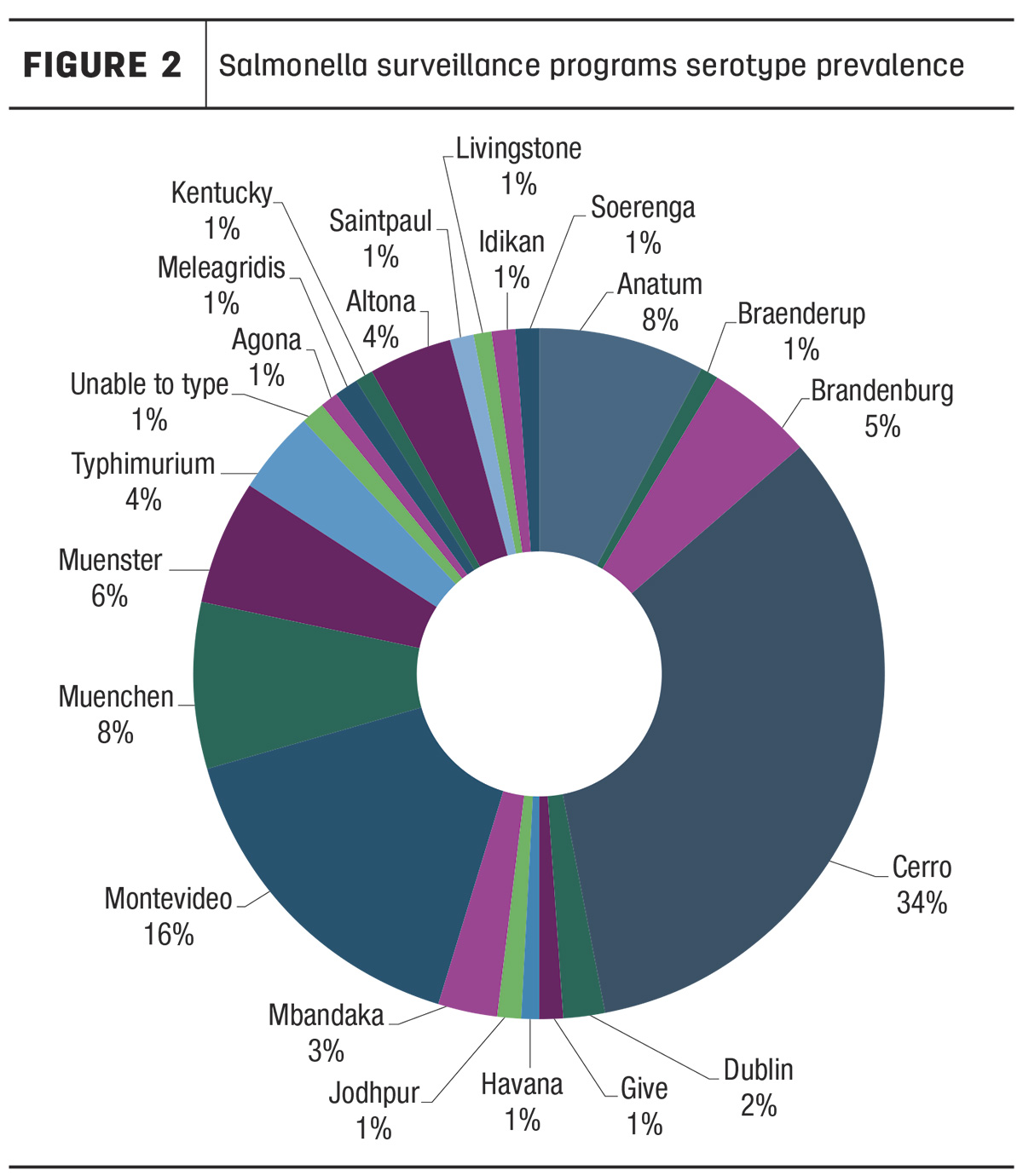
A total of 22 different serotypes of salmonella were cultured from dairy cow pens (Figure 2). The most common serotypes of salmonella found were S. Cerro (34% of pens), S. Montevideo (16% of pens), S. Muenchen (8% of pen), S. Muenster (6% of pens) and S. Typhimurium (4% of pens). Twelve of the 22 kinds of salmonella were found in only 1% of tested pens.
Seventy-two percent of dairies tested had at least one bulk tank milk sample positive for S. Dublin antibodies, and 67% had serum from at least one calf test positive for antibodies to S. Dublin. These results indicate that S. Dublin is present on the majority of farms tested.
The results of this on-farm evaluation confirm that salmonella remains a significant concern for animal health and human food safety. To help decrease the risk of infection in their cattle, dairy producers should work with their veterinarians to develop and implement routine biosecurity, monitoring and preventative practices, like vaccination, that will help control salmonellosis on their farm.



