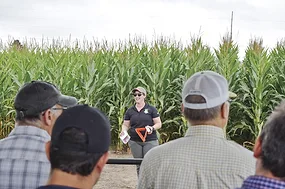
What if corn silage could do more than feed cows – what if it could feed the soil too? Three Wisconsin farmers worked with Sand County Foundation staff to test that theory by interseeding cover crops early into their corn silage crops to maximize soil cover while minimizing yield decline.

In June, the Sand County Foundation and Sheboygan River Progressive Farmers hosted Shop Talk: Diversifying Silage with Cover Crops for Dairy Feed Quality at the Double Dutch Dairy near Cedar Grove, Wisconsin.
During the winter of 2022-23, Sand County Foundation staff started working with three farmers in Sheboygan and Ozaukee counties. Each farmer had some experience with adding other species of cover crops into their corn silage and diversifying their rotations, but none knew exactly how it was affecting the feed quality for their dairy cows.
The use of cover crops in Wisconsin has slowly increased; however, use by dairy farmers on silage corn acreage is not often considered as an opportunity to increase silage biomass, improve livestock health or offset costs.
“When successfully established, cover crops can decrease erosion and nutrient runoff, improve trafficability for machinery and increase water storage capacity during periods of drought,” said Tricia Verville, agricultural systems director with Sand County Foundation. “Diversifying feed cover crops can decrease veterinary bills and increase milk quality and quantity due to the added plant diversity introduced into the diet.”
Farm trial approach
Cover crops were interseeded into about 20 acres of established corn silage fields with the objective of increasing biomass without negatively impacting yield beyond an acceptable threshold. Each farmer implemented an herbicide management plan and tailored the cover crop blend to what grows best on their farm. A control field was planted to corn silage without cover crops.
The general rotation was corn silage planted with interseeded cover crops, silage harvest, a small grain was planted in the fall with spring small-grain cover taken for forage, and then the field was prepared for the next crop.
Each farmer approached interseeding differently. One grew a multispecies mix including sorghum-sudangrass, clover, ryegrass and more alongside corn silage. Another planted soybeans directly with corn to add biological nitrogen and boost biodiversity. The third used twin rows of sorghum with a bean-based intercrop for herbicide flexibility.
Despite the variation, all shared a commitment to cover crops, reduced tillage and minimizing reliance on purchased inputs like fungicides and synthetic fertilizer.
Co-owner of one of the three farms participating in the farm trial, Brody Stapel, summarized it simply, “Healthy soil makes healthy plants. Healthy plants make healthy cows. It all connects.”

Owners of Double Dutch Dairy interseed cover crops in silage corn with a minimum to no-tillage approach. Image by Marian Viney.
Three different farms
Dan Jacque owns 450 acres and milks 160 cows. He focuses on continual improvement through covering the soil, enhancing livestock feed and managing manure storage while increasing conservation across the whole operation by focusing on the full system. Jacque has been using early-seeded cover crops in his silage crop longer than the other two farmers in the trial.
He plans for continual cover of the soil, moving from alfalfa or annual forage to seeding in a small grain that overwinters, harvesting that growing forage in the spring and planting corn, then the cover crops.
“You’ve got to be willing to tinker – this is not plug and play,” said Jacque.
Mark Loehr co-owns 1,300 acres of cropland and milks 500 cows. For 10 years, he has planted corn and soybeans for silage, interseeding the soybeans within corn, rotating into wheat, alfalfa or an annual mix the following year. For the trial, he interseeded cover crops into the corn rows in the same field pass. After silage harvest, he planted small grain with winter peas and crimson clover and then broadcast spread manure. The small grain overwinters and is chopped for feed.
They also planted fields with a diverse annual species mix that were chopped and fermented separately.
Mark explains that for long-term management on the farm, the annual mix appears to be a more appealing option to bring diversity to the feed, coupled with corn soybean silage fields that allow for better weed management.
Brody Stapel’s family manages more than 900 acres and milks 260 dairy cows. Through their dairy and cash crop operation, they have transitioned to a diverse crop rotation with high field residue that improves the land and the feed fed to the cattle. They have also transitioned from a conventional tillage system to a minimum or no-tillage system. They found that an ideal rotation for their farm is to interseed corn silage, followed by a cereal rye harvested for feed in the spring, with an annual mix to follow and planting a cereal rye cover crop to overwinter, then back to corn.
For the trials, they interseeded a cover crop into corn silage, followed by cereal rye harvested in the spring. The cereal rye is chemically terminated before corn and covers are planted. At one point, they focused on cover crop species with broadleaves and now continue to use sunflowers, forage soybeans and clovers.
"Everyone talks about tons. We've got to start talking about margins," said Stapel. "We're feeding better. We're spending smarter. We're managing systems, not just acres."
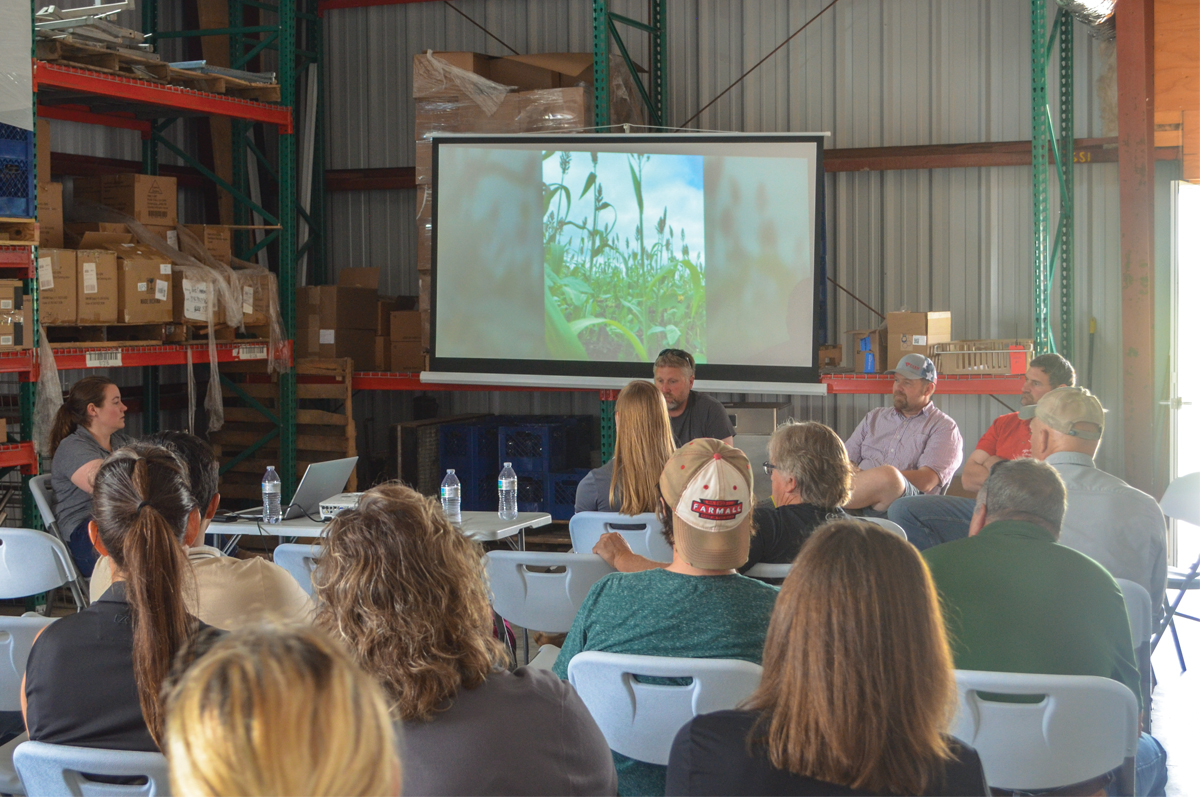
Sand County Foundation and Double Dutch Dairy hosted Shop Talk: Diversifying Silage with Cover Crops for Dairy Feed Quality. A farmer panel of local dairy farmers including Brody Stapel, Dan Jacque and Mark Loehr talked about field management for interseeding cover crops into silage corn and sorghum. Image by Marian Viney.
Analysis
Sand County Foundation staff partnered with the farmers to process feed samples and track their management to demonstrate how adding cover crops to their corn and sorghum silage impacts feed quality.
When harvesting silage, the chopped silage is collected and packed into mini silos designed to simulate the farm fermentation process. Each farm has five samples taken – two are control samples without cover crops and three samples are from the interseeding trial. The silage samples ferment for 60 days in the silo, separate from the farm’s primary silage storage.
Sand County staff had the fermented silage analyzed both with and without the cover crop biomass to understand how the cover crop biomass impacts feed quality. In 2023, the results indicated that the mini silos did allow the silage sample to properly ferment – the lactic acid, pH and mold counts were within normal testing range.
“Feed analysis results will be compiled and shared after the second crop season of the project wraps up,” added Verville.
Follow-up to trial
“Our grower showcase features management details on how the farms accomplished growing crops in this innovative fashion," added Verville. “This project allows farmers to learn from each other to improve management for next year. It is a cross effort between networking, on-farm research and soil health improvement on the farm.”
Over the course of the trial, what they discovered provided new insights about forage quality, feed value and the unexpected benefits of everything working together.
Preliminary feed results were shared during the Shop Talk by Maggie Hoffman from Agri-King. Project leaders are also working to find funding to continue the feed sampling beyond the two years to add replications to the analysis.