Lean Six Sigma (LSS) is the result of merging two continuous improvement approaches and has become a significant force within organizations in all sectors to optimize processes and drive out waste. By combining Lean with Six Sigma, organizations are achieving both speed and accuracy. Lean Six Sigma is a fact-based, data-driven method of improvement that drives customer satisfaction and bottom-line results by reducing variation, waste and cycle time where everyone in the organization is involved.
CONSISTENCY AND IMPROVEMENT
One of the themes of the Operations Managers Conference was consistency and improvement. The reality is that no organization or industry sector is exempt from continuous improvement. It is important to emphasize the role of steady, incremental changes in achieving long-term progress.
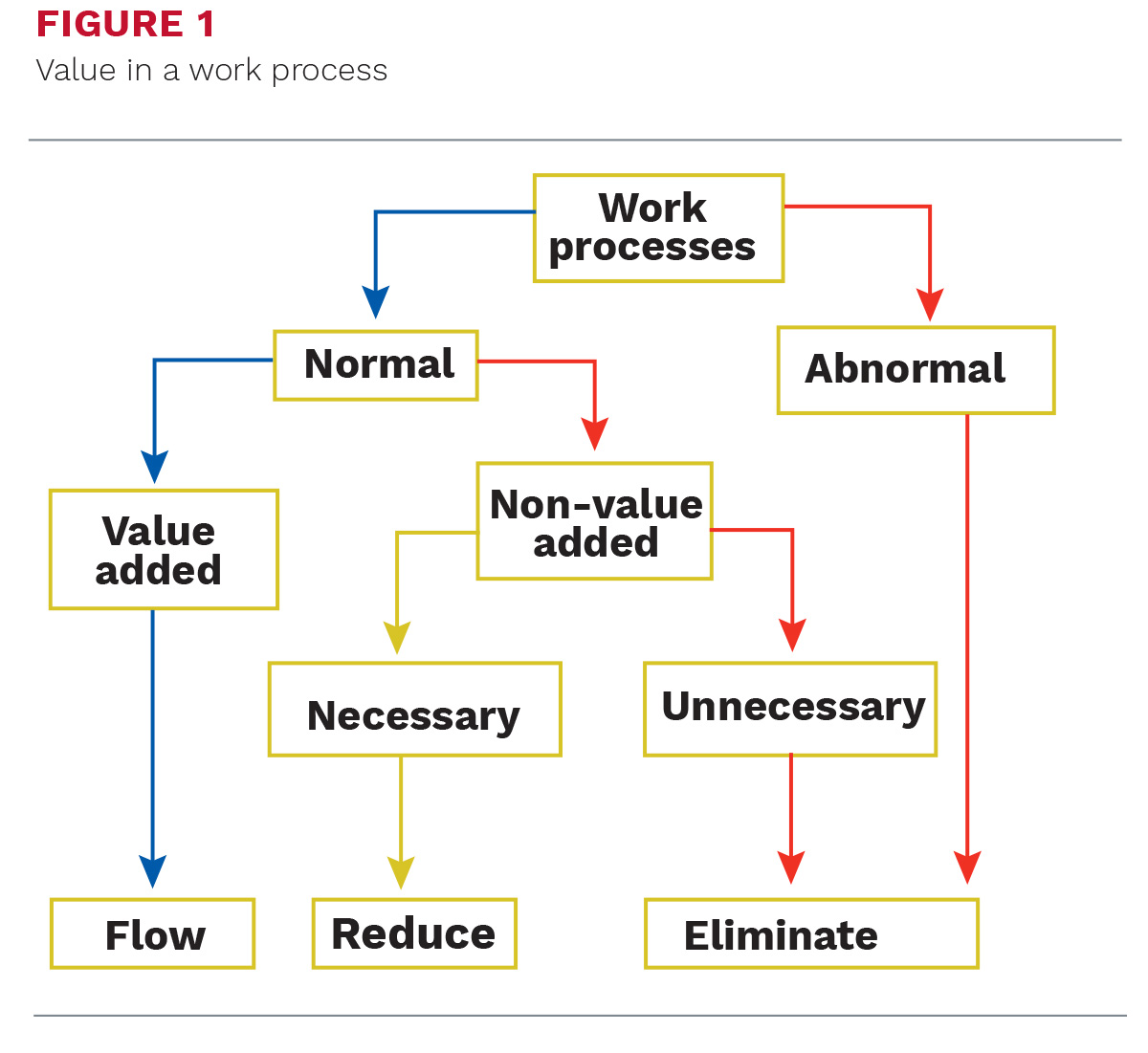
One key concept of LSS is all work is a process. Another basic concept of LSS is the elimination of waste in processes. It is useful to define the three different types of activities within any work process. (Figure 1)
“Value-added” is something that the customer would be willing to pay for (if they knew). Value-adding activities generally change form, function or features to a product or service. These value-added activities should be linked and made to flow to reduce overall lead time. Although the definition states that the customer defines what has value, the customer usually has no choice in what they pay for and what they don’t. Unless an organization wants to lose money, they will pass all of their costs along to the customer. The choice that customers do have is not buying at all or buying from somebody else. Any activity that does not add value is waste and only adds cost to the process. Some waste may be necessary nonvalue-added activities, and the objective should be to reduce the time and resources allocated to them. Other waste may be unnecessary and the objective should be to eliminate those activities. It is very important to remember that any waste identified exists in the process and not in the people.
Waste falls into nine categories: transportation, inventory, motion, waiting, overproduction, overprocessing, defects, variation, and people’s talent.
TIM WOOD VP is a handy acronym to remember these nine types.
- Transportation is the movement of people, information or goods between processes or locations inside or outside the company.
- Inventory is keeping more material or information than is necessary to meet customer needs.
- Motion is any movement of people or machinery that does not add value to the product or service.
- Waiting is any delay or downtime resulting in a period of inactivity of people, information or goods.
- Overproduction is defined as producing more, earlier, or faster than is required by the customer.
- Overprocessing is any additional work or effort that adds no value, product or service from the customer’s perspective.
- Defects are the result of not doing something correctly the first time.
- Variation is the difference or fluctuation that occur in products, services and processes.
- People’sTalent is the lack of involvement and participation of employees in improving operations, quality, and safety.
Waste can be found in any type of organization or process. Unfortunately, some companies do not recognize these factors as wasteful and some, oddly enough, choose to ignore them or simply don’t see them. Therefore, waste can easily accumulate over time. Unless workers are trained on these types of wastes, these wasteful practices can easily blend in and become part of the normal company culture. It is important to help employees develop “eyes for waste.” In many ways, LSS is a way of thinking and a mindset that can be counterintuitive, at least in the beginning.
PROACTIVE MINDSET
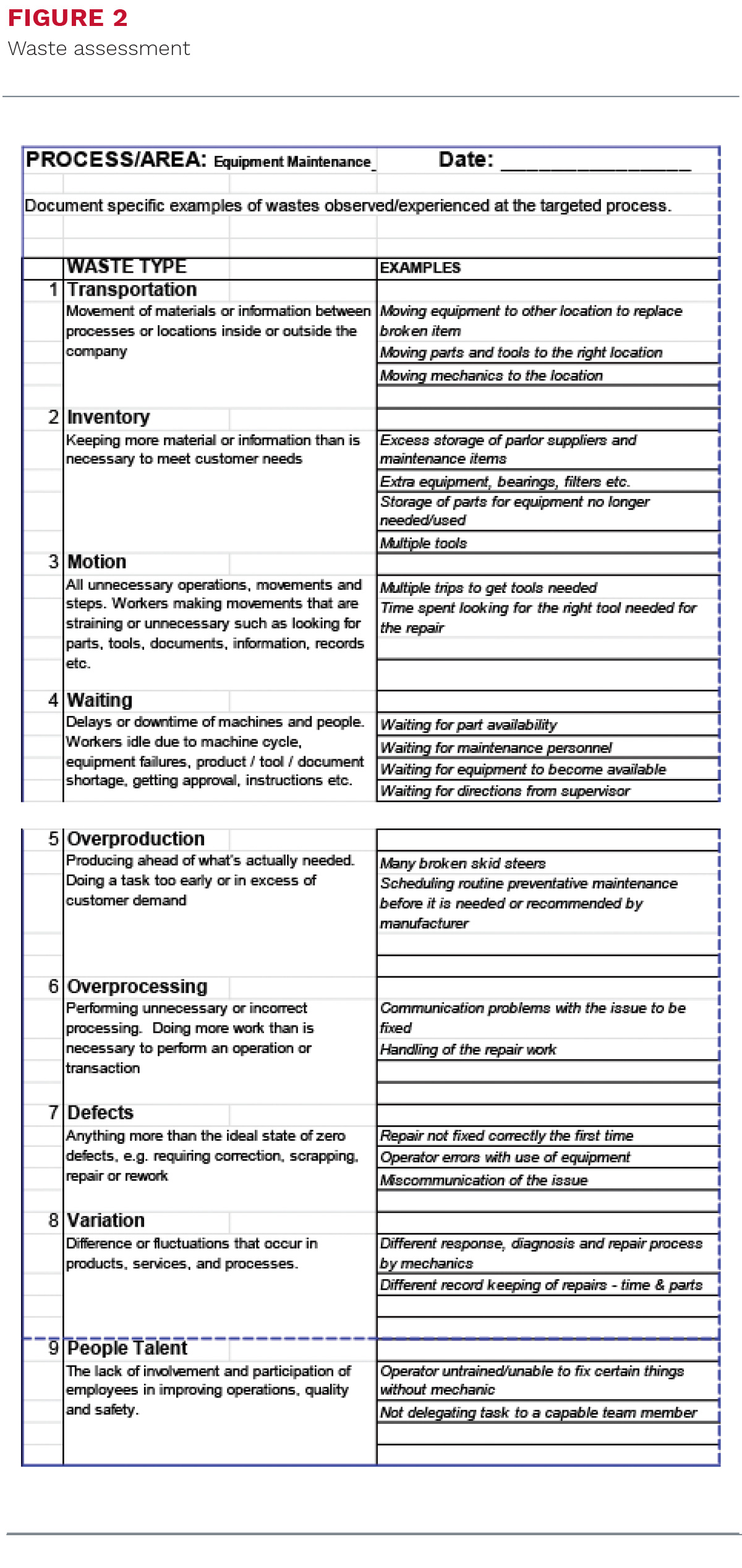
A second theme of the conference was proactive mindset, by acknowledging how a positive and proactive mindset can empower teams and drive innovation and resilience. A simple initial exercise employees and teams can do is to identify current waste examples in a process. Figure 2 is an example of a waste assessment on equipment maintenance.
DMAIC
LSS utilizes the DMAIC (Define-Measure-Analyze-Improve-Control) structured method (Figure 3) to improve processes with a focus on reducing waste and using data-driven decisions to drive customer satisfaction and bottom-line results. While LSS may have started in the manufacturing sector, it is just as effective in the transactional or administrative segments of any business. It is being applied to service, healthcare, education, not-for-profit, government sectors and even dairy farms. Traditionally, individuals and organizations immediately start brainstorming solutions when a problem emerges, resulting in short-term gains and the need to revisit the same issue in the future. Instead, DMAIC seeks to implement a breakthrough improvement that is more lasting.
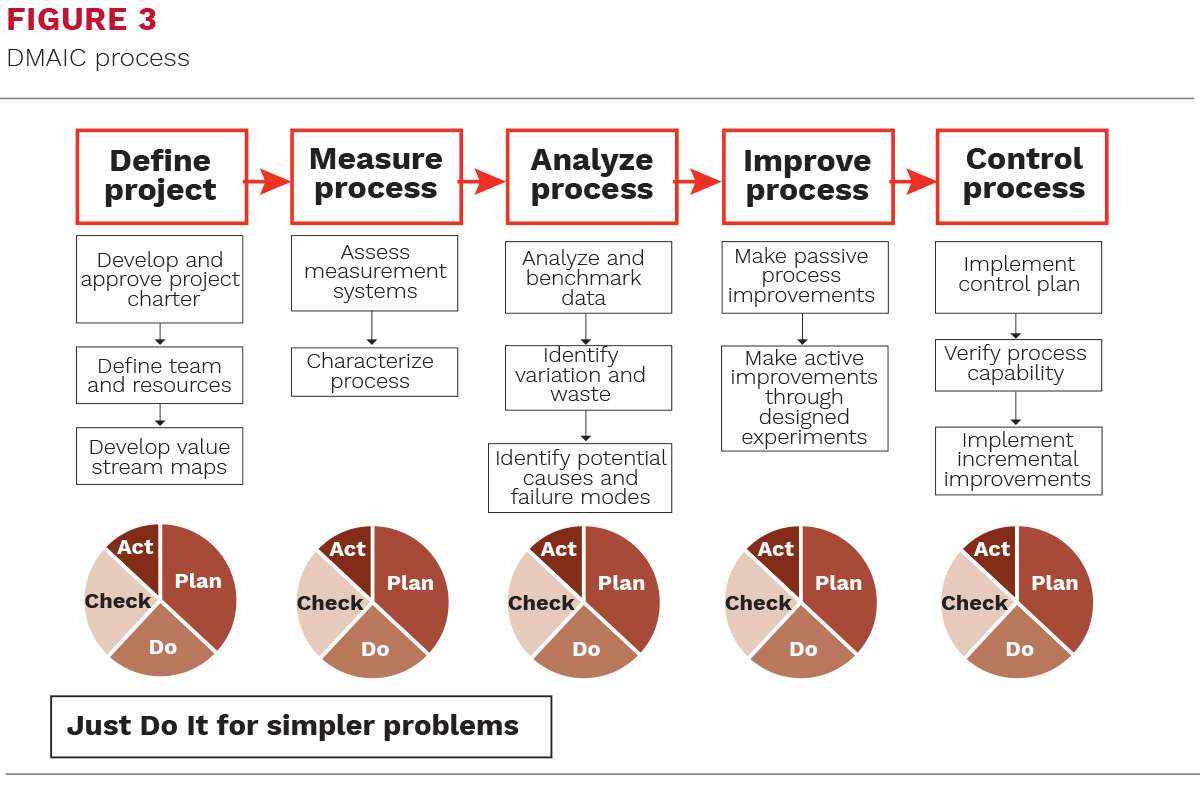
DMAIC starts by defining the project in terms of the objectives and the resources that will be required.
- Define Project: The “Define” stage focuses on identifying a clear problem statement and project objectives, and culminates with the signing of a project charter, signifying the approval of management to move forward. The key information is summarized in a one-page project charter document.
- Measure Process: In the “Measure” stage, data and information are gathered that will help to characterize the current process capability and better identify problems.
- Analyze Process: In the “Analyze” stage, data and information are used to identify variation, waste and ultimately the root causes of the problem.
- Improve Process: Once the root causes are understood, the team can move to the “Improve” stage, where improvement strategies and plans for implementation are developed and the necessary changes are implemented.
- Control Process: Finally, the “Control” stage is critical to ensure that the improvements are sustained. This might include updating work instructions and documents, providing training, and having a method to monitor the process performance.
Throughout the DMAIC process, teams likely will identify simpler problems or opportunities which often result in “quick wins” for the organization.
EMPOWERING DAIRY AND CROP MANAGERS
A third theme of the conference was empowering dairy and crop managers. Companies need to focus on continuous improvement by encouraging all workers to come up with creative ideas and empowering them to act on those ideas to eliminate and reduce waste. This is the most powerful, cost-effective method for implementing successful Lean Six Sigma change in any organization. The benefits are many, including a reduction in lead time, inventory, floor space, scrap, rework and setup times, while increasing productivity and competiveness. Equipping managers and employees with tools such as the nine types of waste and DMAIC leads to company growth and success.
 |
This article appeared in PRO-DAIRY's The Manager in August 2025. To learn more about Cornell CALS PRO-DAIRY, visit PRO-DAIRY. |