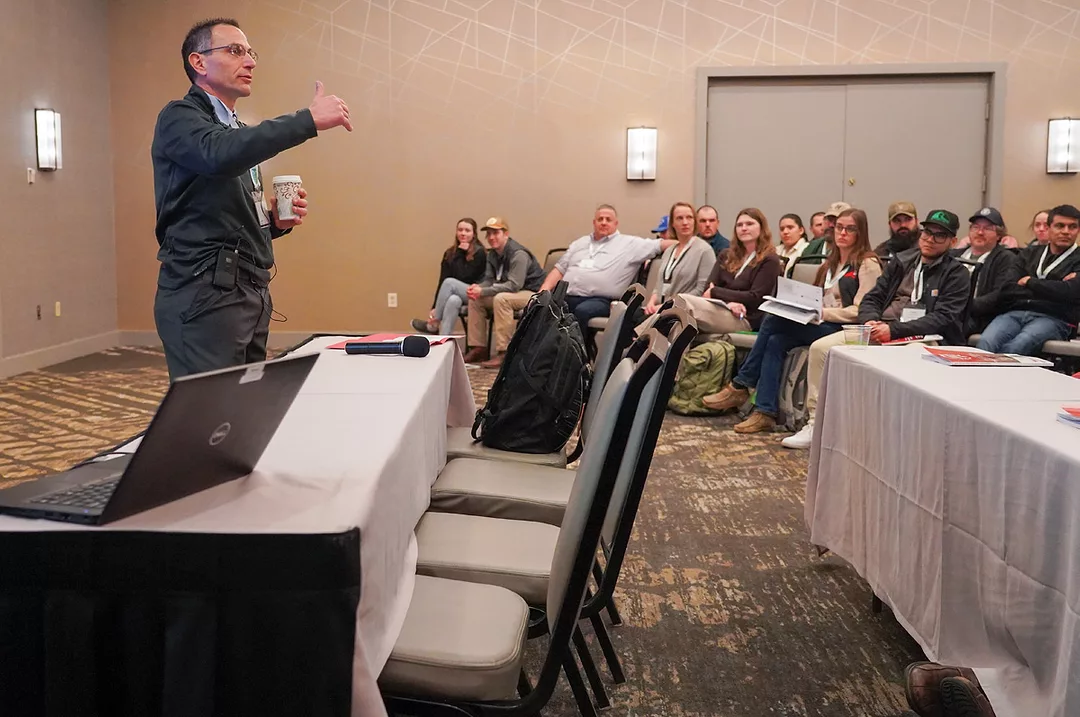
Of course, change is never easy and Lean Six Sigma (LSS) certainly involves change. Proposing change and getting buy-in from your team is key. Have you ever encountered resistance to change? For example, you rolled out an action plan and have been disappointed with the execution. It is important to understand that with any change, there is an internal and external component. This is why change tends to be slow moving, since transition deals with internal personal issues. A few pushback comments might include “we tried that before and it did not work” or “are you saying we are doing it wrong now,” among many others. A key law of any change is that people don’t resist change, but they resist being changed.
According to John Kotter in his book, Leading Change, he provides the following reasons why change fails: allowing too much complacency, failing to create a sufficiently powerful leadership base, under-estimating the power of vision, under-communicating the vision, failing to create short-term wins, neglecting to standardize the transformation firmly into the culture, and declaring victory too soon.
Therefore, to deploy successful change management, leadership needs to create a climate for change, engage and enable their employees, and implement and sustain those changes. By engaging the workers, the primary outcome has a far better chance of obtaining accountability and ownership. By simply sharing information without employee engagement, the best outcome is conformance, if lucky.
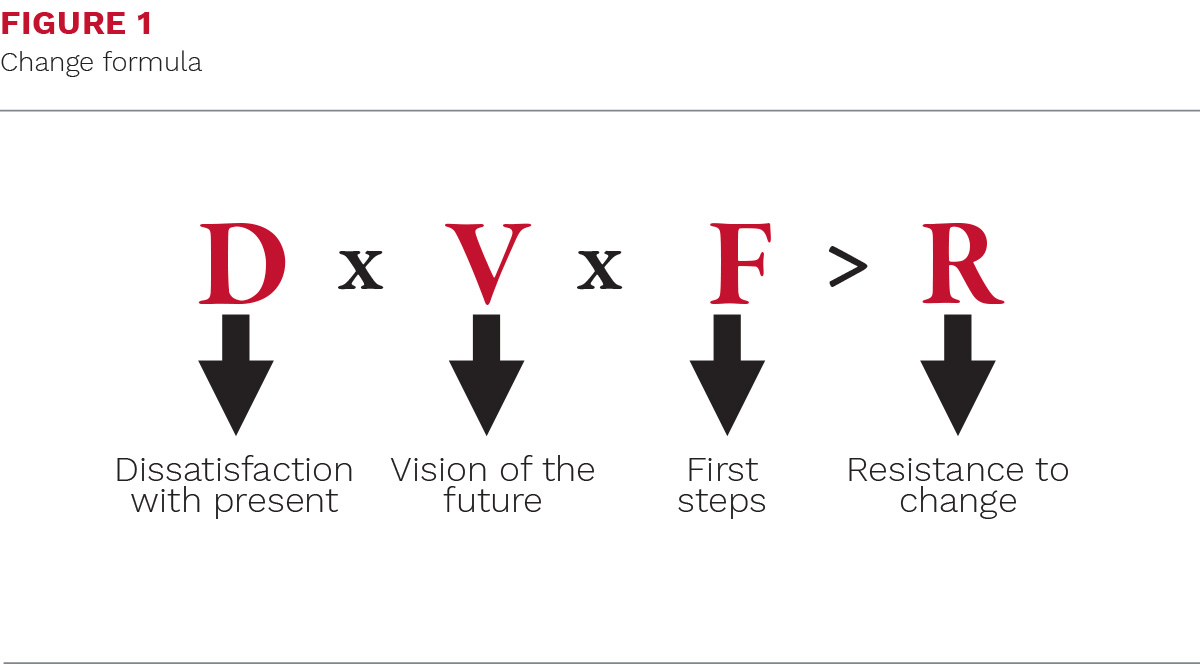
Richard Beckhard developed a simple change formula. (Figure 1) It presents a way for individuals or groups to determine readiness for change and can be used as a tool for planning forward movement. A critical mass of influencers needs to understand and agree on the D, V, and F portions of the formula to overcome the resistance. Interestingly, all elements of the formula must be present to overcome the always‑present resistance to change. By far, the most effective method of dealing with resistance is to engage stakeholders in shaping the elements on the left side of the equation – need, preferred change, and first steps.
It is always helpful for leaders to assess the current situation and plan for a successful change. A visual tool, such as a force field analysis, is a good start. By identifying “as-is condition,” desired state, and all the helping forces and all the hindering forces, an initial strategy for the proposed change can be developed.
EMBRACING DIVERSITY
Much of what is accomplished at an organization is done through teams. Most change involves cross-function teams. Another Operations Managers Conference theme was embracing diversity. It is important to recognize and value the different perspectives and backgrounds of individuals. Understanding team development and its stages is critical to lead teams.
Bruce Tuckman developed stages of team growth: forming, storming, norming, performing, and adjourning. It is helpful to understand each phase and strategies to work through them as a leader.
- Forming is the “honeymoon” phase where there can be excitement, pride and members tend to be on their best behavior – a sort of a feel-out process. Individuals obtain membership status and begin to explore their boundaries.
- In the storming phase, interpersonal conflict arises due to different perspectives, turf wars, defensiveness, and factions. This probably is the most difficult time for the team. They are realizing that their responsibilities are more complex than first imagined. They may take a protective stance or lash out at others.
- In norming, the team starts to build some cohesion and work collaboratively. Members start to recognize each other’s strengths and role for team success. Usually, small wins tend to occur, confirming the work is paying off. Team members reconcile their conflicts and accept the team expectations as the norm. Competitive relationships become more cooperative as they begin to work together and help one another.
- In the performing phase, there is a high level of involvement among members, and they can work through or prevent team problems. The team has settled its relationships and expectations. Their focus now is on diagnosing and solving problems as well as choosing and implementing changes. They have learned to utilize individual strengths and mentor individual weaknesses. The role of the leader begins to change to one of influencer, developer, and coach.
- In the last stage, adjourning, it is important to recognize contributions, review positive and negatives of team experience, and celebrate successes as the team breaks up.
In summary, change is not optional. It is important to make sure everyone knows “why” by selling the problem and not the solution. If we keep doing what we’ve always done, we’ll always get what we’ve always gotten. Communication, communication, and communication are key for successful change. Change must start somewhere, so it is important to model the new leadership qualities for others to emulate.
 |
This article appeared in PRO-DAIRY's The Manager in August 2025. To learn more about Cornell CALS PRO-DAIRY, visit PRO-DAIRY. |