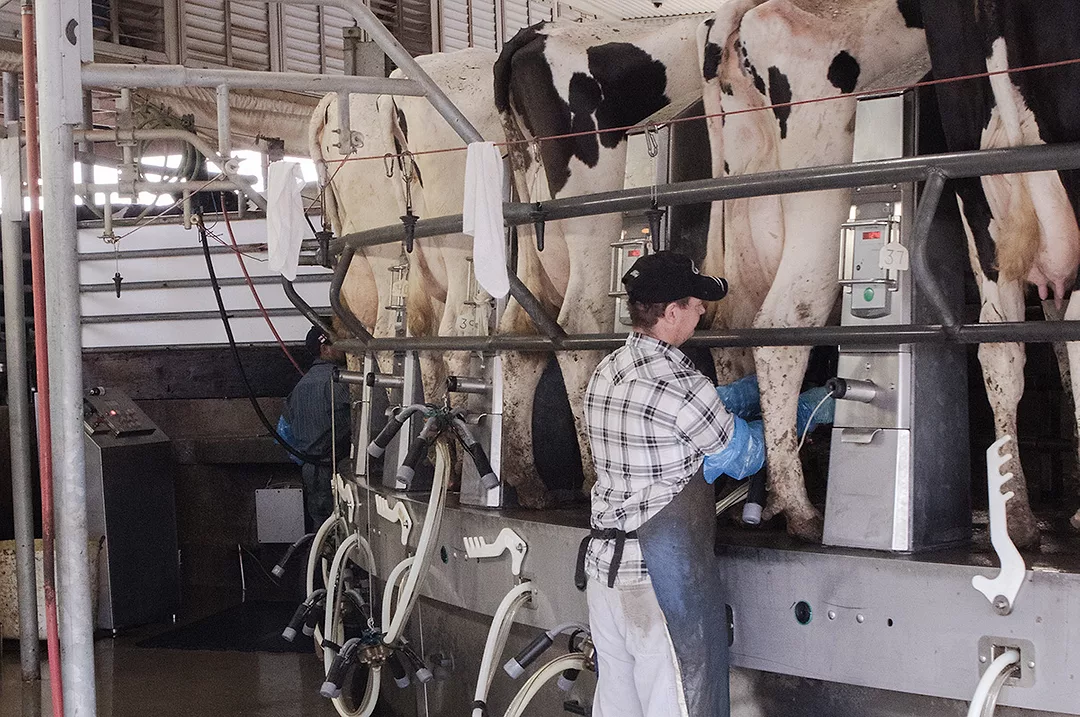
The next time you’re in a milking parlor, picture this: Each group coming in is made up of cows that all milk out in approximately the same amount of time. Group after group, side after side, there are fewer and fewer – and, potentially, zero – animals that employees have to spend more time with or remove the unit from early to keep the parlor on schedule.

Sounds great, but why would this matter? This scenario would move more cows through the parlor per hour, making the most of a farm’s workforce. It would mean more milk could be harvested without limiting cows’ production because of time. It would make a milking technician or parlor manager’s job just that much easier.
Cutting down on the number of slow-milking cows in the herd can make a marked change in farm efficiency; in fact, culling decisions might even be made for that specific purpose. Now, dairy farmers have a more powerful, long-term tool to affect the milking time of their herds with a new trait developed by the Council on Dairy Cattle Breeding (CDCB): milking speed, which became available for Holsteins in the August triannual genetic evaluations.
Animals vary
Milking speed for Holsteins, abbreviated MSPD, estimates how fast a cow milks, in pounds per minute, in a conventional milking system. For Holsteins, the standardized average is roughly 7 pounds per minute. Predicted Transmitting Abilities (PTAs) for the trait will be expressed on a phenotypic scale: the pounds of milk per minute that daughters of a cow or bull are expected to produce. So at the time of launch, a PTA of 7 pounds per minute would be average.
Anyone who has milked dairy cows can attest that there may be wide variations in how long it takes a cow to milk out. In researching this trait, the team from CDCB and the USDA’s Animal Genomics and Improvement Laboratory (AGIL) found that milking speed PTAs for evaluated Holstein bulls born since 2000 ranged from 5.9 pounds per minute to 8.2 pounds per minute. This spread indicates there is room to impact individual animal performance.
There is also great potential to make an impact on this characteristic through genetics. MSPD is estimated to have a 42% heritability, the highest of the 50 traits CDCB calculates.
Developing a new trait
When the industry identifies an important characteristic that can be improved through genetic selection, how is a new trait created?
Pinpointing an individual attribute that is valuable from an economic and/or management viewpoint is that first step. Milking speed checked both of those boxes.
Then, the research and data collection begin. Analyzing milking speed traits that already exist around the world was part of this process for MSPD. Most of these evaluations use subjective measures to calculate the trait. In other words, they rely on an owner describing a cow’s observed milking speed on some type of linear scale to a classifier during type appraisal. For example, in Canada, dairy farmers can give cows a score from 1 (for a slow milker) to 8 (for a fast milker). From that insight, a milking speed evaluation is produced. This is the same data collection process the U.S. uses for Brown Swiss and Milking Shorthorn milking speed (MSP) traits.
However, because of the size of U.S. herds, this is not a feasible universal system in our dairy industry. Data collected subjectively is also not as accurate because individuals may judge the same performance in different ways.
Instead, the U.S. team chose to identify a way to objectively measure milking speed. In-line milk meters already collect data on milk flow and timing across the country, so this is where researchers turned for a reliable and steady source of information that could be used to support a future trait. Researchers analyzed milk weights and milking durations in 131,015 lactation records from 121,662 cows. These records were collected by 11 different milking equipment manufacturers, which introduced a key component of this research work: how to standardize data from various systems to enable appropriate comparison.
Analyzing this data then shows us how it connects to pedigrees and DNA of genotyped animals. Understanding these relationships is how we can develop both traditional and genomic evaluations for a new trait.
One component of the analysis is reviewing how a potential new trait is related to traits already published. For MSPD, the largest correlations are with somatic cell score (SCS) at 0.43 and with mastitis at -0.28. It’s estimated that these relationships are explained by the moderate to strong correlation milking speed has with milk yield; milk yield is also known to have an antagonistic (negative) correlation with SCS. Correlations between MSPD and the fertility or longevity traits were not found.
What could be next?
After a trait is researched, the infrastructure to support and calculate it must be developed. MSPD required the adoption of a new data format so industry collaborators could send the information to the National Cooperator Database. This national database is what fuels all genetic evaluations powered by CDCB. Once routine data submission is established, the CDCB team performs test runs to ensure the PTA calculations perform as expected. The Dairy Evaluation Review Team and Genetic Evaluation Methods Group independently validate those results and the methods used before the trait is released to the industry. After the trait is launched, further validation takes place at the international level through Interbull.
Even once a trait is released, phenotypic data collection remains crucial to further improve the trait’s reliability. MSPD is currently only available for Holsteins, but more breeds will be added in the future as that data becomes more prevalent. It is also important to note that this trait does not directly apply to automated milking systems at this point, as the supporting data was collected from traditional parlors. Like all new traits, MSPD is not included in the lifetime merit indexes, including Net Merit $ (NM$), at the time of launch, but it could be in the future. A low correlation between MSPD and NM$ suggests it is information not already captured in the index.
In the meantime, MSPD stands to be a valuable tool in making Holstein herds more efficient and consistent. Built upon real-time milk production data and with a high heritability, the trait provides an impactful opportunity to select the cows that farm owners and employees want to run through the parlor.
Milking speed (MSPD) was developed through a research partnership that spans the integrated industry system responsible for supporting genetic evaluations in the U.S. This includes CDCB, USDA-AGIL, Dairy Records Management System, Holstein Association USA, National Association of Animal Breeders and National Dairy Herd Improvement Association. Additional information about the trait, supporting research and more is available online.