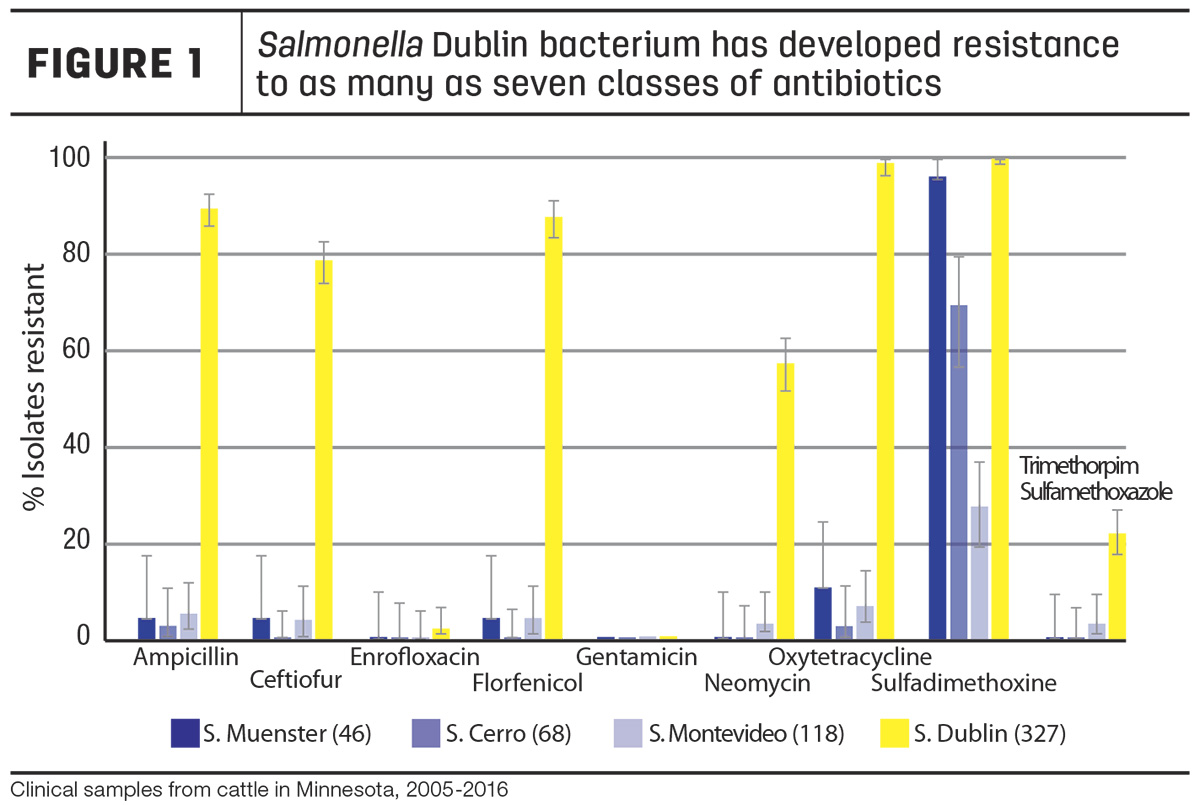
Beware Typhoid Mary in your herd. She may not be showing signs of infection, but could be carrying and shedding Salmonella Dublin, a bacterium that can be transmitted from lactating cows to calves. A management nightmare, the bacterium also has developed resistance to as many as seven classes of antibiotics.
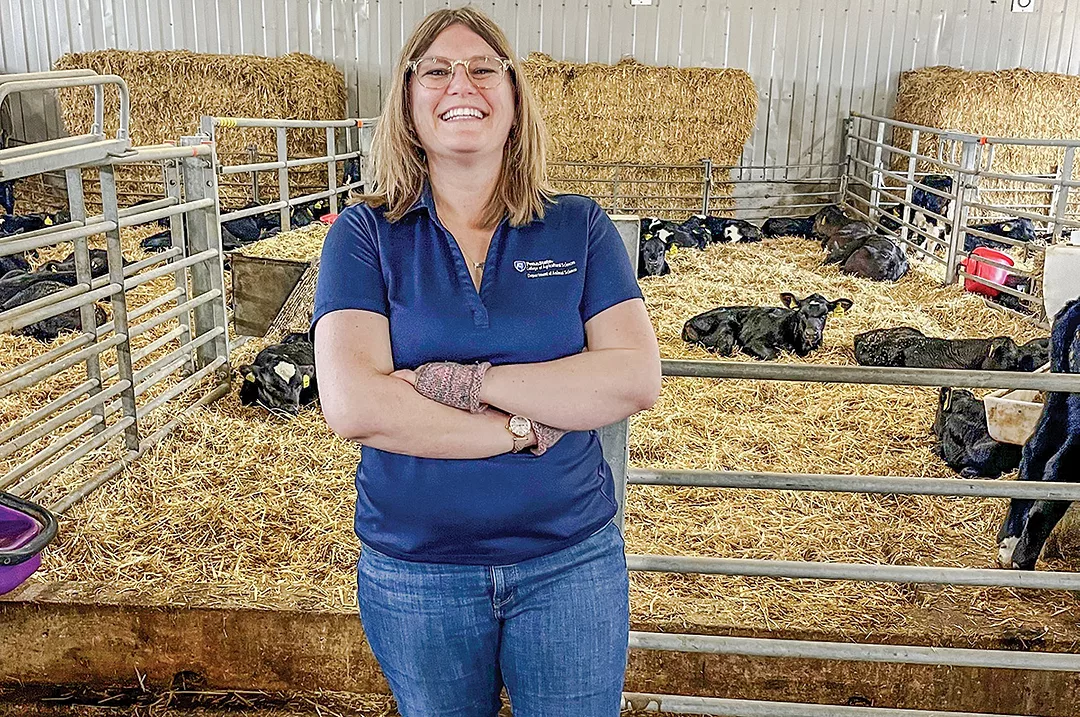
Salmonella Dublin has been flying under the radar for several years. It was rare in the early 2000s, but laboratories are seeing that it’s now one of the most common pathogens they’ve isolated, said Melissa Cantor, an assistant professor of precision dairy science in the department of animal science at Penn State University. She recently gave a presentation on Salmonella Dublin on the Professional Dairy Producers’ Dairy Signal webcast.
A new study by the University of Copenhagen has also found that Salmonella Dublin infection has been increasing worldwide. Denmark has had a national plan to eliminate it since 2008. The infection rate there has declined from 20% to 25% in 2008 to about 5% today. Yet that’s with a national eradication plan in place. Many countries don’t have a control program for Salmonella Dublin (including the U.S.). The study’s authors, Dagim Belay and Jakob Vesterlund Olsen, reported about 18% of herds in the U.S. and as much as 60% of herds in the United Kingdom are infected. The study appears in the journal Agricultural Economics.
Infection reduces productivity and weakens the animals year after year – and the financial losses accumulate over time, Belay wrote.
Dairy farms with high levels of infection face additional annual costs averaging $13,307. But even herds with low levels of infection face financial losses. A typical herd of 200 dairy cows with low-level infection incurs extra variable costs of about $7,891 per year, according to the report.
Cantor listed several economic implications of Salmonella Dublin infection:
- Decline in milk production
- Mortality
- Abortions
- Treatment costs
- Milk losses from antibiotic contamination
- Culling
- Labor for sick-animal management
- Reduced feed efficiency
- Difficulty in selling animals from an infected herd
Because the bacterium has developed resistance to as many as seven classes of antibiotics (Figure 1), prevention is critical. Lactating cows can pass the bacterium through their milk, so calves should be fed pasteurized colostrum and pasteurized milk. Cantor also suggested moving calves away from maternity pens as early as possible to prevent transmission through cow manure.
Calves should be moved to clean, dry housing. Lime is useful because it inhibits bacteria from living in bedding. If there is an outbreak of Salmonella Dublin, Cantor suggested using chlorine dioxide or Virkon to kill pathogens. In addition to cleaning surfaces, one should clean skid steers of manure. She also recommended that boots be sanitized.
Despite manure being the main culprit behind infection, culturing feces is not reliable. Testing blood serum is better, Cantor said. She advises working with a veterinarian to conduct bulk milk tank enzyme-linked immunosorbent assay (ELISA) testing and taking blood test samples on 4- to 6-month-old calves to identify whether they’re shedding the bacterium.
“Work with a veterinarian to determine how many animals to test and which ones to sample,” Cantor said. “Farms that have the disease need to identify a testing and control plan with their herd veterinarians.”
Salmonella Dublin infection in calves looks like respiratory disease because it is a respiratory disease – its clinical signs are similar to other respiratory diseases, Cantor said. A high fever (greater than 104ºF) is generally what distinguishes it. Infected calves may look unthrifty and show drooped ears and stiffness in their rear legs.
The University of Wisconsin – Madison’s Veterinary Diagnostic Laboratory and the University of California – Davis’s School of Veterinary Medicine both have scoring systems that use ELISA technology to measure the level of antibodies directed against antigens from Salmonella Dublin in both blood and milk samples.
Denmark’s Veterinary and Food Administration measures the level of antibodies against the bacterium in a farm’s milk tank. If the antibody level is below a certain threshold, the herd is deemed salmonella-free, according to the University of Copenhagen study.
Threshold-based regulation has been instrumental in helping Denmark substantially reduce the prevalence of Salmonella Dublin to its current low level, Olsen wrote. He added that the current threshold is rather arbitrarily set, noting that data from the University of Copenhagen study shows that production losses already occur at infection levels well below that threshold.
Mycoplasma bovis infection shows similar signs as Salmonella Dublin, but it progresses slowly. The latter progresses quickly, often within 24 to 48 hours. Mortality rates can range from 20% to 100%.
Salmonella Dublin can affect calves as early as 1 week to 8 months old. Calves are susceptible to infection at weaning time because they’re already under stress adjusting to a new diet and new surroundings.
Producers who send calves to a calf raiser should be vigilant when reintroducing those animals to the herd. Those calves may be intermittently shedding bacterial pathogens, Cantor said.
“That’s why manure samples aren’t that helpful,” Cantor said. “Sometimes (the bacterium) show and sometimes not.”
Bacterium has zoonotic potential
Salmonella Dublin is not just a serious threat in the barn. It’s a potential public health risk that is likely to grow as antibiotic resistance spreads, Belay wrote.

A three-dimensional (3D) computer-generated image shows Salmonella serotype Typhi bacteria. Courtesy image.
Infection can occur through contact with animals and manure as well as through unpasteurized dairy products and undercooked meat. Producers who are licensed to sell raw milk must regularly test for the bacterium because it’s easily transmitted through milk, Cantor said.
The Danish study authors advocated for giving farmers stronger incentives to eradicate Salmonella Dublin. This could include offering subsidies to farmers who invest in prevention, early detection and control measures or by introducing a discounted milk price for milk from chronically infected herds, Belay wrote.
In the U.S., Salmonella Dublin is associated with severe illness and has been increasingly detected in humans. That’s partly due to better surveillance efforts.
Penn State University researchers are tackling the Salmonella Dublin challenge from different angles, said Erika Ganda, an associate professor of food animal microbiomes at Penn State University’s Department of Animal Science.
“By working directly with farmers, testing novel procedures at the laboratory and better understanding the genetic makeup of the bacteria circulating in the country, we hope to make a difference and bring awareness about the issue,” Ganda said. “Our team has recently developed a phone app based on a risk-assessment tool to help farmers identify where the risk is on their farm.”
The team seeks feedback to improve the app. Apple users can download the prototype app and provide feedback online. Android and Spanish versions are currently being developed.
Because this bacterium has been flying under the radar for so long, making people aware of the issue and how the disease manifests is a priority. They can work with their veterinarian if it’s present on their farm.
“In the end, biosecurity practices are key to prevent the spread of this disease,” Ganda said.
Visit the Dairy Signal Showcase and Agricultural Economics for more information.