Today’s farmworkers inherit a centuries-old legacy of exemption from basic labor protections. The agricultural labor environment continues to be shaped by Jim Crow-era labor laws that perpetuate the systemic exclusion of farmworkers from overtime pay, a day of rest and the right to organize. Due to the year-round nature of the industry, dairy farmworkers are particularly underprotected, as they are not covered by those protective laws that do exist, such as the Migration and Seasonal Agricultural Workers Protection Act, the standards enforced by the Department of Labor for temporary guestworkers under the H-2A visa program and some other state-specific laws.


Given these gaps in labor protections for dairy farmworkers, many modern dairy farmers actively seek to accommodate the needs of their workers to ensure worker satisfaction, which is directly associated with animal health and well-being, and therefore, farm profitability. Yet, the underdeveloped and oftentimes unclear regulatory environment can be confusing and unguided for farmers. As such, dairy industry stakeholders and researchers often reflect on the substantial need for educational programs that help farmers and farm managers navigate these regulatory gaps and ambiguities.
We have been conducting research for the last several years aimed at better understanding how dairy farmworkers experience the workplace environment in this unclear context. In a large study we conducted in 2021 and 2022 in Pennsylvania, we interviewed 150 dairy employees from 11 dairy farms regarding their experiences with human resources practices at their farm workplace. In our study population, 74% of the surveyed workers were Spanish-speaking – more than half of whom were from remote parts of Mexico and Guatemala where they grew up speaking an indigenous language – and 26% were English-speaking. Interestingly, there were strong differences between these worker populations.
The job duties differed significantly, and Spanish-speaking workers were often hired for entry-level positions where they primarily worked with animals, such as milking and moving cows, while English-speaking workers were hired for crop and machinery-related jobs. Another interesting finding was that when asked how they had been trained, a larger percentage of Spanish-speaking workers answered that they had been trained for their job compared to English-speaking workers, who often said they hadn’t received any job training at all. Moreover, other common HR practices, such as orientation meetings, regular staff communication meetings and annual evaluations, were more commonly experienced by Spanish-speaking workers than by English-speaking workers. These findings may reflect additional efforts by producers and managers to bridge the language gap that often exists between dairy farmworkers and their Latin American employees.
On the other hand, a larger percentage of English-speaking workers reported having been offered life insurance and retirement benefits than Spanish-speaking workers. These findings might also suggest gaps in communication between employers and Spanish-speaking workers, whereby concepts such as employment benefits are poorly understood, or where employment benefits are not offered to a large share of the workforce due to the assumption that they will eventually leave the U.S. In either case, the study findings confirm that more defined structures and guidelines for human resources practices must be developed in clear, bilingual and culturally appropriate ways to ensure that all worker groups benefit equally from the opportunity of employment on a dairy farm.
Employee housing
Another important dimension of employee management on dairy farms is farm-provided housing. There are many reasons why on-farm housing can be appealing for dairy farmworkers, including lack of transportation from housing in urban centers to more remote farms, as well as work schedules that require arriving early in the morning or split shifts that require coming back and forth several times a day to the farm. In a recent study we performed in 2023 and 2024, we interviewed 77 employees from mushroom and dairy operations, all of whom were of Latin American background. Of these research participants, 35 were dairy workers, and they worked on seven different farms. Almost every single dairy farmworker lived in housing provided by the employer near the farm.
We asked participants to reflect on this preference for employer housing. Indeed, most of the dairy farmworkers in our study stated that they preferred to live in housing provided by the employer as opposed to finding housing on their own or through a labor contractor. Dairy farmworkers consistently explained that the benefit of employer-provided housing is that it is provided free or at very low cost, and that the logistics of seeking out housing on their own are too great an obstacle. However, workers sometimes expressed concern over the lack of privacy in farm housing, and the risk that personal conflicts between housemates can transfer over to the workplace or vice versa. Moreover, our discussions with employers suggest that housing maintenance is a critical and contentious issue, and that both employers and employees can be upset when some workers do not take care of their housing.
Our research also found that mushroom workers, whose workplaces are closer to southeastern Pennsylvania towns and cities, tended to live in their own housing off the farm. Yet, unless they had families, they too often expressed a desire to live in farm housing instead, explaining that a lack of U.S. credit history, low wages, limited savings and transportation barriers were significant factors undermining their access to safe and decent housing. Thus, many workers see significant benefits to living in employer-provided housing, making it a critical labor management topic for today’s dairy farms. Nonetheless, dairy farmers have extremely little guidance on how to keep worker housing up to basic standards.
The federal Migrant and Seasonal Agricultural Worker Protection Act (MSPA) of 1983, the H-2A guestworker visa program and its associated housing standard, and the Pennsylvania Seasonal Farm Labor Act all contain housing standards and associated mandatory inspection protocols that help to guarantee a potable water supply, waste disposal, prevent overcrowding, ensure sufficient heating and cooling and to provide other basic aspects of housing safety and security. Yet because these regulations pertain to seasonal agriculture, the year-round housing provided on dairy farms is excluded.
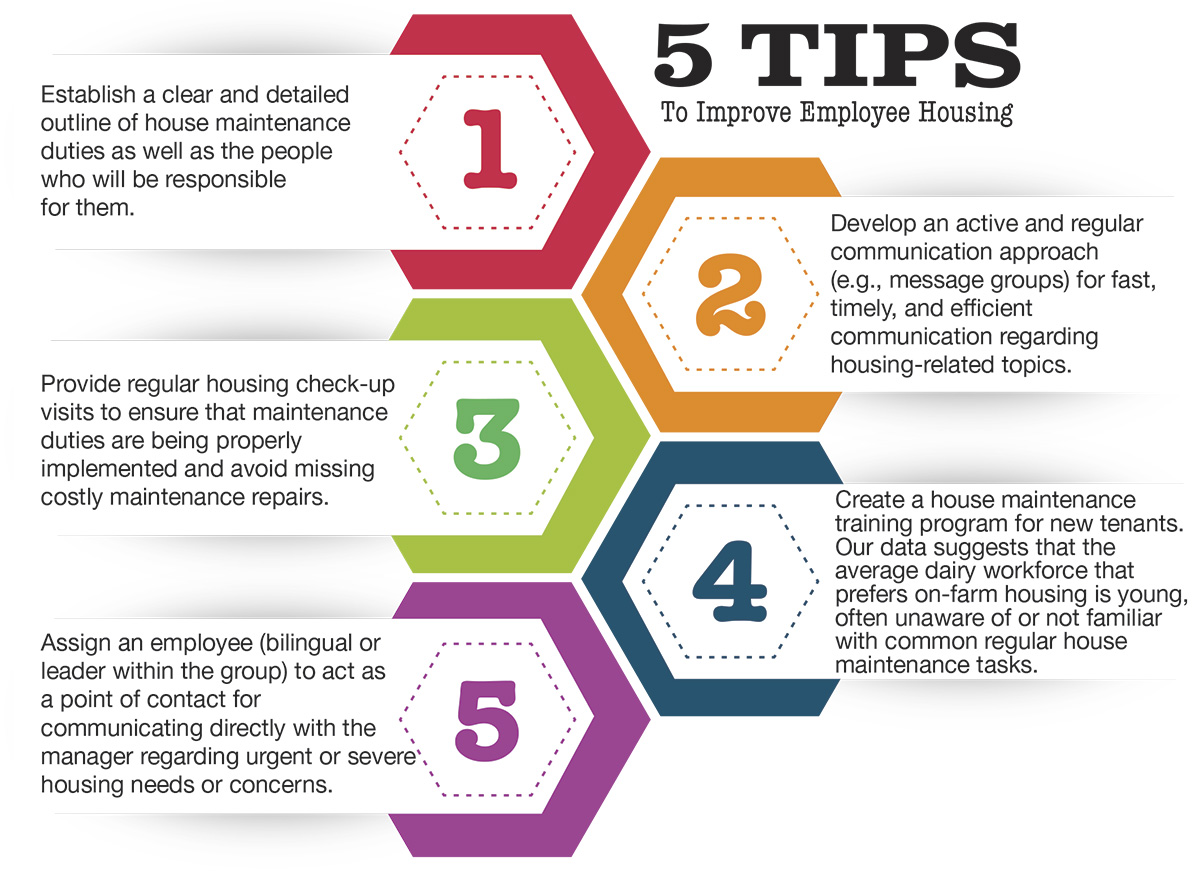
To provide satisfactory housing in the face of these regulatory gaps, some of the farms we have worked with have developed their own HR programs with very specific details about housing, such as house maintenance training, establishment of house maintenance duties/responsibilities, regular house-related inquiries meetings and housing check-up visits by a farm manager. While these practices may appear time-consuming at first, once the specific guidelines and responsibilities have been set, such housing management programs could be implemented consistently and time-efficiently. These types of efforts to provide decent, safe and clean housing are critical for the overall farm’s success, since poor housing can create physical problems or emotional stress that negatively affect the farm work environment and worker productivity. Moreover, these systems help to address and prevent costly maintenance problems that can arise from poor housing management.