Fescue toxicosis – a condition that impairs cattle health and growth – is commonly seen in cattle grazing endophyte-infected tall fescue. Despite the risk, tall fescue remains widely used across many regions because of its ease of establishment and long-term persistence. Its hardiness and longevity is partly due to insect and nematode resistance, as well as tolerating poor soil and harsh climates.

Unfortunately, most tall fescue is infected with a fungal endophyte that lives between the cells, especially in the seedhead. An endophyte is a plant within a plant. A symbiotic relationship between the fungus and grass plant makes the grass hardier and more durable, but this fungus is detrimental to cattle.
Dr. Eric Bailey, state beef nutrition specialist at the University of Missouri, says fescue toxicosis results in poor growth, poor reproductive performance and susceptibility to heat and cold stresses. Even if one tries to get rid of infected plants, there are usually infected seeds in the ground that will eventually take over the stand again because these plants are usually hardier than what’s been planted to replace them.
“Ergovaline is the compound that causes problems in livestock,” says Bailey. “It concentrates in stems and seedheads when fescue matures in late spring. Nitrogen fertilizer increases the ergovaline in spring growth – when using commercial fertilizer on these pastures in the spring, the University of Missouri Extension recommends no more than 45 pounds of nitrogen per acre.”
He adds that in dry hay, ergovaline in tall fescue decreases by 50% in about six months. If you cut hay late and it has lots of stems and seedheads, it may still be toxic because the ergovaline concentration was so far above the toxic threshold to begin with.
Late spring and summer are generally when grazing cattle suffer from toxicosis, with poor weight gain and more susceptibility to heat stress; the alkaloids hinder efficient blood circulation, which interferes with dissipation of heat from the body.
“Fall grazing can also result in toxicosis if cattle graze pastures to the ground,” explains Bailey. “Ergovaline concentrates in the crown of these plants in the fall. In spring, the opposite is true; we usually don’t graze hard enough. Keeping fescue pastures short keeps this grass in a vegetative state, reducing ergovaline concentration. I recommend 'double-stocking' and grazing heavily in the spring and not putting up dry hay.”
On fescue, a producer could use stocker cattle in the spring, with enough animals to keep the grass short and lush, and Bailey recommends that if you put up hay, not to cut late when it’s mature; try to avoid stems and seedheads in cattle diets.
Dr. Travis Mulliniks, beef cattle nutritionist and range production systems specialist at the University of Nebraska – Lincoln, says producers have several options in their strategies to reduce toxic effects.
“One is seedhead suppression,” says Mulliniks. “Before plants get to that stage of maturity, producers can spray with a broad-spectrum herbicide like Chaparral to keep the seedhead from emerging. Spray late March to mid-April, depending on the year. This can increase daily gains on steers and cow pregnancy rates.”
Another option is to dilute the fescue by adding other plants, especially legumes, to the pasture mix or hayfield.
Mulliniks adds that a common practice is to interseed legumes so that the diet won’t be so high in fescue – this is a common practice in the Southeast using various clovers or alfalfa.
Dr. Holly T. Boland, associate research and extension professor with the Mississippi Agricultural and Forestry Experiment Station (MAFES) in the Prairie Research Unit at Mississippi State University, has done grazing studies looking at cattle selection between tall fescue and alfalfa.
“Research in Great Britain, New Zealand and Australia looked at cattle preferences when grazing ryegrass and white clover,” says Boland. “In most of those studies, they found it didn’t really matter what proportion of those two plants were in the pasture; cattle consistently ate about 70 percent of their diet as legume and 30 percent as grass. They sought out the legume to make that proportion, for a balanced diet."
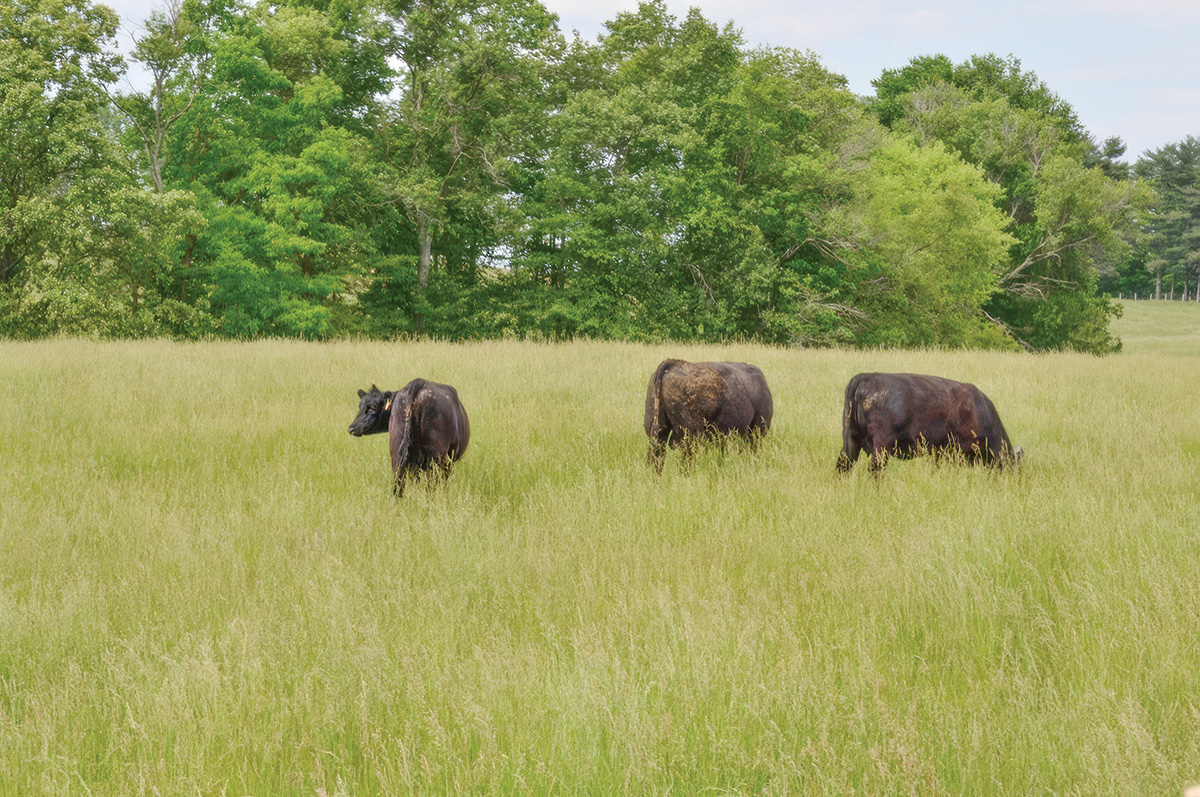
When grazing tall fescue, producers must weigh the benefits of persistence against the risks of toxicosis. Image by Travis Mulliniks.
Some people dilute fescue by feeding a supplement – to replace part of the fescue in the diet.
“Soybean hulls have been a traditional supplement in the Southeast,” says Mulliniks. “There is increased performance, due to decreased intake of fescue, but also increased nutrients with the supplementation.”
Rotational grazing can be helpful, to graze these pastures early in growth before seedheads form, keeping plants in a young, growing stage and not letting them mature.
“Many of these environments have a lot of rainfall and potential for growth. Intensive rotational grazing, moving through pastures quickly, can often keep fescue from getting to seedhead stage,” adds Mulliniks.
Shifting the calving season may offer producers a practical way to reduce the impact of fescue toxicosis. When cows are bred in June or July for March calving, they’re consuming mature fescue during peak summer heat – conditions that compound the physiological stress caused by toxic endophytes. Poor blood circulation, a hallmark of fescue toxicosis, limits the animal’s ability to regulate body temperature, leading to reduced weight gain, impaired fertility and increased vulnerability to heat stress. This “summer slump” in growth can erode herd performance and profitability, making seasonal adjustments a valuable tool in pasture-based management.
Fertility is a problem with bulls as well as cows. The endophyte toxin alters blood flow to the testicles, which can decrease semen quality. This is even more problematic if you bring in bulls that have never been on fescue before.
Research in Tennessee has shown that shifting to fall calving can increase pregnancy rates.
“There are still some issues, due to regrowth of fescue pastures through fall and winter, but the amount of toxin from endophyte fungus is much lower when weather is not as hot,” Mulliniks explains.
Some producers have changed from cow-calf to stocker operations, to avoid fertility problems, but must deal with reduction in weight gain. Supplementing with things like distillers grains can offset some of the negative effects, and rotating through pastures fast enough to not let plants mature enough to develop seedheads.
If fescue hay has seedheads, dilute it with other hay, especially if you see signs of toxicosis such as rough hair coat, impaired circulation to extremities, e.g., loss of tail switches, ear tips – worst case scenario is cattle losing feet.
Matt Poore, a farmer in southern Virginia, has been fighting fescue problems for more than 30 years and says countless “solutions” have been proposed – ivermectin, niacin, implants, binders (yeast cell wall), trace minerals, antioxidants, flavonoids and more.
The late Eldon Cole, a beef extension specialist in Missouri for 58 years, kept a list of things people thought might reduce fescue problems. That list grew to more than 100 items. Some of these “solutions” help sometimes, according to Poore, such as feeding a concentrate to improve cattle performance or adding clover – but they all create added expenses.
Poore adds that many producers graze or clip pastures to control seedheads, use a good mineral supplement or some energy and protein supplement, and select for cows that seem to get along better with fescue. These practices allow a stockman to survive, but add additional expenses.
On his farm, he used many of these strategies, but it was a constant battle. He finished calves for the local market, and it took a lot of feed to get them as fat as they needed to be. He decided to eradicate the toxic fescue and plant annuals for grazing cattle to finish and improve performance on replacement heifers. Grazing crabgrass or summer annuals instead of fescue, his heifers gained more than 2 pounds a day in the spring on ryegrass and more than 1.5 pounds per day during summer on crabgrass or other summer annuals. They calved in great body condition and required very little feed.
Poore believes the ultimate solution is to eradicate endophyte fescue and plant novel endophyte tall fescue and other nontoxic forages. His goal is a system where he doesn’t have to provide supplemental feed, and minimize the amount of feed it takes to finish fat cattle. It’s a lot easier to rotationally graze. Some people fear that novel endophyte tall fescue stands won’t last, but nearly all the research shows that these new tall varieties with proven nontoxic endophytes are strong and aggressive.
The cost of converting fescue pastures pays off after several years, and the stands last a long time with good grazing management. Unlike the annuals Poore depended on earlier, he doesn’t have to buy seed every year or do the spraying that goes into an annual program.