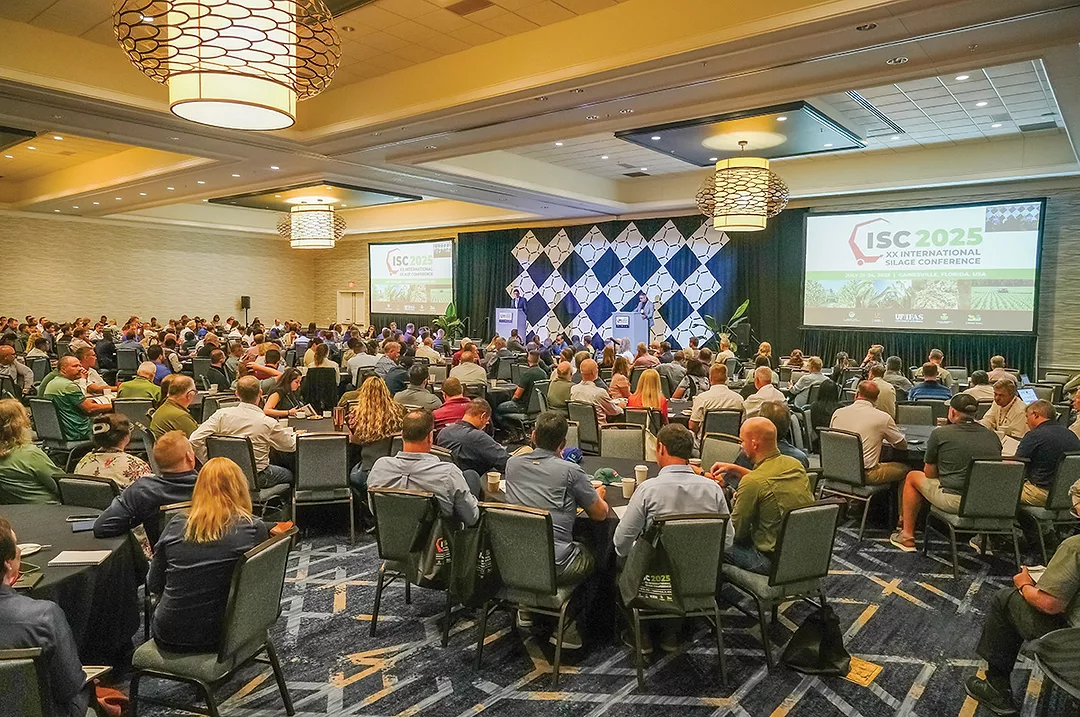
What began as a research-focused gathering has evolved into the most anticipated event in silage science. The 20th International Silage Conference (ISC), hosted this year in Gainesville, Florida, brought together 330 participants from 37 countries, representing 160 institutions – a vibrant, global blend of custom harvesters, academics, industry professionals and forward-thinking producers.

The ISC isn't just a venue for presenting the latest research; it's a dynamic space for exchanging experiences, exploring emerging technologies and revisiting foundational principles with a fresh perspective.
The ISC is a global platform for sharing and exchanging breakthrough research in areas of silage production, conservation and feeding. Since its inception, this community has emphasized the pivotal role of silage in ruminant rations. Deep insights are shared in complementary topics like forage agronomy and conservation strategies, feeding and personnel and equipment safety. Over the years, it has inspired a new generation of silage researchers and fostered unmatched global networking opportunities.
Silage is the starting point
The ISC is a place where real-world issues meet real-world solutions. What was once a technical forum is now a vital platform for addressing bigger-picture challenges like climate adaptation, rising input costs and feed quality.
This year, a major announcement signaled that shift: the launch of the International Silage Science Society (ISSS) and plans for a new journal solely dedicated to silage research. That might sound academic, but it’s a huge win for farmers and nutritionists looking for clear, trustworthy guidance backed by real data.
Start smart: Choosing the right crop
“Start with what grows best in your area,” advice shared by Dr. Marcelo Wallau, University of Florida, became a theme throughout the week. His research showed that choosing the right forage crop and hybrid can boost yield and milk production by more than 30%. That’s not just an improvement, that is a strategic advantage.
Sorghum stood out as a strong alternative, especially in hot, dry regions. While not a direct replacement for corn silage, it offers reliable yields under stress, lower water demand, reduced input costs and better pest resistance. And don’t sleep on cereal crops, either – especially in mixed systems. Harvested at the soft dough stage, they’ve shown strong results in digestibility and starch contribution to rations, particularly in Europe and Canada, and are a viable alternative in the U.S.
Field care = feed quality
Of course, growing the crop is just the beginning. Keeping it clean and digestible is just as important. Dr. Phil Cardoso of the University of Illinois showed that applying fungicide in the field led to better corn yields (plus 5 bushels per acre) and, more importantly, better feed efficiency in the cows. Healthier plants ferment more cleanly, which means less spoilage and more value per ton.
Dr. Luiz Ferraretto’s team from the University of Wisconsin added another layer to the story with a meta-analysis linking yeast populations to forage ethanol levels and digestibility. High yeast counts? Expect more ethanol and lower fiber and starch digestibility. That’s a problem for performance and palatability. Fortunately, inoculants like Lactobacillus buchneri and L. hilgardii have been shown to inhibit fungal growth, improve aerobic stability and reduce dry matter losses.
Proof in the performance
The real test? Milk in the tank. Dr. Heather Dann of The Miner Institute reported that farms feeding inoculated silage saw an extra 28,000 kilograms of milk per 100 metric tons compared to untreated silage. That’s real-world benefits shown as a projection of potential milk production based on less waste. Any product can claim results, but inoculants backed by independent research consistently reduce shrink, delivering returns that more than cover their cost.
Don’t skip the basics
For all the new research and tools, some of the strongest messages at ISC came down to basic silage management practices: Cover your silage, seal it properly and act fast.
“Fermentation is anaerobic,” reminded Dr. Giorgio Borreani, University of Torino. “So, yes, cover it!” Proper covering and sealing reduce dry matter loss, keep out oxygen and lower the risk of mold and mycotoxins. It’s not glamorous, but it’s one of the cheapest ways to protect your feed quality.
The closing session brought the key takeaway home with honesty and a laugh: Even the best technology can't fix poor execution. “Do the basics right,” the speaker reminded the room. “Then build from there.”
Looking ahead: From pile to planet
This year’s conference made one thing clear: Silage isn’t just a feed strategy, it’s a systems tool. It impacts feed efficiency, cow health, farm economics and environmental impact. As producers face tighter margins and navigate unpredictable weather, smart silage practices are essential, not optional.
With the next ISC set for Abuja, Nigeria, in 2028, the conversation is just getting started. But the challenge and the opportunity are already here; silage is no longer just about what goes in the bunk. It’s about what keeps your herd productive, your costs stable and your operation moving forward.