Another crop year is nearly behind us, and another year of uncertainty lies ahead. While nobody can say for sure what the economics of agriculture will look like in 2026, one truth continues to prove itself repeatedly: Those who pay attention get ahead – or at least less behind.


Using laboratory analysis to determine the fertilizer value of the manure you’re spreading on the land is an increasingly popular means to stay attentive in agriculture. While it may seem straightforward, it’s important to have a full understanding of how manure analysis works to avoid common pitfalls. We’ve created a brief guide to help you understand the basics and get the most out of your manure analysis dollars.
Sampling is key
Gathering manure into a container, preferably without wearing said manure, is the easy part. Capturing a representative sample is the most difficult and most important part of manure analysis. When it comes to liquid manure, the task of pulling a quality sample is generally manageable. A manure sample can be pulled from most any point in the system during application. As long as the pit is thoroughly agitated and ready for application, a grab sample will be the best representation of the manure being applied.
Most liquid systems have some sort of sample port in the existing plumbing. If no sampling port is available, pulling a sample may prove messier. The only limitation is your imagination, but most do-it-yourself collection systems involve a long stick, a sample collection container and duct tape. Liquid manure nutrient values can vary greatly, even in a well-mixed manure pit. Be sure to sample frequently to pick up on these fluctuations throughout the storage structure.
Collecting a solid manure sample is generally more difficult due to the lack of homogeneity of the applied material. Many producers have walked up to a pile of manure and pulled a grab sample from the side of the pile for laboratory analysis. Unfortunately, this simple method of sample collection does not capture a quality representation of the applied manure. One of the most reliable methods for collecting an applied solid-manure sample involves a tarp to collect the sample in the application field.
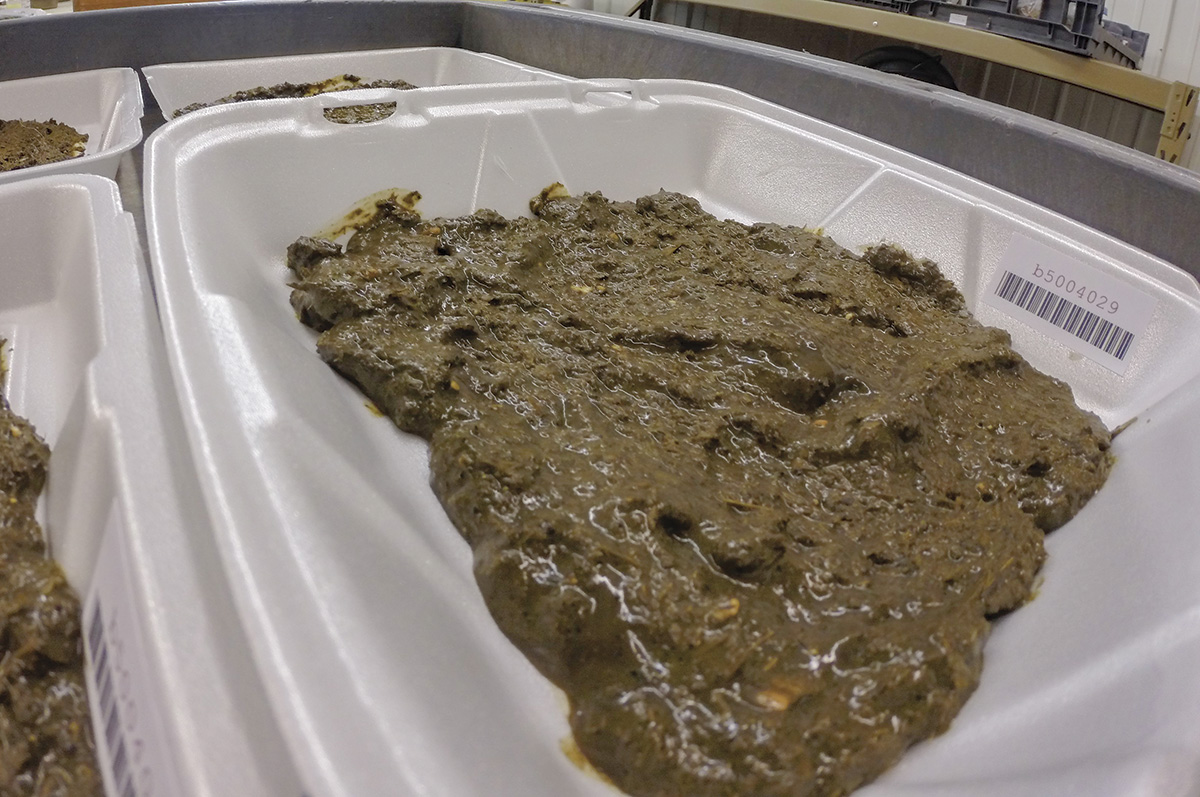
If stored or handled improperly, manure samples will almost certainly provide the end user a false nutrient value. They are very susceptible to nitrogen volatilization, so users should time sample laboratory arrival as soon as possible after collection. Image courtesy of Rock River Laboratory.
The tarp is placed in the field and held in place with a few well-placed rocks or stakes to ensure the blast of manure during application doesn’t move the tarp. Apply manure as you normally would, including over the top of the tarp. Following manure application, gather all four corners of the tarp, ensuring the collection of all material deposited on the tarp. A grab sample can then be pulled from this manure. With the use of a scale and a little bit of math, this method can also determine the manure application rate. Ascertain the surface area of the tarp and the weight of the applied manure and extrapolate the application rate.
Manure samples are very susceptible to nitrogen (N) volatilization. If stored or handled improperly, they will almost certainly provide the end user with a false nutrient value. Manure samples should arrive at the laboratory as soon as possible after collection. In a perfect world, manure samples would be pulled early in the week and shipped or dropped off at the testing laboratory the same or next day. Since manure application tends to be a 24/7 task during the busy fall rush, keeping the sample stable prior to its arrival at the laboratory is often necessary. If next-day delivery isn’t an option, refrigerating or freezing the samples prior to shipping is the best way to stabilize them. If your significant other doesn’t care for liquid dairy manure stored next to the milk, a disposable cooler is a great storage and shipping option.
Place the samples in the cooler with a few ice packs, and they will be ready to ship the next business day. The key to a quality sample is timing the arrival at the laboratory as close as possible to the time of sampling.
Understanding the availability of manure nutrients
We’re probably all familiar with the cartoons that depict the nitrogen cycle. This cartoon is relevant when manure is used as a nutrient source in crop production, as it helps remind us that nutrients aren’t all immediately available. Biological and ecological processes need to take place to convert the elements into nutrients that can be taken up by the plant. Those processes apply mostly to the nitrogen component of the manure, and their efficiencies are not only impacted by the animal source but also by the application method.
This is why a manure analysis report will often list first-, second- and third-year nutrient availability alongside the total nutrient content. The table below from the University of Wisconsin Extension publication Nutrient Application Guidelines for Field, Vegetable and Fruit Crops in Wisconsin (A2809), breaks down the N availability by the amount of time passing between application and incorporation into the soil (Table 1). Not surprisingly, manure that is injected, or in other words, incorporated immediately, has the greatest N availability. In the case of beef or dairy manure, the N moves from 30% available if the manure is never incorporated to 50% available if injected.
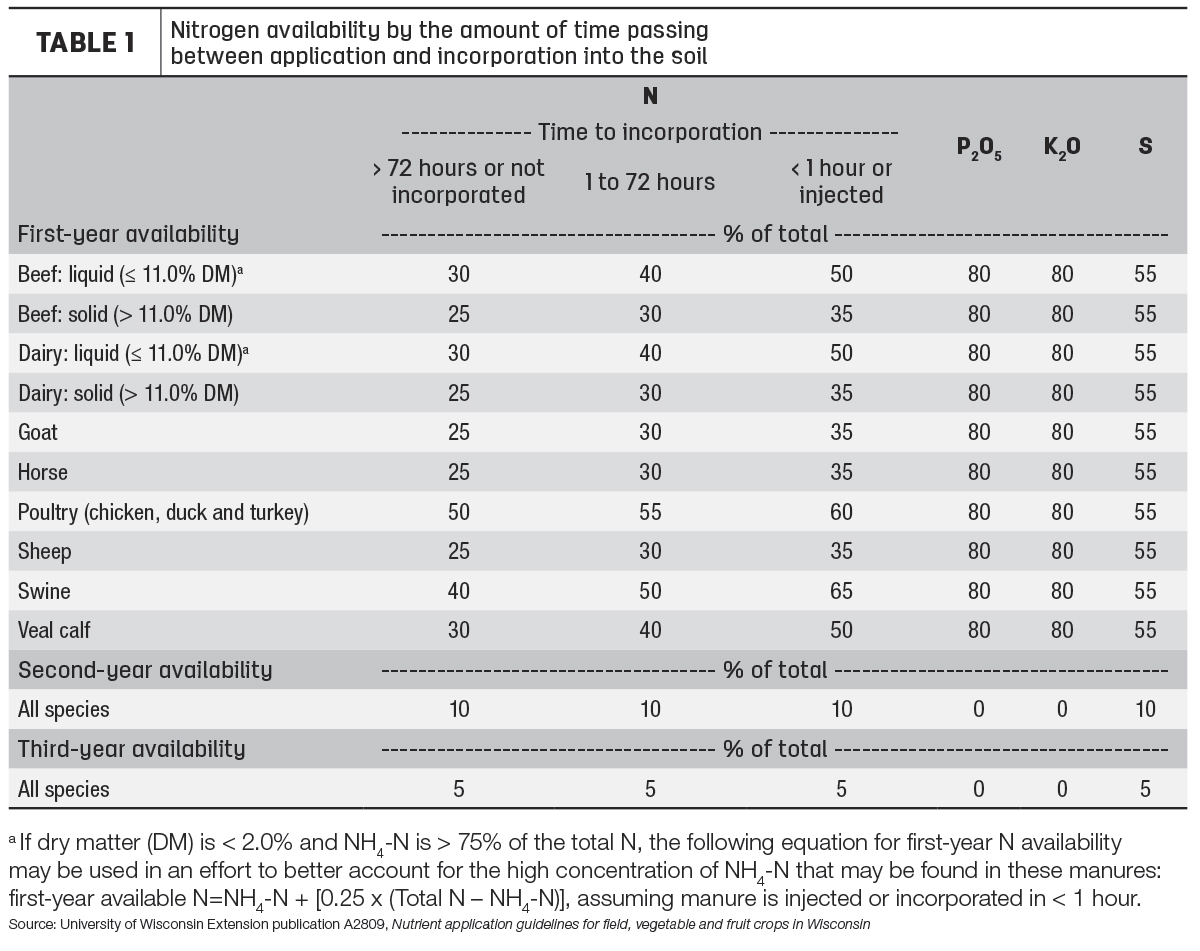
It is important to note that no combination of nutrients, source animals, or application methods ever reaches 100% availability. Biological and ecological processes are inherently leaky and not designed for efficiency. Nutrients will be “lost” to the system – it’s just a fact of life. The total nutrient content of the manure should never be used as the fertilizer credit when determining fertilizer needs. A complete laboratory report should list the discounted amounts that can be used in fertilizer calculations.
It’s also important to understand the units that a laboratory is reporting. Many laboratories will report the manure analysis in “as-applied” units. These are pounds of N, phosphorus (as P2O5), potassium (as K2O) and sulfur (S) per 1,000 gallons if it is a liquid manure, or per ton if it is a solid manure. Total moisture should also be on the laboratory report. Some laboratories will report the manure analysis as a percent of dry matter, leaving the end user to convert the results into as-applied values. In this case, it is important to know how to properly convert the values.
To convert a given result (N, P, K, etc.) from percent of dry matter to as-applied, follow these steps:
- Correct for moisture.
- Multiply the result as a decimal by the dry matter as a decimal. For example, if N is 1% and dry matter is 20%, the formula would be 0.01 x 0.20.
- Convert to as-applied units.
- Liquid manure: Multiply the result of step one by 8,340 (the weight of 1,000 pounds of water). Now the results are pounds per 1,000 gallons applied.
- Solid manure: Multiply the result of step one by 2,000 (the number of pounds per ton). Now the results are pounds per ton applied.
- If the manure report lists P and K in their elemental forms, they should be converted to the oxides.
- P to P2O5: Multiply the result from step two by 2.29.
- K to K2O: Multiply the result from step two by 1.205.
Manure nutrients listed in these units will be immensely helpful when calculating the nutrient credit from the fertility program, as they will be comparable to commercial fertilizer.
Any style of farming will require a sharp pencil and a keen eye for getting all the details right in the year to come. Manure analysis is a tool that will aid in doing just that. With a proper sample, fertilizer crediting of manure will become easy and exact. When you know the value of what was applied, there is no more hoping and wishing you have enough fertilizer to make the crop. Keep an eye on the details and stay in the green for years to come.