Whenever I think about family farm transition planning – I always think of a paradoxical statement. Yes, the landscape of transition planning in the dairy sector is becoming increasingly complex and yet the issues and opportunities many families face today have been the same for decades – they’re just now at a heightened level.
So if we scale back and look at the big picture, what has stayed the same? What has changed?
I use the three-circle diagram, created by Renato Tagiuri and John Davis, in Figure 1 to provide education, awareness and recognition for all family farm members in my consulting. The three overlapping circles of a family-run business consist of family, ownership and business.
- Family: Family members are working together in a wide range of capacities – all of the joy and difficulties that arise with this.
- Business: Agriculture is a volatile, ever-changing enterprise with increasing production and market risk.
- Ownership: Not only are you responsible for managing this business, you also have all of the responsibilities of owning the operation and deciding what shall be left to whom in your estate planning. Remember that estate planning is not simply updating your will.
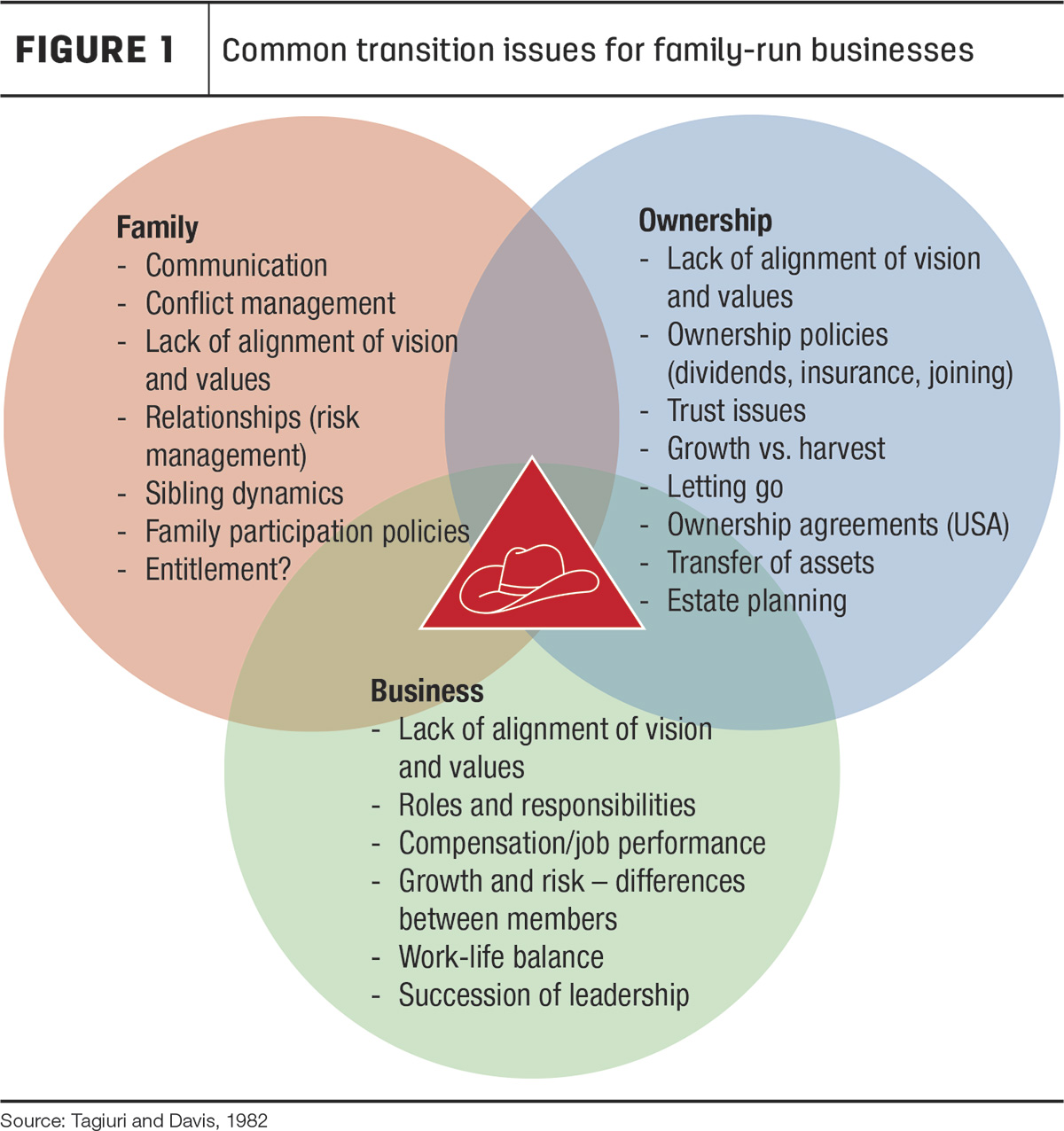
Guess who is in the centre of this diagram, feeling the push and pull from all of the angles? Wearing their parental hats, banker hats and investment hats at the same time, every single day?
The senior generation. You are in the centre in this diagram. Typically, you are family members; you operate the business and you own the critical farming assets.
The successor(s) will also be in the middle as their ownership/management of farming assets evolves.
As a family, you have a lot of competing priorities coming at you. The amount and frequency of these priorities has vastly increased over the years. Sitting in meetings with my dairy families, the number of dings/alarms/notifications received in one single meeting is overwhelming – whether it be the A.I. tech, the nutritionist or the milking robot. All of those notifications just came out of the one circle – the business circle.
Thus, it is easy to see why the senior generation appears to be becoming more comfortable at handing over the “day-to-day operational reins” – specifically regarding the technology side of the business circle. This helps them focus on the managerial/ownership (CEO) considerations. However, what does this leave as a critical gap? The successor(s') awareness/involvement in learning the critical managerial skills.
While this is a large gap in all of the agriculture industries, in my opinion, I often find that supply chain successors are often less exposed to the financial side, as they are so busy with the day-to-day herd health/milking/farming operations. Thus, aspects such as financial awareness/projections or proAction planning are often more foreign. This a huge area I focus on – are we setting up the successor for success? If not, what are we working this hard for?
Yes, labour shortages are real and pricey – but if the successor cannot find time nor is provided the opportunity to learn how to manage all aspects of the operation – how will your family’s legacy continue? This also greatly impacts the senior generation’s estate planning considerations.
So how do we magically come up with more time to address these priorities? A key development in transition planning today is building your transition team. As I always say, “One can have it all; one just cannot do it all themselves.”
Use Figure 2 to consider how this model might look on your operation and ask yourself the following questions.
- Where does your internal and external team fit into these three circles?
- For the internal team, where do your family members, business partners and/or owners sit, for example? Is there overlap?
- How will this look as junior generation (even grandchild level) increases involvement and/or eventual ownership?
- Where do your external advisers fit to support your family farm?
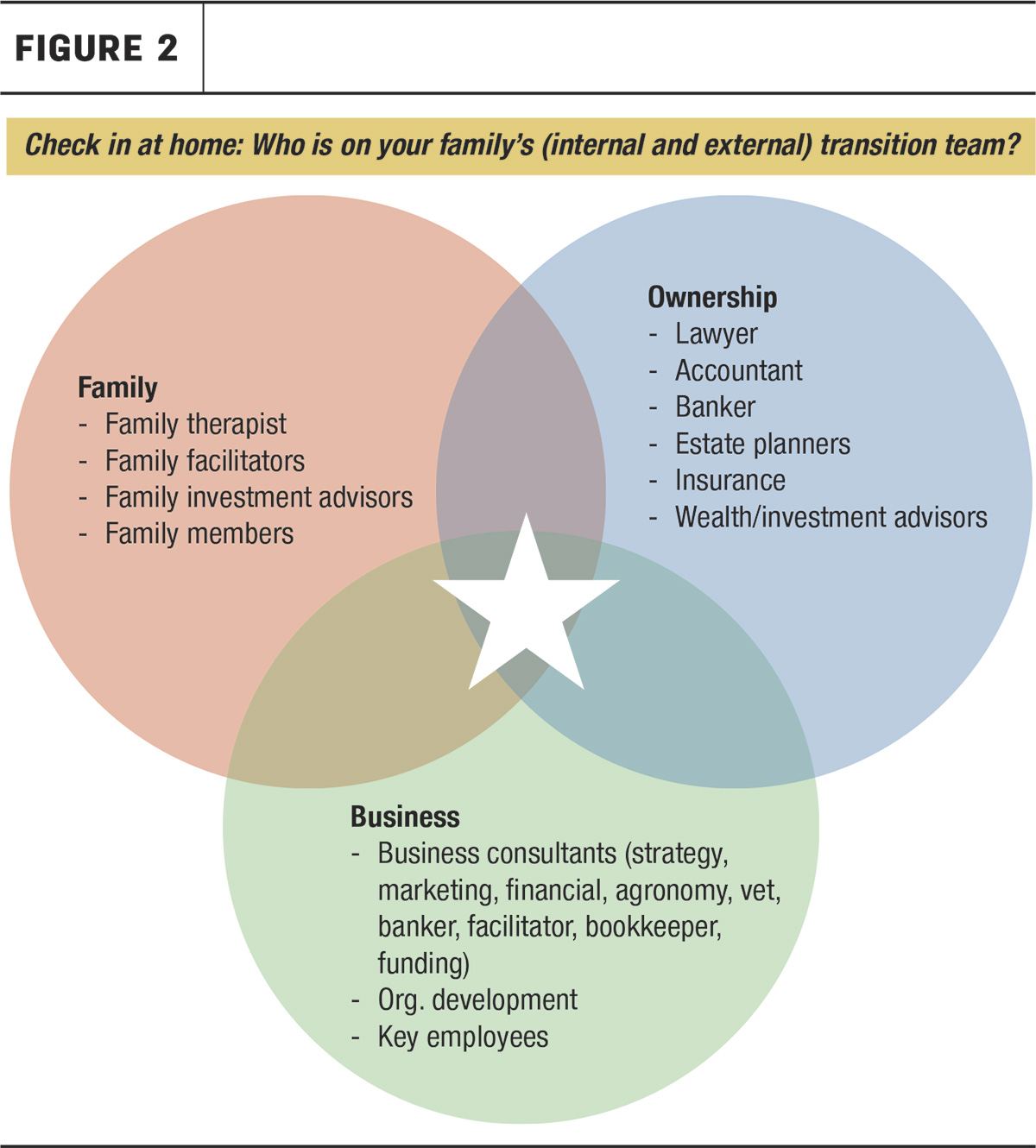
I encourage all family farm members to independently draw and fill in your own circles. Compare your results. For example, are there any key advisers that everyone is not familiar with yet? This is a key step in continuity planning. If senior generation passed away prematurely, who are our family’s trusted team members? Have relationships been fostered with the successor(s)?
In agriculture, we have industry-specific stressors that compound the original three circle influences of family, business and ownership. What makes farming succession different from non-farming business succession?
- Generally, land is the one of the most valuable assets:
- Market value is not related to productive capacity.
- Low return on invested capital (land) to fund buyout.
- Demand for land causes extreme pressure to the business to maintain capital land base.
- Land value inflation over time has been considerable in the Western democracies.
- Increasing equipment capacity makes expansion a goal for most farms.
- But we also add on the complications with supply managed industries on top of that (aka quota):
- Home quarter is integral to business (Commonly corporately-owned – impacts housing taxation and relationship dynamics)
- Smaller land base
- High quota values and potential policy implications
- Often two or more siblings in business
- Non-family labour/key managerial expertise
- Increased complexities for estate planning (cannot cut a dairy barn in half)
Thus, agriculture is its own beast when it comes to thinking about income versus wealth.
My father Merle Good created Figure 3 in the early 1980s, and it still stands true today. It is critical in a family farm to try and pull apart all the integrated pieces and identify which assets fall into which buckets.
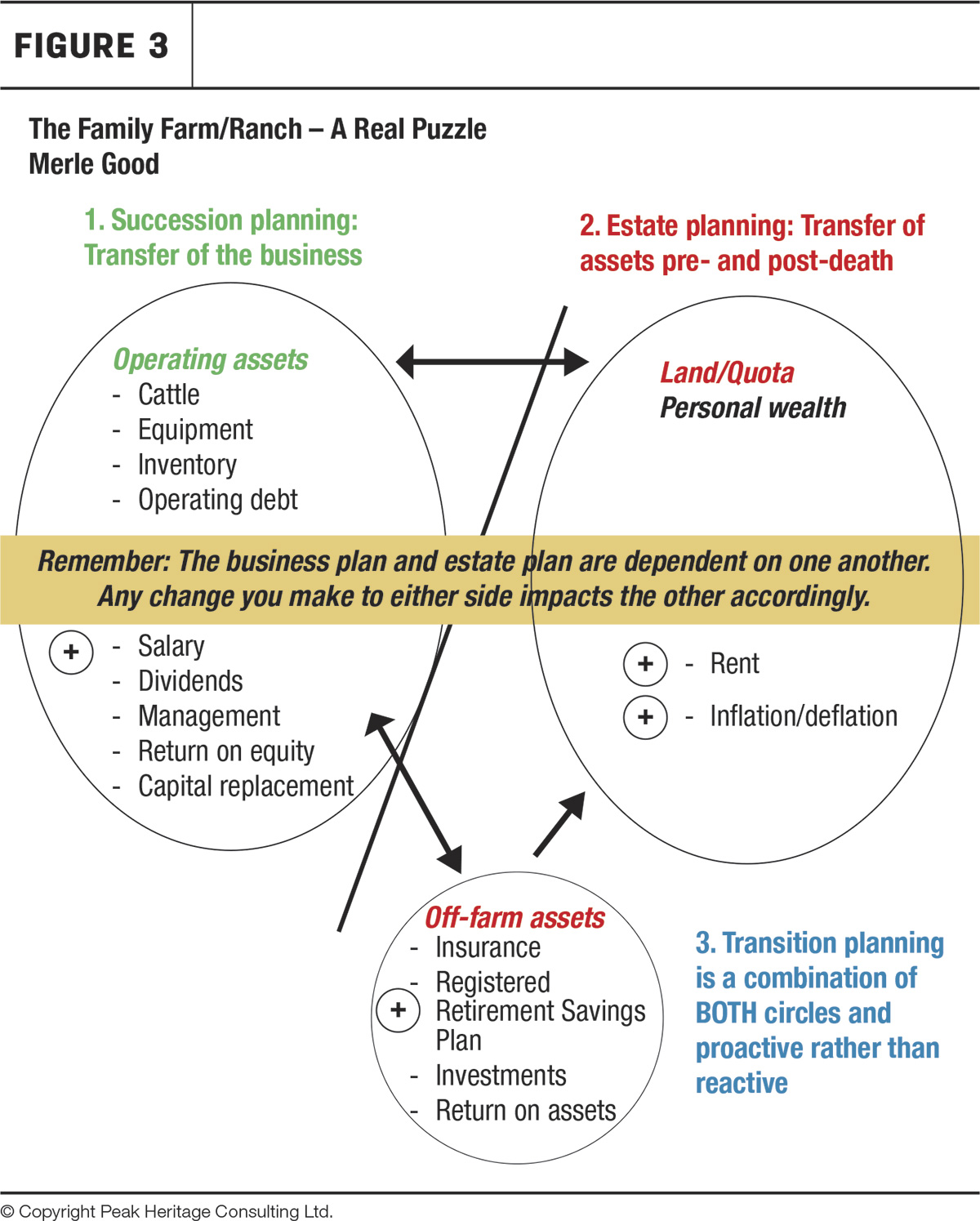
The left-hand side of the diagram focuses on the business – who chose farming as their career – while the right-hand side focuses on personal wealth – even if your land/quota is corporately owned – often the shares of the company are still owned personally.
From this diagram, I came up with my core mantra for my consulting career: “Succession is the transfer of a business, while estate planning is the transfer of assets pre- and post-death. Transition is a combination of both and is proactive rather than reactive.”
Thus, “the business plan and the estate plan are dependent on one another.” A large problem is families not proactively addressing that any changes they make on the business side of the diagram (ex. expansion) impacts the estate planning side (i.e., inheritance distribution).
- Example 1: If the farm business is currently paying $X debt – and the parents' will(s) is read tomorrow and the farm business (aka the successors) are now expected to buy out siblings for $X – is this feasible? Are the parents kicking this dilemma down the road?
- Example 2: If the parents choose in their retirement to primarily live off their off-farm asset bubble to reduce the financial stress on the business – what is their plan for estate distribution for off-farm heirs?
This is often where you see parents panic in their later years, as they spent their cash and thus now may decide to leave more farm assets to their off-farm heirs as a result – which may drastically impact the business’s long-term viability.
That is the beauty of this diagram – you can work with endless scenarios and see how each side impacts the other. Thus, proactive planning is critical. Any big changes on either side of the diagram will impact the other side and must be taken into account for proactive planning and implementation.