November is a time of various weather conditions across the nation. Some areas, such as Kentucky, have temperatures around 50ºF and are still getting 3 to 5 inches of rain. Other states, such as Montana and Idaho, have temperatures that can hover near freezing, with snow on the ground. With forage harvesting season long over for many states, the focus then turns to storing and managing the current inventory of hay.

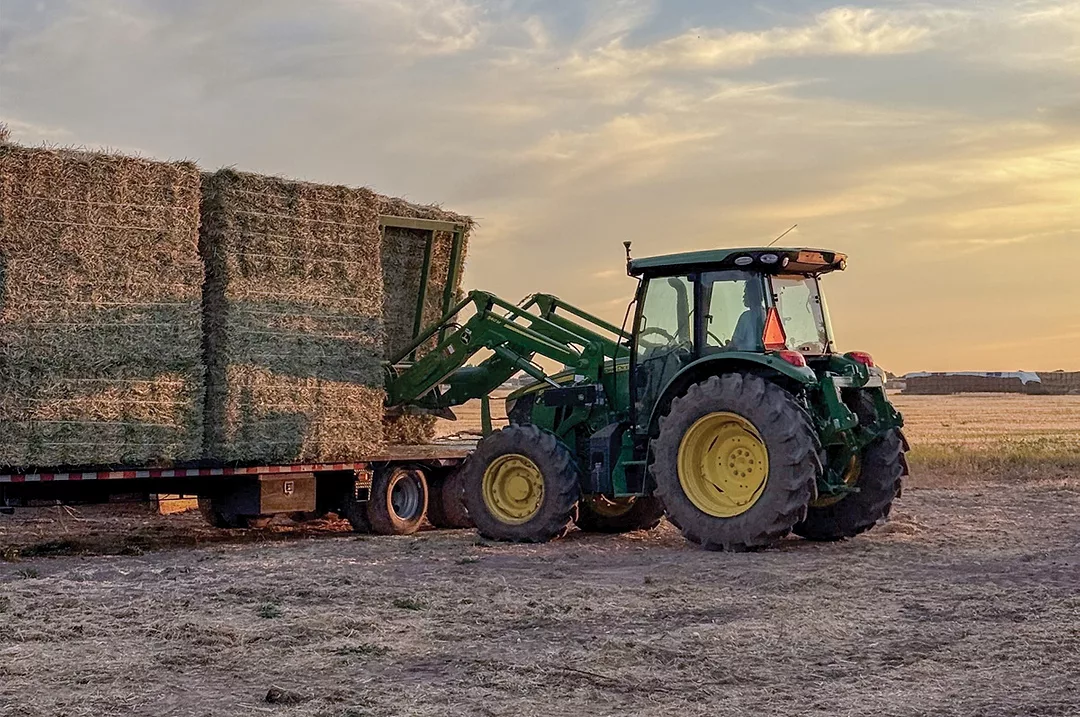
Baled forages are a vital investment, whether you are the producer growing it, the broker trying to sell it or a livestock owner using it as winter nutrition for your animals. Having owned and raised horses all of my life, I can appreciate the value of good-quality hay. Storage of that investment, however, comes in a variety of options. Loss of dry matter within baled hay can range from 5% to 15% or more (in more humid climates) over the course of a few months, depending on the weather and storage conditions.
Some may go as simple as to stack the hay at the edge of the field where it was cut. While this is the simplest option with the least amount of labor and cost, going cheaper is certainly not better in this situation. Moisture and the elements will have the greatest effect on the quality and quantity of the bales. Covering these bales with a tarp would be the next step up, and you can either cover just the top of the stack or fully enclose a stack with tarps. Finally, a hay shed or a barn provides the most protection to these bales from the elements outside.
Since water damage is the common denominator we are trying to avoid with each of these methods, let’s talk about moisture prevention from the top and bottom. If moisture, rain or snow is allowed to contact and accumulate on the top of a bale, it will percolate through and will create an environment where mold or bacteria will cause spoiling within the bale. Denser bales will have less waste when compared to looser bales.
I have seen some farmers or ranchers who discarded all the top bales on a haystack due to mold growth or spoilage because a tarp or other covering was not used to protect the stack. If you have removed black or dark brown parts of a bale before, that is the result of mold and bacterial pigments and the oxidation of the hay. When using tarps over a wide stack, ensure that the tarp covers the entire top of the stack and extends down the sides for a few feet to allow any moisture runoff to go straight down the side of the stack or straight to the ground.
Moisture coming into a bale from the ground is also a concern. When hay is placed directly against the soil, that contact allows dryer hay to then absorb some of the ground moisture. Losses depend on the amount of water in the soil, but it could be enough to cause mold in the bottom 3 to 8 inches of the bale. Here, too, a barrier is needed to protect baled hay from getting wet and allowing mold and bacteria to thrive. Avoiding this can keep you from needing to discard portions of these bales when being fed to livestock. The most common barrier I have encountered is a thick layer of crushed gravel. This gravel needs to be thick enough (1 to 3 inches) to allow water to drain into it and prevent it from becoming packed down. Other options include wood or plastic pallets or even a layer of old car tires or sidewalls.
Anything that will prevent water from wicking up into the bales will work. It is also worth noting that haystacks should be placed on a piece of property that has a higher elevation than the ground around it so that your hay will not be standing in a pond of water when the rain comes or the snow melts.
A simple pilot research project being conducted with the University of Idaho is working to answer the question of how quickly the quality of hay degrades under an assortment of storage conditions. This pilot project has shown, with repeatable testing over the course of 16 months, that uncovered hay lost quality at a much higher rate than protected hay, as expected.
While the macrominerals did not vary much during those 16 months, acid detergent fiber (ADF) in uncovered hay increased five times more than in protected hay. Neutral detergent fiber (NDF) increased 10 times more than in covered hay. These two parameters are commonly used to determine the palatability and digestibility of baled forage. While these changes come as no surprise, this project provides actual data on how quality changes over time. When this project concludes early next year, an actual rate of decline will be projected for different storage types. This will then lead to further research looking deeper into baled forage quality over long periods of time.
If you are storing this baled forage as an end user and providing it as feed to horses or livestock, it is worth considering placing this feed source closer to where the livestock will be housed during the winter months. A permanent structure, such as a barn or hay shed of some sort, will limit you in this respect, but tarps or other covers can be moved to different locations. If your animals are wintering in a large pasture or perhaps a crop field, then having hay nearby makes feeding every day more convenient for you or your employees.
Take note of all the storage tips above by keeping the hay off the ground and covered as much as possible. This may take some planning, but it will be easier to move hay around in November than later in the winter when the snow really begins to accumulate, especially in the Western states where I am located. Also, taking inventory of stores regularly to determine how fast your animals are consuming the hay will allow you to monitor rations and determine if you will be left with an excess at the end of the feeding season or if you need to purchase a few more bales.
If you are still actively selling hay, ensure that it is in an easily accessible location that will not restrict bale access to buyers later in the winter or early spring when stores are largely depleted.
Baled forages are such a versatile feed source for livestock animals and are well used in the U.S. Make sure you are maximizing your efficiency by properly storing your hay to minimize losses. Your local extension agent or livestock nutritionist are great individuals to consult with to gain feedback on your farm or ranch.
References omitted but available upon request by sending an email to an editor.