Harvesting hay as baleage can capture nutrient quality without the losses often associated with trying to get it dry enough to bale and store without mold. Baleage technology has advanced dramatically in the past 15 years, and more people are using this method of harvest.

John Hall, extension beef specialist with the University of Idaho, says that forage must be between 45% and 60% moisture, and usually the higher is better for baleage. Some wrappers encase each bale individually and some wrap bales in a long tube.
“The advantage of individual bale wrappers is a lower-cost machine up front, though it will cost a little more in terms of plastic per bale – because you are wrapping all sides of each bale. The advantage of the in-line method is that it’s much faster and takes less plastic,” says Hall.
For producers doing a lot of baleage, inoculants might be worthwhile, but you need a piece of equipment to add to the baler, to spray inoculant onto the forage as it goes into the baler. There is improvement in protein quality and stability, as well as increase in digestibility when inoculants are used, and they speed the fermentation process.
"Also, there are a variety of inoculants; you need to see which one might be best for your situation," says Hall. "In general, these are either lactobacillus or propionic acid – these are helpful when forage is at the right moisture for putting up baleage."
The disadvantage of baleage is if you have to take the bales far to feed them, they are heavy because of all the moisture.
“Another issue with wrapped bales is wildlife – mice get into them and coyotes go after the mice and you have holes in the wrap," explains Hall. "In our area, elk can also be a problem, tearing into the bales."
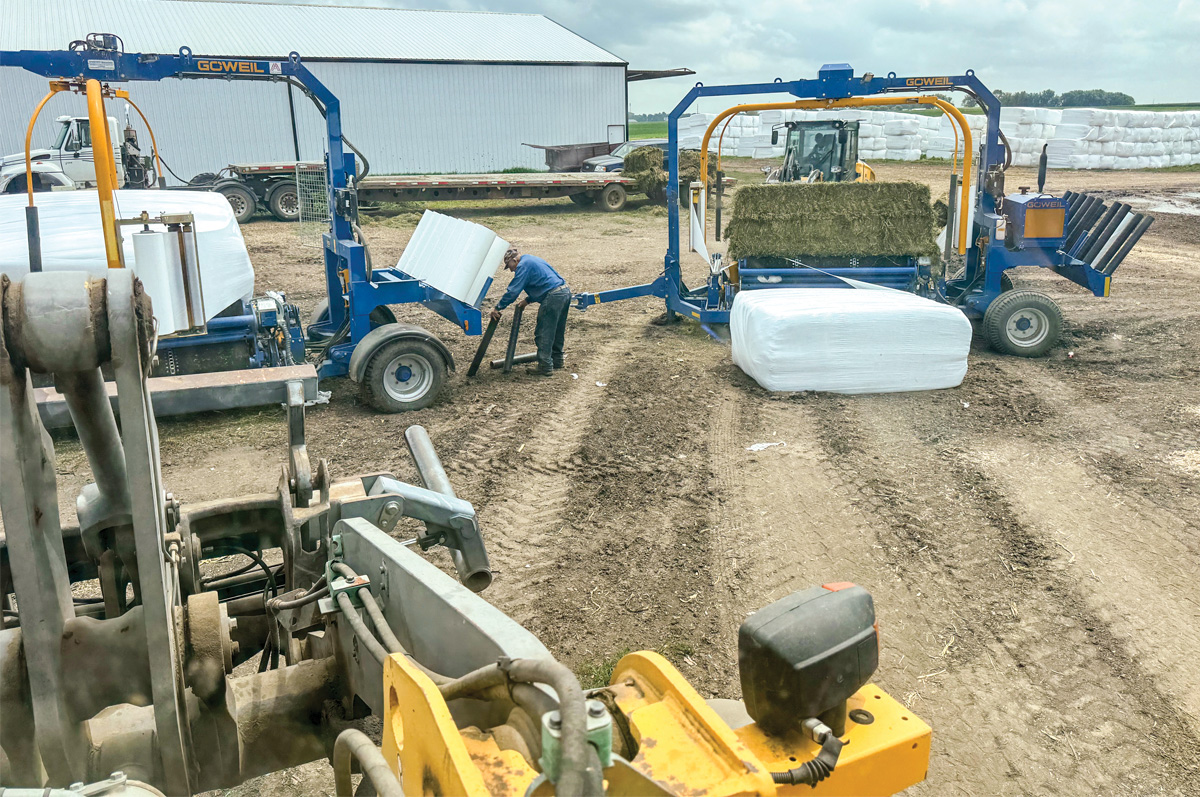
Stationary wrapping helps reduce waste, protect feed value and stretch every acre’s worth of forage. Image provided by Dan Funke.
One disadvantages of the in-line system is you can’t stack the bales, so it takes more space to store them.
“If you don’t have elk, you might put them along the edge of a field where you will be wintering cows," adds Hall. "Many people in our region like the in-line wrappers – the bales can be transported wet to the location where they will be wrapped.”
Learning how long you need to dry the hay to get down to 50% moisture is crucial. It might be just a few hours in heat of summer or overnight in a cooler time of year.
If it’s too dry, it won’t ensile and will mold. If it’s too wet, you lose a lot of yield; the material becomes runny and slimy with too much liquid. A lot of the soluble carbohydrates end up in the fluid and can be lost.
Hall says that baleage is a good product with high nutrition levels, so it should be fed to a class of animals that can benefit – such as a lactating cow or young, growing steer or heifer, so it will pay back on your investment and be cost-effective.
Dan Funke has a cattle operation in northwestern Iowa and harvests and sells a lot of baleage to dairies.
“One of the biggest struggles in producing forage, no matter how people harvest or store it, is dry matter loss. There are many ways to minimize that loss," says Funke. "Most people do a good job of growing a crop but end up losing half of it at various stages along the way through poor harvest management, storage or during feeding."
Density is also important.
“We started with a standard-density baler, then went to a high-density baler and a few years ago got a super-high-density Krone baler," says Funke. "The more you can compact the feed, the less oxygen in it and the better it will be. A loose bale is subject to losses and potential spoilage.”
It’s also crucial to use enough high-quality film. A few dollars more for a roll of good-quality film can make a difference, and typically it takes eight layers.
"The only time we use less film is at the start of the season when the supply of old crop is low and the new crop won’t be stored very long," adds Funke. "We may put six layers on when we know it will get fed within a week.”
There are different brands of film for wrapping, some for round bales or square bales, and some are more expensive. Many people want to save money, but the wrapping is not a place to try to save money. Each individually wrapped bale is fresh, perfect feed, every day. Some people say they don’t need perfect feed. But they worked hard and spent a lot of money to grow it.
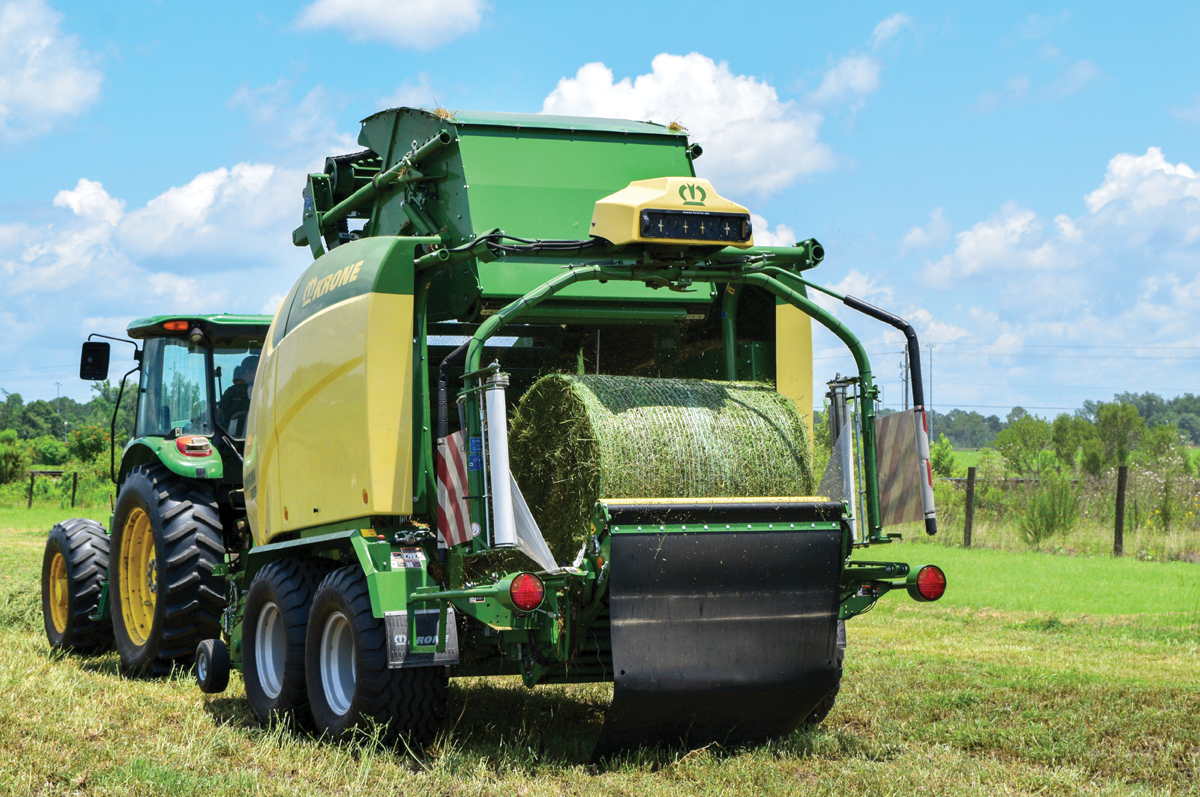
Image provided by Lisa Baxter.
“What we use comes from overseas and it’s the only thing I am willing to use because it works," says Funke. "I compare it to people who harvest corn. If you drove your combine through the field and 20 percent of your crop was landing on the ground, you would do something to fix that combine. So why are people complacent about forage losses?”
Many crops are difficult to harvest as dry hay and do it effectively. In some climates, this is almost impossible.
“Baleage is great because it allows us to utilize many crops and crop mixes that we wouldn't be able to harvest any other way,” says Funke. “In my cow-calf operation, the cows never leave the yard. This complements our forage harvesting – there are always some odds and ends that can’t be sold, and I can utilize that feed.”
Funke says he hasn't purchased protein of any kind for years. When he mixes a load of feed, he has to mix in lower-quality roughage for proper balance because the protein quality is too high. He says he mixes alfalfa or corn silage and cornstalks or straw or some other low-quality roughage to provide some fiber.
He also uses baleage for finishing cattle. He used to sell the calves but now keeps them and finishes them on forage with no grain – one needs high-quality forage for finishing.
Funke adds that they individually wrap every bale – in-line wrapping works for some but not for him because of the challenge of transportability.
"I sell a lot of baleage – it’s not that you can’t transport in-line bales, but you have to take them out of their package," explains Funke. "There are several advantages to individually wrapped bales. If you get a hole in the film, it will only ruin that one bale and not a whole bunch.”
A few years ago, Funke changed to stationary wrappers. He says that they used to wrap everything in the field and pick up wrapped bales. Now they haul the bales in and wrap them in the stack yard, which minimizes handling of wrapped bales and requires a different labor structure.
"We used to be more concerned about getting bales wrapped immediately after they came out of the baler," adds Funke. "Now we realize that if we get them wrapped within a day and a half, they are fine.”
Another challenge with baleage is getting rid of used plastic. In certain regions, there are companies that will recycle it. Revolution Plastics, for instance, has locations in seven states. They send out containers to put the old wrap in, and when the container is full, they pick it up.
As baleage technology continues to evolve, producers gain more control over forage quality, harvest timing and feed stability. Whether choosing individual or in-line wrapping, the method offers flexibility to suit different systems and budgets. For those managing large volumes or seeking enhanced digestibility, inoculants can be a worthwhile investment – especially when paired with the right equipment. Ultimately, baleage offers a reliable path to preserving nutrients and reducing spoilage, helping producers make the most of every cutting.

High-speed wrapping protects forage value, reduces spoilage and maximizes every acre harvested. Image provided by Dan Funke.