If your cows could speak, would you listen?

It’s the kind of question that makes people smile at first – a whimsical thought you might share over coffee. But for me, it became a serious challenge. If animals are constantly communicating, and we fail to hear them, what opportunities are we missing – not just for better welfare but for better farming?
I work in that rare space where agriculture meets computer science. My career has been about building systems that measure, monitor and model farm animals with precision. But a recent project is different. This is about using technology to interpret an animal’s voice – and in doing so, helping farmers save money, improve productivity and meet the rising demands of sustainable agriculture.
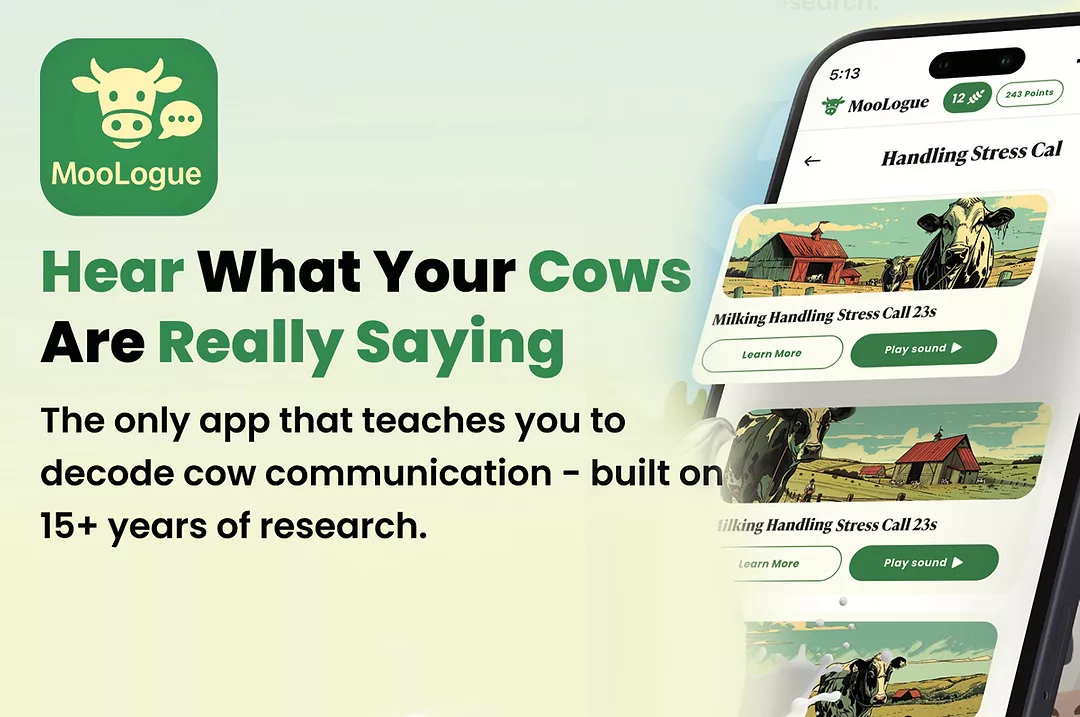
That’s how Project MooLogue was born. And from it, the MooLogue app – our bridge between scientific research and farm-ready technology.
Recording cows on real farms
Our MooAnalytica research group set out to create the most comprehensive dataset of dairy cow vocalizations ever recorded in Atlantic Canada. The idea was simple but ambitious: Collect enough high-quality sound data to train artificial intelligence (AI) models that could detect changes in cow welfare before they became visible.
To do this, we went into real barns. Armed with Sennheiser ME66 and Rode NTG2 microphones and Zoom F6 field recorders, we captured over 300 hours of cow vocalizations in milking parlours, feeding lanes, water stations and resting areas. We logged not just the sound but the context – time of day, activity, herd composition, even weather conditions.
This wasn’t just for academic curiosity. We knew that if the models worked, they could become a practical, affordable tool for farmers. And in dairy farming, early action can make the difference between a healthy herd and thousands of dollars in losses.
What different moos mean for your herd
Most people hear “moo” and think it’s just one sound. Farmers know better – but even they are often surprised by how much variation and meaning hides in those calls.
We recorded the warm, harmonic moos of a mother calling her calf. We heard sharp, urgent notes when cows were separated or uncomfortable. We picked up rhythmic, almost impatient calls before feeding. And we documented the low conversational moos that seemed to knit the herd’s social fabric together.
When analysed as spectrograms, these weren’t just noises – they were emotional fingerprints. And that’s where the business value begins: A herd that “speaks” more distress than usual may be signaling a health issue days before it is visible to the eye. Intervening early can save treatment costs, protect milk yield and prevent animal loss.
Listening with machines – at scale
Human intuition is powerful, but it has its limits – especially on large farms where it is impossible to watch every animal all the time. That’s where AI earns its place.
We trained deep learning models on our annotated audio, teaching them to distinguish between call types and link them to probable emotional states. These models don’t just label a sound; they estimate likelihoods – the probability a given call indicates distress, anticipation or social bonding.
For a farmer, that’s a powerful early-warning system. Instead of waiting for a drop in milk production or visible lameness, they can be alerted when vocal patterns change – and act before losses mount. In financial terms, that can mean thousands of dollars saved each season, not to mention meeting the stricter welfare criteria demanded by retailers, co-ops and certification bodies.
From research to reality: The MooLogue app
It quickly became clear that this technology had to leave the lab and get into farmers’ hands. That’s why we developed the MooLogue app – bringing science to the farmer’s hand.
This app contains curated recordings from our dataset, labeled and explained, so farmers and farm staff can learn to recognize different call types and their meanings. It’s a training tool, an awareness builder and – in future iterations – a gateway to real-time acoustic monitoring.
In today’s market, where consumer trust, sustainability claims and compliance reporting matter as much as production volume, this is more than a novelty. The app is positioning itself as:
- A staff training accelerator: Building animal observation skills faster and more consistently.
- A welfare documentation aid: Supporting audits, certifications and transparency requirements.
- A competitive differentiator: Allowing farms to brand themselves as leaders in welfare-driven, precision agriculture.
Even before adding live monitoring, the app delivers measurable business benefits by making animal welfare awareness part of daily farm culture. This program is designed to complement existing herd management systems by adding vocal pattern analysis as an additional data layer alongside traditional monitoring metrics like activity levels, milk production and health indicators.
The economics of listening
Here’s the hard truth: Every missed welfare signal has a cost. An untreated illness can reduce milk yield for months. A stressed herd can produce lower-quality milk. Unnecessary culling due to preventable health issues is a direct capital loss.
By identifying potential problems earlier, this app offers a clear return on investment. A single prevented case of mastitis can offset the cost of using the technology for months. Across a season, proactive welfare management can raise productivity, reduce vet bills and improve reproductive success.
And there’s another layer: sustainability. As environmental and welfare standards tighten, farms that can demonstrate high welfare standards will have better access to premium buyers and potential carbon or welfare-linked credits. The data collected on the app can feed directly into those reporting systems, turning welfare into a market advantage.
What the cows taught us and what it means for business
One of the most surprising findings from this project is just how socially and emotionally complex dairy cows are. They respond quickly to environmental changes, and their vocal patterns shift accordingly. These changes can be detected – and acted on – before they turn into costly health or production problems.
We’ve also found that certain call patterns – particularly heightened vocal activity with distinct pitch changes – can signal the onset of estrus (heat) in cows. Detecting heat from vocal cues, even without visual observation, can help farmers improve breeding timing, increase conception rates and reduce the costs associated with missed heats or unnecessary inseminations.
For the dairy sector, that’s a competitive edge. Better welfare leads to better productivity, but it also builds resilience against market shocks. A healthy, low-stress herd is less vulnerable to disease outbreaks, supply disruptions and the reputational damage that comes from welfare violations.
In a marketplace where sustainable and humane are becoming non-negotiable labels, the ability to demonstrate those qualities with objective data is a business asset.
Why this matters now
We’re at a turning point in agriculture. Consumers, regulators and buyers are asking tougher questions about where their food comes from. Farms are under pressure to do more with less, all while demonstrating environmental and ethical responsibility.
Technology that bridges welfare and profitability isn’t just nice to have – it’s going to be a requirement for staying competitive. This project offers exactly that bridge. It’s science you can put in your pocket, backed by years of field-tested research, designed not for the lab but for the realities of daily farm life.
And it all started with a simple question: If your cows could speak, would you listen?
We chose to listen.