In 2020, Gov. Brad Little signed Executive Order 2020-01, known as Zero-Based Regulation. The order requires every Idaho administrative rule to be repealed and either allowed to expire or reissued after a complete and thorough evaluation.

Under this order, the Idaho State Department of Agriculture (ISDA) must review the brucellosis rule and justify each part before it can be renewed. There will be no automatic continuation of the rule in its current form.
Zero-Based Regulation places several specific requirements on state agencies. First, the ISDA must conduct a retrospective analysis of the rule to determine if its intended goals are being met and whether the benefits of the regulation outweigh its costs. The department must also evaluate whether there are less restrictive ways to achieve the same objectives. Any changes that come out of the review process must maintain or reduce the existing level of regulatory burden on producers. Agencies are encouraged to remove outdated, redundant or overly complex provisions when rewriting their rules.
The process also requires public involvement before any changes are finalized. ISDA must post its retrospective analysis on its website before holding public hearings. At least two public hearings are required to allow producers, veterinarians, and other stakeholders to weigh in. One of these hearings was held June 17, and the second took place July 15. Once ISDA finalizes its proposed version of the brucellosis rule, it will go to the Idaho Legislature in early 2026. Lawmakers will decide whether to approve or reject the changes, and if they pass, the new version will take effect July 1, 2026.
Idaho’s state veterinarian, Scott Leibsle, shares more about what was discussed at the public hearings and where the brucellosis rule currently stands:
How has stakeholder participation shaped the rule-making process so far, and is there still an opportunity for public input before the end of the year?
LEIBSLE: Multiple stakeholders participated in the two negotiated rule-making meetings this summer – by far the most well attended of all the animal industries rules negotiated this year. Unless there is a specific request to hold a public hearing, stakeholders may still submit their thoughts/position on the rule/program in writing to ISDA and it will be added to the rule-making record.
Will any changes be made to the 02.40.20 brucellosis rule based off those hearings?
LEIBSLE: The proposed rule that will be presented to the 2026 Idaho Legislature contains no significant changes to the brucellosis program. The stakeholders that participated in the negotiated rule-making meeting were largely supportive of all aspects of the brucellosis program.
Maintaining a brucellosis-free cattle industry remains one of ISDA’s top priorities and we will continue to aggressively pursue any and all options, resources and strategies that will further prevent the disease from affecting Idaho’s cattle industry in the most cost-effective way possible.
Do you feel that 02.40.20 has played a key role in keeping Idaho brucellosis-free? And can you share any numbers that show its success?
LEIBSLE: Yes. From October 2023 to September 2024, the Idaho brucellosis lab conducted nearly 400,000 brucellosis tests. See Table 1 – MCI stands for market cattle identification, which is the term used to describe cattle that are tested for brucellosis at slaughter.
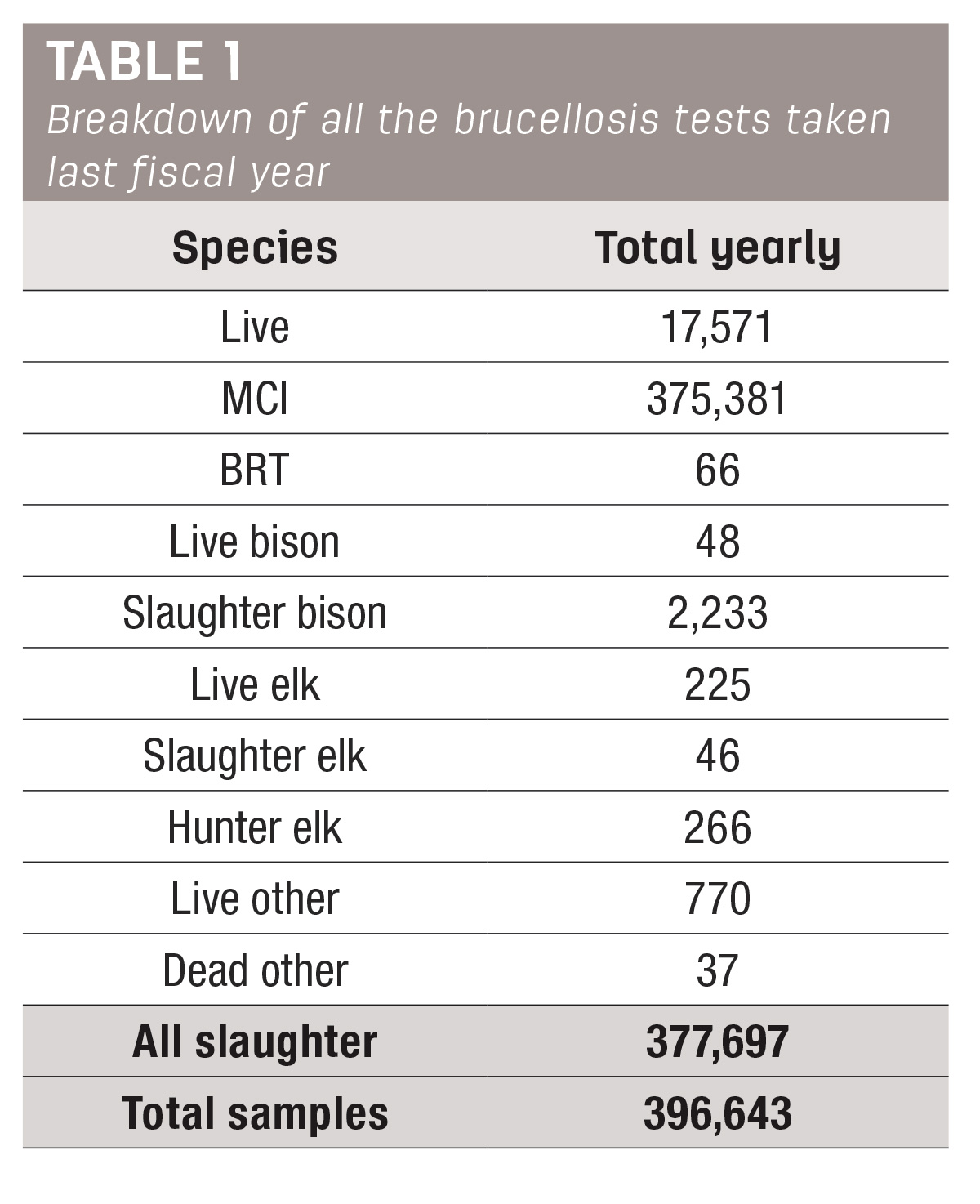
With nearly 400,000 animals tested, there were zero Idaho cattle identified as brucellosis reactors during this time period. The year prior to this, only one Idaho cow was identified as a brucellosis reactor with about 500,000 animals tested.
What this data tells us is that Idaho’s brucellosis testing program is so effective that if/when a reactor is found, it’s identified well before it’s had an opportunity to spread to multiple animals. Since the source of the disease will likely never go away (wildlife in Yellowstone National Park), the current state of the program is the very best we can hope for in terms of time and ability to identify infected animals.
Are there any other programs within the livestock industry that are being reviewed under Gov. Brad Little’s executive order? Or is there anything else you would like readers to know?
LEIBSLE: The other administrative rules that were opened for negotiation this year are:
IDAPA 02.04.26 – Rules Governing the Public Exchange of Livestock
IDAPA 02.04.24 – Rules Governing Tuberculosis
IDAPA 02.02.11 – Rules Governing Eggs and Egg Products



.webp?height=auto&t=1783636475&width=285 "63802-Thomas-GPS-equipment--Automated-Magnum-Tractor--Matt-Skinner-photo(1).jpg")