Prices
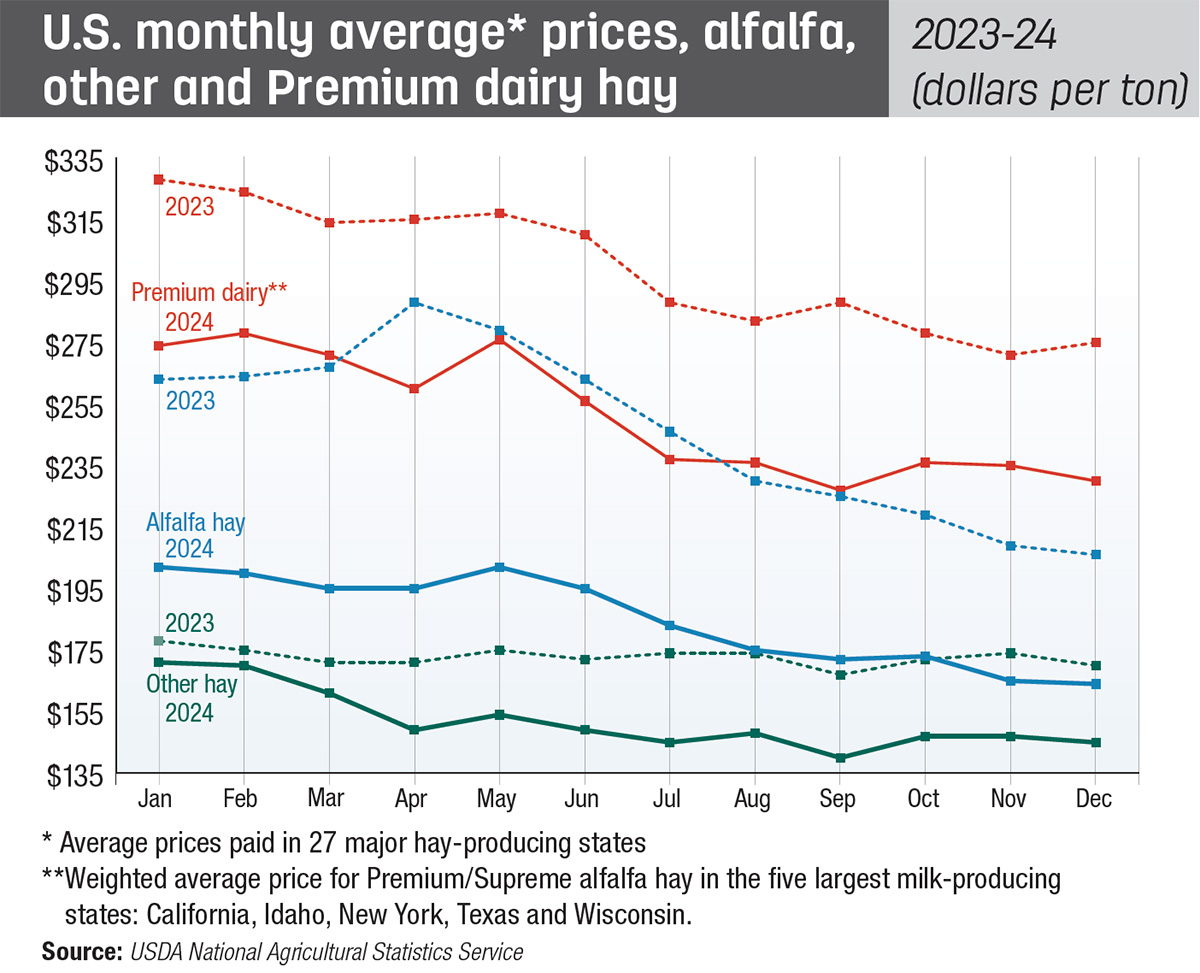
After peaking in late 2022 and the first half of 2023, average monthly prices for alfalfa and premium dairy alfalfa classes of dry hay continued to soften through much of 2024 (see line graph below). Similar trends were seen in the market for other hay.

The 2024 annual average price for dairy-quality alfalfa hay was about $251 per ton in the five major dairy states tracked by the USDA, down about $48 from 2023’s average of $299 per ton. Prices averaged about $233 per ton in the second half of 2024.
U.S. prices for all alfalfa hay* in 2024 averaged $185 per ton, down almost $61 from 2023. In the final six months of 2024, prices averaged
$172 per ton.
Prices for all other hay averaged $152 per ton in 2024, down more than $36 from 2023’s average of $188 per ton. July-December 2024 prices averaged $145 per ton.
Once at more than $100 in 2022-23, alfalfa hay’s price premium over other hay narrowed to less than $20 per ton in November and December 2024.
Production
With higher prices in 2022-23, increased dry hay and total forage production and yield contributed to the lower prices in 2024. In many categories, yield increases offset slight declines in acreage. Compared to a year earlier:
- All dry hay: 2024 production was estimated at 122.5 million tons, up 3% from 2023. Area harvested was estimated at 49.4 million acres, down 6%, while U.S. average yield, at 2.48 tons per acre, was up 0.23 ton from the year before. Alaska saw record-high production and acreage, while record-low acreage was estimated in 10 states, including Indiana, Michigan, North Dakota, Ohio, Pennsylvania, Vermont and Washington.
- Alfalfa and alfalfa mixtures: 2024 production was estimated at 49.8 million tons, up slightly from 2023. Harvested area, at 14.6 million acres, was down 6%; average yield was estimated at 3.41 tons per acre, up 0.22 ton from 2023. Record-high yields were estimated in Nebraska and Wisconsin.
- All other hay: Production in 2024 totaled 72.6 million tons, up 6% from a year earlier. Harvested area, at 34.8 million acres, was down 6% from 2023. Average yield was estimated at a record-high 2.09 tons per acre, up 0.24 ton. Record-high production was estimated in Alaska, with record lows in Michigan and Ohio.
- Total forage: The USDA’s total forage estimation program covers 17 states. Haylage and greenchop are converted to 13% moisture and combined with dry hay production to derive total forage estimates.
With dry hay, the 17-state total for all forage production was nearly 81.7 million tons, up 11% from 2023. About 39.2 million tons were alfalfa and alfalfa mixtures, up 4%.
All haylage and greenchop forages were harvested from 3.69 million acres in 2024, up about 6%. Average yield was higher, with total production at 28.5 million tons, up 10%.
- Corn silage: 2024 production was estimated at 123 million tons, down 5% from 2023. Area harvested for silage was estimated at 6.1 million acres, down 6%; average yield was estimated at 20.2 tons per acre, up 0.1 ton.
- Sorghum silage: Production was estimated at 4.06 million tons, down 18% from 2023. Area harvested for silage was estimated at 306,000 acres, down 20%; yield averaged 13.3 tons per acre, up 0.3 ton per acre from 2023.
- New seedings of alfalfa and alfalfa mixtures: Acreage newly seeded to alfalfa increased for a third consecutive year. In 2024, acreage was estimated at 1.85 million acres, up 107,000 acres (6%) from 2023 but still the fourth-lowest total in more than 25 years. About 1.45 million acres (78%) of new seeding was concentrated in 22 of 24 major dairy states, where new seeding was up about 153,000 acres compared to a year earlier.
- Hay stocks: Heading into the 2024 growing season, all dry hay stocks stored on U.S. farms on May 1 totaled about 21 million tons, up 45% from a year earlier. With higher production and increased use, hay inventories as of Dec. 1, 2024, totaled about 81.5 million tons, up 6% from a year earlier.
“Disappearance” from May 1 – Dec. 1, 2024, totaled 61.9 million tons, up 10% from the same period in 2023.
Among major dairy states, December 2024 hay inventories were estimated about 14% higher than a year earlier, with a record high in New Mexico but a record low in Ohio.
Exports
At 2.13 million metric tons (MT), 2024 alfalfa hay exports fell to a 10-year low. Sales to China represented 44% of the total market, but midyear sales there again softened somewhat.
At 60,471 MT, export sales of dehydrated alfalfa cubes fell to a 17-year low, offset somewhat by gains in sales of dehydrated and sun-dried alfalfa meal.
While remaining low historically, 2024 exports of other hay did pick up slightly compared to 2023, with annual sales inching above 1.05 million MT. Japan maintained its spot as the top market, taking about 55% of other hay shipments during the year, followed by South Korea, at 27%.
Weather and drought
USDA Drought Monitor maps estimated less than 20% of U.S. hay acreage was under moderate to severe drought conditions through the first six months of 2024, before escalating in July and peaking at about 64% at the end of October.
The percentage of alfalfa hay acreage under drought conditions ran slightly higher through 2024, peaking at about 67% at the end of October and ending the year at about 51%.
As 2025 got underway, most extreme and severe drought conditions were in hay-producing areas of Arizona, southern California, Montana, Nebraska, North Dakota, South Dakota, Texas and Wyoming.
*Monthly average prices calculated by USDA are across all hay qualities. Among major hay-producing states, the range of monthly prices can vary by $100 per ton or more.
See the poster with the full year's stats here.