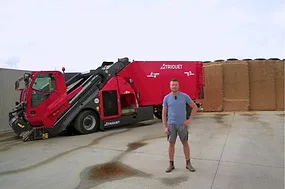
For those of us born during the last millennium, we will remember how wonderful it was when the concept of total mixed ration (TMR) was introduced. Mixers with capabilities of taking all the ingredients and creating one feed where a cow maximized her nutrient intake and her ability to power the rumen, which meant more milk and components. All of that being true, we still must outsmart the bovine beast that looks for the goodies in the diet that she wants to consume, and that means sorting.
Why do cows sort?
Cows can sort for two reasons: the presence of alpha cows and lack of feed at the bunk.
- Alpha cows exert dominance by sorting out the good stuff (often grains, sugars, the top-quality forage). Consider the following:
- Lowering the competition by considering bunk space per cow – ideally 24 inches.
- Grouping dynamics if herd is large enough. Place first-lactation cows and some elders in the herd while mature cows are in another pen. Competition can still exist, but less intensely. Calm cows milk more.
- Feedbunk runs empty.
- If cows know feed is going to run out, they will slug feed to ensure they get what they need not to go hungry. Keeping cows hungry is not ideal; cow rumens need to have feed constantly to keep the rumen moving. Think of the rumen like electricity – if you have a power outage, things are OK for a bit, but too long and suddenly you must reprogram your whole house. Imagine that is your dairy cow who no longer has rumen bugs to digest forage and must now suffer a rebuild to turn feed into milk. It is a nice way to dry off cows, but not ideal if she is only 150 days in milk.
What causes the sorting behaviour to happen at all?
- Physical form of the diet: This can be a major issue. If forage particles are too long (greater than 2 inches), the cow just moves them aside with her nose, and the bullied animals in the herd are often left with those as her whole diet. If the ration is too dry, it is by nature easy to sort. I prefer a diet that is around 40% to 44% dry matter (DM) to really hold it together. Infrequent feed push-ups often makes sorting worse. Cows will eat until they reach the bottom of the feedbunk and then will go elsewhere. That often leaves them full, but does it leave them full enough to maximize milk production? This creates very low feed efficiency.
- Mixing inconsistency: Like every other piece of equipment, things need to be checked to ensure everything is in good working order, including scales. If scales are providing you a number that is off by 5%, the cow receives a different diet every day. Some ingredients, like straw, are tough to measure. Does the mixer come with recommendations of how to load ingredients? Is there an advantage to adding some ingredients with water to add weight before the lighter ingredients?
- Comfort: Cows prefer the path of least resistance, so the ability to walk, having a comfortable place to lie down and a calm group setting helps improve feed intake and feed efficiency.
- Lighting: Cows do not like shadows, and when they perceive shadows, they will avoid the area or spend their time watching the spot rather than eating. This also increases their stress.
Measuring and monitoring sorting
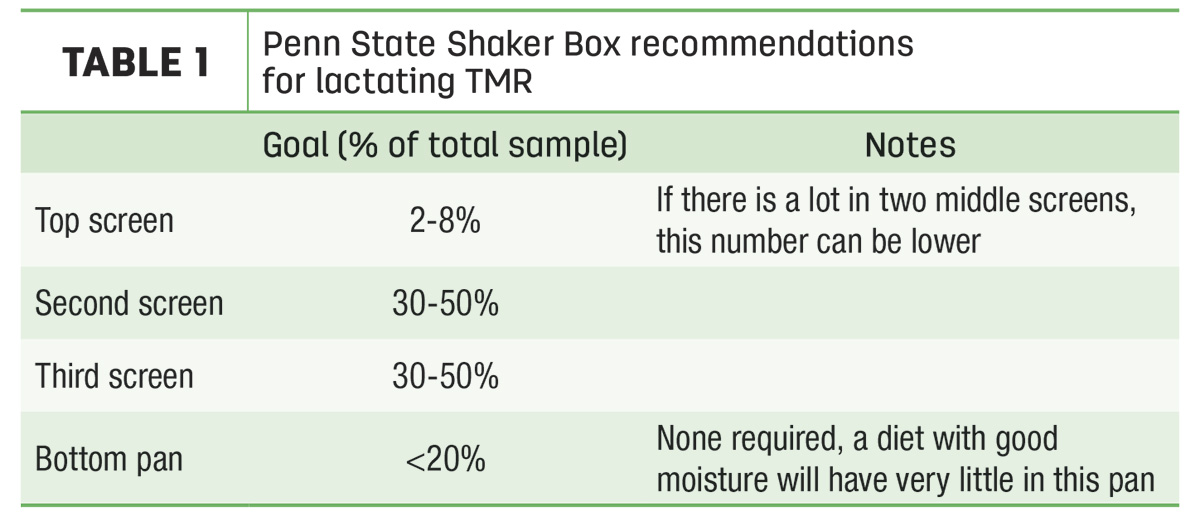
The Penn State Shaker Box has been a tool in the industry for a long time. With ongoing research, the requirements have been adjusted and revisited, making it still a very valuable tool. When using this tool, take a sample of the fresh feed – sample at the beginning, middle and end of feed delivery and then shake it out using the four-tier box. Taking a sample of refusals and shaking it out is a great way to evaluate the diet and how it changes throughout the day. It should be the same regardless of the time. Note that high-forage rations make chop length consistency important. Consistency in the TMR is critical to holding the ration together, reducing sorting, which is the key factor to most nutritional issues on farms.
Reducing sorting
Consider implementing the following tips to reduce sorting at your feedbunks.
- Forage quality is key. Cut forages on time and at a good moisture that stores well.
- Use the Penn State Shaker Box to measure TMRs and address concerns. (Targets are shown in Table 1.)
- Push up feed regularly.
- Monitor refusals – rations are driven by dry matter intake (DMI). Milk is driven by DMI. Having refusals that the cow would never eat or no refusals at all limits the potential to produce milk. Measure and be sure; refusals should be around 2% to 4% or roughly 1 kilogram of DM per cow.
The benefits behind a TMR
Every mouthful of TMR contains the nutrition which fuels the rumen, the cow and, ultimately, milk and component production. When a ration is out of balance, one of those things will be compromised. Depending on the cow’s health and the stage of lactation, it may be one, two or three of all these areas. When a ration is out of balance, it is often a driver of acidosis. In early lactations, this can also drive larger concerns like displacements.
When a cow consumes her meal and every mouthful is the same, this allows her body to be wholly nourished. Her rumen remains in good health as she intakes forage with concentrate (grain and protein). This promotes stronger feed efficiency, where less intake is needed to get milk out of the cow. This also promotes stronger components due to a healthier rumen.
What should you look for?
- Consistent manure: Wet enough to drop to the ground with a watery thunk but not soup and not dry cow manure. This tells us rumens are working.
- Cows eating off the top: Not making holes in the feed as they nose it around.
- Cows eating feed with their ears forward: When their ears are back, it means something is off.
- Consistent components: Fat, protein and milk urea nitrogen (MUN) all move around when DMI or diet is inconsistent.
Summary
While mixing feed is not a new concept, nor is sorting, it is still one worth revisiting and constantly evaluating for continuous improvement on-farm. Ensuring cows are eating the ration you see on paper is critical to achieving optimal production. More than that, being less than particular on feed is costly and creates many health concerns. It is best to expect that things will change on a farm over time, so continuously monitoring what is going into the mixer versus what the cows are eating and what they are leaving behind is important for validating that the ration on paper continues to make it to the rumen.