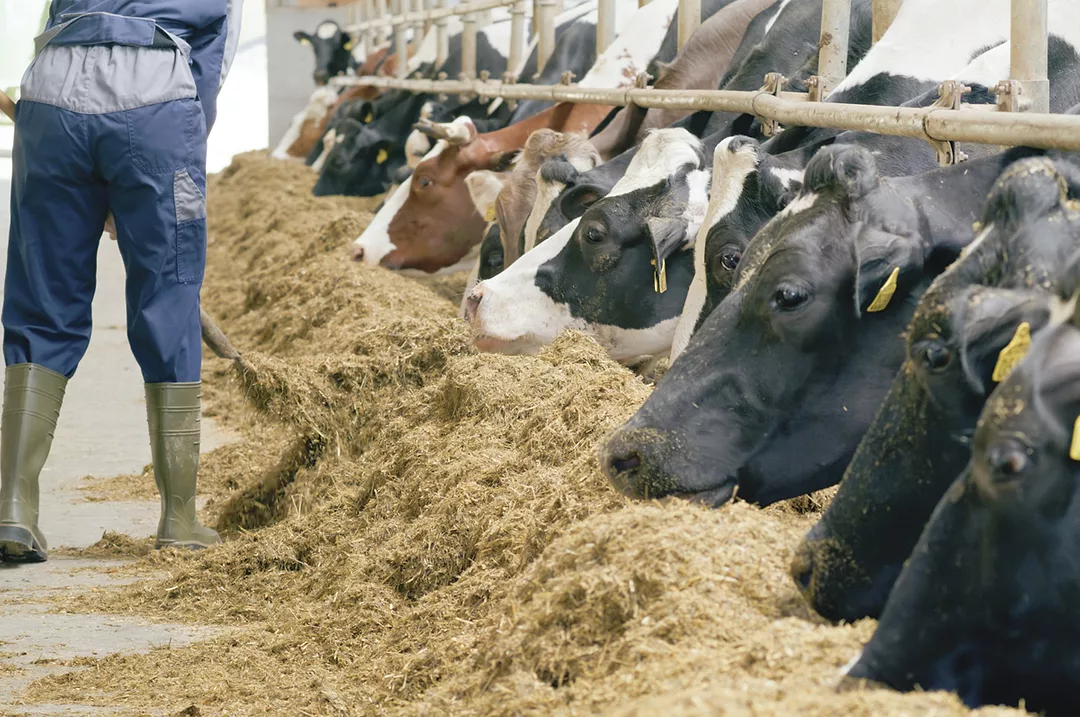
Dairy cows thrive when their environment is consistent from day to day. Eating behavior and feed management are two critical areas where managers and employees should strive for consistency. A consistent feeding operation can result in improved rumen health, higher dry matter intake (DMI), improved milk and milk component yields, and ultimately improved income over feed cost.


When a cow’s maintenance caloric requirements are consistently met, an extra pound of dry matter intake (DMI) could result in an extra 2 pounds of milk. Focus on the following five critical feed management areas with the overarching goal of cows being able to consume a consistent ration whenever they desire.
1. Feed mixing
Achieving ration uniformity throughout the feedbunk is dependent on many factors, including material, methods, machines, Mother Nature and people. To assess ration uniformity, take 10 samples sequentially as feed is discharged from the mixer and analyze the samples using a Penn State Particle Separator. The coefficient of variation (the average divided by the standard deviation for the 10 samples) for the middle sieve and the bottom pan should not exceed 5% and ideally be less than 3%.
Another way to assess uniformity is to compare the particle size of feed refusals with fresh total mixed ration (TMR), which is an indicator of ration sortability. Average particle size of feed refusals and fresh TMR should not differ by more than seven percentage points.
While there are many factors to consider when mixing feed, some of the most common factors contributing to ration variability are equipment wear, load size, levelness of the mixer, ingredient loading sequence, vertical mixer auger speed and mixing time after the last ingredient is added.
2. Feed delivery
Feed delivery is a strong stimulus to drive cows to the feedbunk, and altering its timing can have large impacts on overall DMI. Separating feed delivery time and milking time creates an additional time point where the cows will be motivated to consume a meal that they otherwise may not have. This allows them to consume smaller, more frequent meals that contribute to a healthier rumen environment.
The time of day is also an important consideration. Cows are crepuscular animals, meaning they are most active at dawn and dusk. This makes their first morning meal a crucial one. Furthermore, intakes may be compromised overnight due to lack of push-ups or empty feedbunks.
When cows cannot access feed, they can experience fluctuations in rumen pH due to slug feeding upon feed delivery or push-up. The rise in pH that occurs with slug feeding disrupts the rumen microbiota and therefore reduces feed efficiency and rumen health.
Robotic TMR mixers create a unique opportunity for farms. These systems allow fresh feed to be dropped in front of cows at a frequency and timing that would be impractical for a traditional system. Adding these feed drops encourages cows to eat the frequent, small meals that are so desirable. Though not practical for every operation, these systems show promise in terms of both production and cow health as consistent access to feed promotes a stable rumen environment. Bunk management remains a priority, although the management focus shifts from keeping feed available to ensuring old feed is removed in a timely manner to keep the bunk from accumulating spoilage and thus deterring intakes.
3. Feed push-ups
Feed push-ups are one of the cheapest and most effective ways of boosting milk production. The first two hours after feed delivery is the most critical time point. Research from Dr. Rick Grant at the Miner Institute has shown production advantages to pushing up feed twice per hour for the first two hours post-delivery.
Many animals choose to eat when they return from the parlor, so prioritize feed push-ups around milking times. Throughout the rest of the day and night, feed should ideally be pushed up every one to two hours because the act of pushing feed is yet another stimulus to encourage bunk visits.
This frequency can be difficult to achieve, particularly during overnight hours when few people are available. Although cows are not as active during this period, feed access remains important overnight and particularly at dawn. Grant’s research has shown an advantage of nearly 8 pounds of milk as well as increased lying time for herds that maintained feed availability between the hours of midnight and 6 a.m. Automated feed pushers have gained wide popularity for their ability to fill this gap and consistently achieve recommended feed push-ups.
4. Bunk access
Cows will have aggressive feeding behavior when a feedbunk is functionally empty for longer than three hours. Dominant cows get first access to newly delivered feed and slug feed while displacing more subordinate (and often younger) cows. If a ration is sortable, this is especially problematic as subordinate cows may consume low-energy feed, reducing their milk potential, while dominant cows are at risk of acidosis due to heavy grain intake. To mitigate this behavior, lactating dairy cows should have 24 inches of bunk space per head and transition animals should have a minimum of 30 inches of bunk space per head.
Also consider how much time cows spend away from the feedbunk. This includes parlor and holding pen time as well as time locked away during alley scraping or stall conditioning. If possible, manual scraping and stall conditioning should coincide with each pen’s milking time to limit disruptions.
Efficient milking protocols will minimize the time spent away from the bunk. This is a particularly important consideration when determining whether a 3X or 2X milking schedule is better for your operation. It is possible that a 3X schedule may disrupt feeding or lying time to a degree that compromises anticipated production gains.
5. Feedbunk observations
Determining how much feed to deliver can be challenging. Has the bunk been empty for three hours or six hours? What is occurring throughout the day and night with different shifts and staff? Time-lapse cameras utilized over a defined period of time can help gain insight into what is actually happening with daily routines and feed management. Our consultants regularly summarize observations from time-lapse video, which then allows farm managers to better understand current operations and identify areas of opportunity for improvement. Looking forward, real-time video recording systems may allow a feeder to routinely view the condition of the feedbunks throughout the past day, which can then assist with determining how much feed to deliver for the subsequent day. Computer vision technology is an emerging area that holds promise for this use as well.
Communication among various employee teams is also critical for maintaining feed access. For example, the employee responsible for feed push-ups overnight should assess feed availability and relay that information to the employee responsible for feeding. This communication could be relayed using a dry-erase board, a group text or a communication app.
Most certainly, many feedbunk management factors should be regularly evaluated by farm managers and consultants. The goal is to provide adequate amounts of a uniform ration that all cows can access whenever they access the feedbunk. Achieving this goal requires sound processes, proper equipment and good communication to optimize conversion of feed to milk and milk components.