Immigration enforcement is on many dairy producers' minds, but the threat most likely to affect your operation isn't an Immigration and Customs Enforcement (ICE) raid – it's a notice of inspection. With only 72 hours to produce your I-9 forms, incomplete or missing paperwork can lead to significant fines and employee terminations that disrupt your entire operation.

“Your paperwork is the lowest hanging fruit, and it’s the most likely piece of evidence that would be used against you if they were trying to find your business liable,” said attorney Sam Moheban with Ruder Ware at the Dairy Strong Conference in January in Green Bay, Wisconsin.
Moheban spoke about the immigration process and its practical implications for dairy operations. He covered key employment authorization issues, starting with compliance, which applies to every employer in this country, regardless of whether they sponsor any foreign nationals.
“Every employer in this country should be familiar with the I-9 form and their related obligations,” Moheban said.
Since the mid-1980s, all employers in the U.S. have been required to verify that the people they employ are authorized to work in the United States. The I-9 form is the most common document used for compliance, and more recently there is a web-based system known as E-Verify.
Paperwork violations are the most common form of noncompliance. This could be as simple as completing the I-9 form late, having an incomplete form or not having one at all for an employee. Moheban said paperwork violation fines range from $288 to $2,861 per worker. “To give you an idea of where they start out on that fine schedule, they start out on a point on that scale that reflects your overall compliance rate and then adjust upward or downward on either aggravating or mitigating factors,” he explained.
A mitigating factor that would lower the fine could be evidence of good faith compliance or violations that are more technical than substantive in nature. An aggravating factor, such as a history of violations or having numerous undocumented individuals working for you, would cause the fine to increase.
Beyond the paperwork violations, if the government can prove that you knowingly employed or continue to employ someone who’s not authorized to work in the United States, you’re looking at a fine between $716 and $28,619 per unauthorized worker.
“We’re just talking about monetary fines here, but there’s a lot of other related criminal charges that they can and have brought against employers,” Moheban said.
These charges can include harboring aliens or money laundering, which could result in imprisonment, fines and criminal forfeiture of property.
Checking your I-9 compliance
An employer should have strict policies and procedures in place to ensure that Form I-9 is completed correctly.
“There are strict deadlines, and missing those deadlines is not something you can really correct,” Moheban said. “Once that time to complete those sections of the I-9 have passed, that’s going to continue to be a violation until the statute of limitations expires.”
Section 1 of Form I-9 needs to be completed on the employee’s first day of work. Section 2, which is completed by the employer after they have reviewed and verified work authorization documents, needs to be completed within three business days of the hire.
There was a time during the COVID-19 pandemic when remote review of the documents was acceptable, but that no longer exists. Now, the only scenario where you can do a remote I-9 document verification is if you are an E-Verify employer and closely follow those requirements for remote verification.
E-Verify
Federal employers and some states require the use of E-Verify. If not required, an employer can voluntarily use it.
“I recommend if you are considering either enrolling in the program or disenrolling from the program, if you have that option, that you carefully consider the advantages and downsides of the system,” Moheban said.
Recently, a new functionality with E-Verify had letters sent to employers after work authorization documents expired. The letter then served as constructed knowledge and made the employer liable if continuing to employ that individual.
“One reason you may not want to voluntarily enroll in E-Verify is because these new functionalities just may place more and more liability on employers,” Moheban cautioned.
In addition, there are rules pertaining to filling out an I-9 form on the computer, storing the information electronically, using electronic signatures, etc. Moheban also noted the services an average vendor provides may not guarantee full compliance, leaving the user liable.
Discrimination
If the employer does too little during the I-9 process, they can be subject to the fines mentioned earlier, but if the employer does too much to investigate the documents supplied, they can be liable for discrimination.
Moheban pointed out that at the federal level it is illegal to discriminate against people based on national origin and citizenship.
“There’s also document abuse, which is when the employer suggests that only certain documents be provided by the employee,” he said.
Instead, the employer should provide the employee with the entire list of acceptable evidence of both identity and work authorization for the I-9 process (Figure 1). The employer also cannot refuse unexpired documents provided by the employee if they appear on that list and appear genuine.
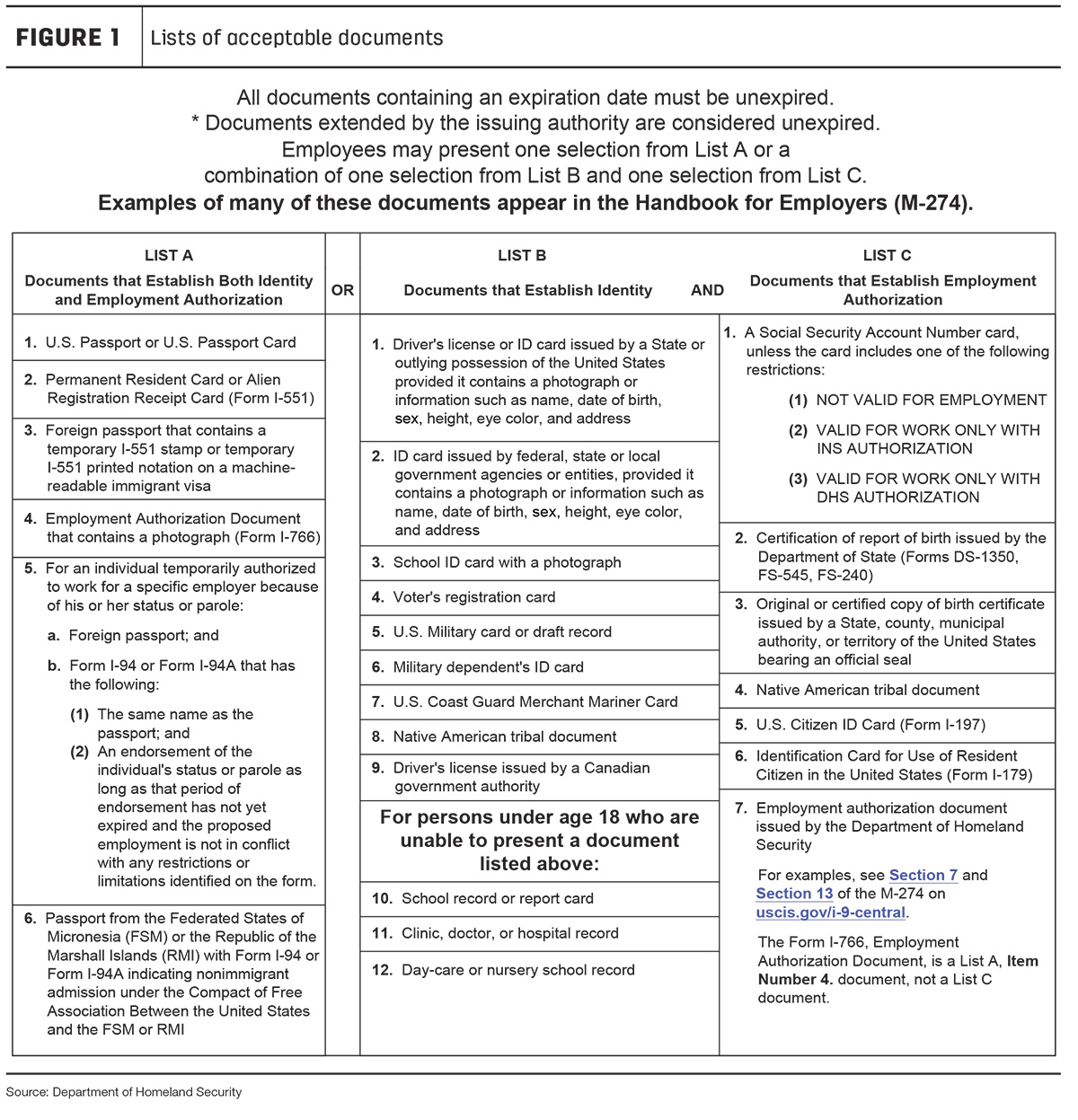
“There are many, many different types of documents that can be produced that require the employer to complete the form in a way that’s very much different than you normally would for a permanent resident or citizen,” he said.
Moheban recommended a list of resources for employers and their human resources staff to follow when completing I-9 forms, which is provided at the end of this article.
Notice of inspection
If the government wants to see your I-9 documents, they will serve you with a notice of inspection. This will usually be served by personal service or certified mail, and you’ll ordinarily have 72 hours to respond.
“If you reach out and request some additional time, there’s a good chance you can get an extension,” he said.
“That 72-hour period does not give you a lot of time, and there are things like corrections to those documents that you would have wanted to make well in advance to having received that notice of inspection.
“That is why we strongly advise that employers have policies, training and periodic audits to ensure that their I-9 documentation is in order.”
Independent contractors
Moheban explained it is not necessary to complete an I-9 form when hiring an independent contractor, but that does not immunize the employer from risk in these situations.
“If the government can prove that even though they’re an independent contractor that you knew that they were not authorized to work the United States, you can still be held liable,” he said.
Aside from avoiding the situation of knowing that a contractor is employing people that are not authorized to work in the United States, Moheban advised to put in the contract that the independent contractor is ensuring verification of work authorization for their employees and that they will indemnify you if you incur any cost/fines related to issues with the work authorization for the contractors they supplied.
Corrections and destroying records
In response to an audience question, Moheban said there are corrections that can be made and other items that cannot be changed.
If you are performing an I-9 audit, he suggested hiring an outside attorney who can not only protect you with attorney-client privilege but ensure any changes are done correctly.
“You need to be very careful when making those corrections because if you do them the wrong way, it can make things far worse than if you had done nothing in the first place,” he said.
In Moheban’s experience, most employers who have not audited their I-9 files before have errors affecting most of their I-9 files. This can be for a few different reasons, such as failure to fully complete the form in the first place or failure to reverify employees with temporary work authorization. He recommended setting a schedule to make sure employees are reverified before their documents expire, especially if it is someone you are sponsoring, to make sure there are no gaps in work authorization.
Also, if someone no longer works for you, you do not have to keep their I-9 file forever. “The rule for retention is three years from the date of hire or one year after the date of termination, whichever is longer,” he said.
When a notice of inspection arrives, 72 hours is not much time. It is better to be proactive, making sure I-9 forms are completed properly in the first place and audited regularly to ensure that your exposure to liability as an employer is minimized.
Resources
Here are some resources available to employers to help with the I-9 process.
- I-9 Central operated by the U.S. Department of Homeland Security
- Handbook for Employers M-274
- E-Verify User Manual