Due to the federal government shutdown, some USDA and federal data sources were delayed or temporarily unavailable. This report draws on state extension services, private market analysts and industry observations to provide current forage market insights.

With alfalfa harvest nearly complete and corn harvest wrapping up, hay markets remain steady but subdued. Trade is light, demand moderate and prices mixed – especially for grass hay, which continues to vary by region and quality. Moisture conditions are improving in some areas, while drought still lingers in others. It’s a season for taking stock, settling inventories and preparing for the winter ahead.
Here’s a review of what we do know about hay and forage markets as you continue to look for answers.
The Midwest continues to struggle, with Missouri, Illinois, Indiana and Ohio facing persistent short-term drought. Soil moisture deficits and elevated fire risk remain concerns, especially with limited late-season precipitation. In the Northeast, expanding dryness in New England reflects a similar pattern, as rains fail to reverse deficits.
In the Southeast, Alabama and Georgia continue to be dry, while the relief in southeast Louisiana has stalled. Meanwhile, parts of the West – including Nevada, Utah and Oregon – are holding onto recent gains from early autumn rainfall. These improvements have helped stabilize forage conditions, though variability remains high.
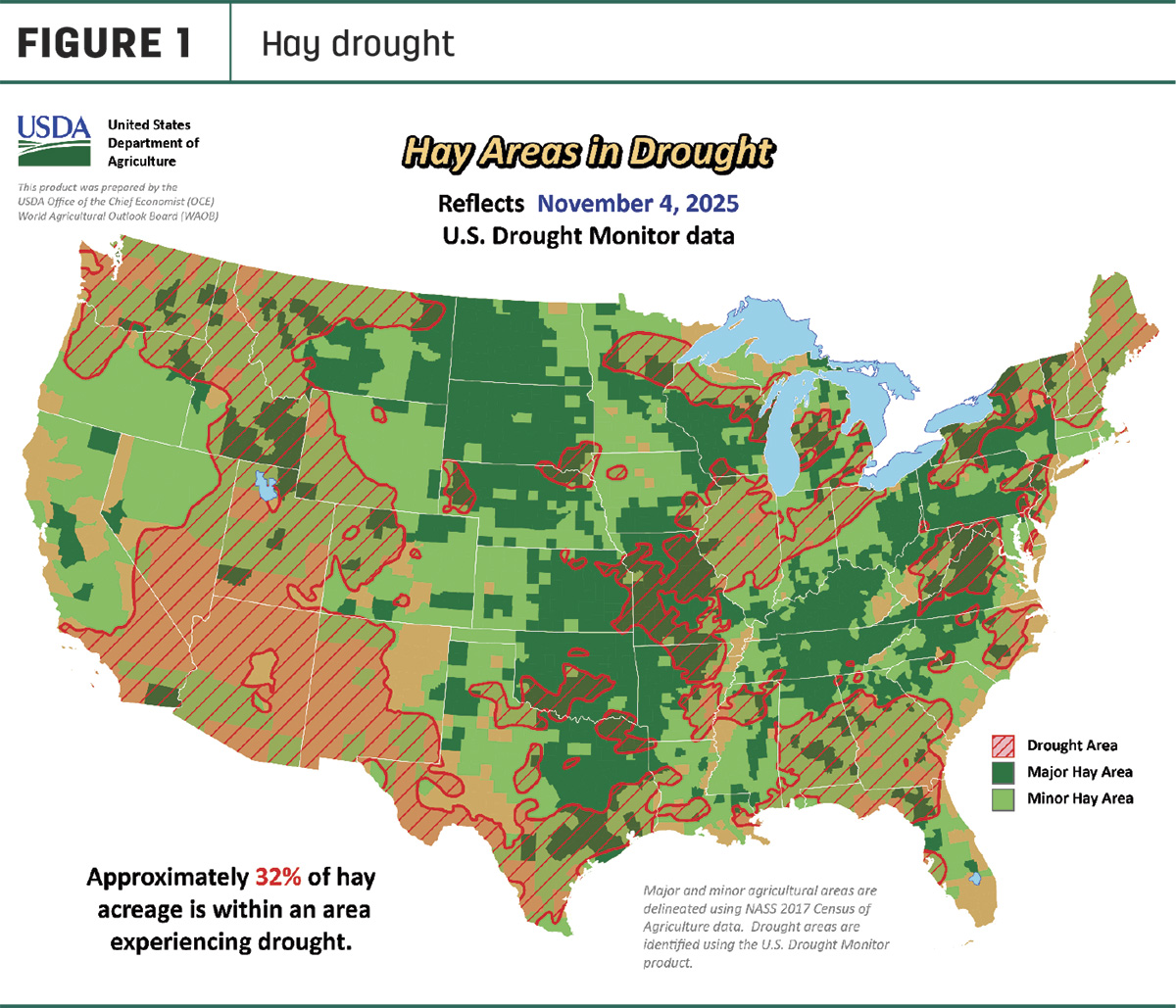
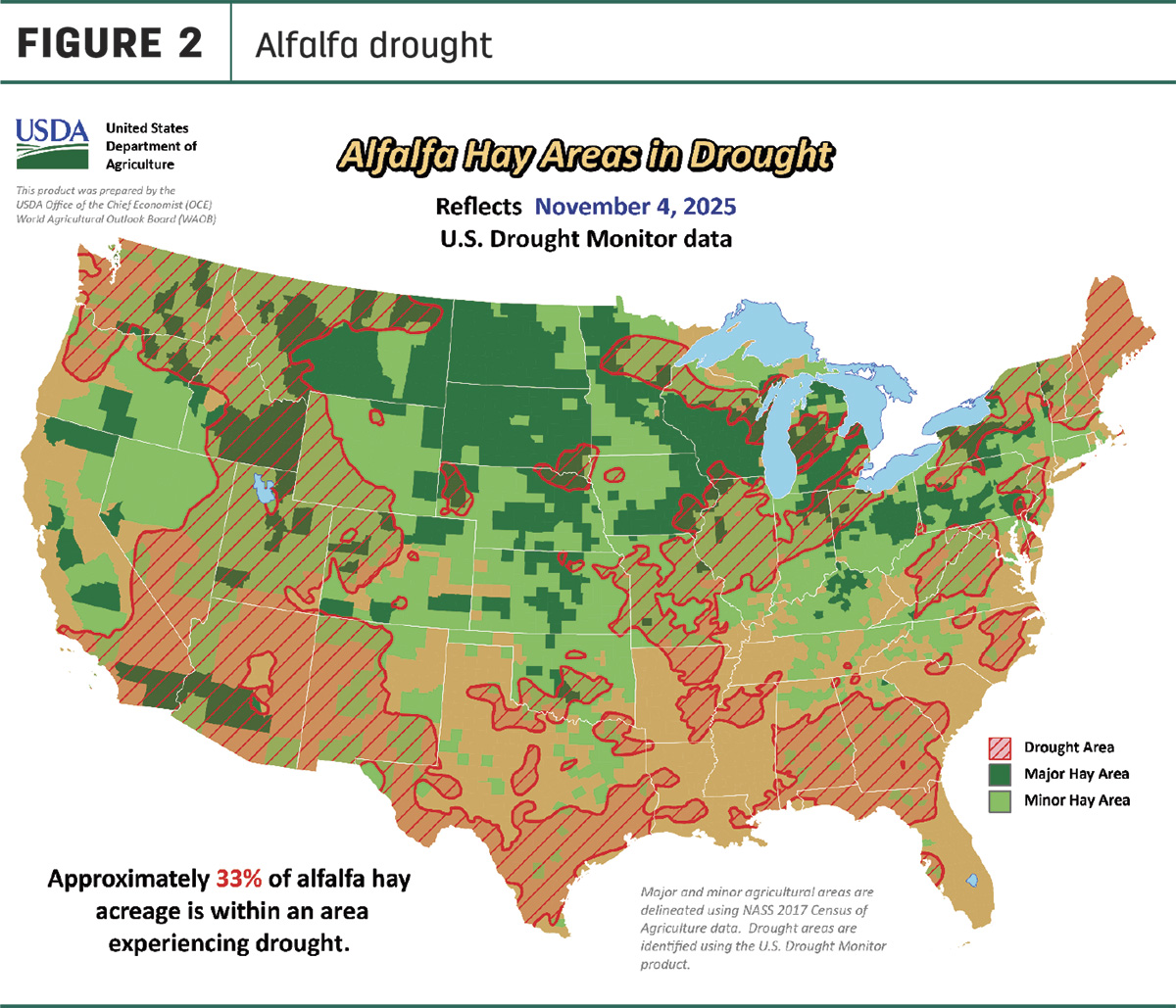
Forage producers face a narrowing window. Late-season growth is slowing, and harvest quality may suffer where moisture remains elusive. With drought affecting roughly one-third of hay acreage and inventories, feed planning and sourcing are becoming more urgent.
As of Nov. 4, approximately 32% of U.S. hay-producing acreage (Figure 1) was considered under drought conditions, a decrease of 1% from a month earlier. The estimate of alfalfa hay-producing acreage (Figure 2) under drought conditions increased slightly to 33%, up 1% from a month earlier.
A snapshot of hay prices
October USDA NASS data was not yet available at press time.
Exports
With federal reporting still paused, exporters are navigating the season without October data. September’s figures showed a modest dip in alfalfa shipments, with China’s softened demand and Japan’s steady pace offering mixed signals. Grass hay exports held firm, led again by Japan, South Korea and Taiwan – a reassuring sign of East Asia’s consistent interest.
Looking ahead, trade partners remain cautious amid tariff questions and weather-related quality concerns. As winter sets in, exporters are watching feed inventories, shipping conditions and buyer sentiment for clues to year-end momentum.
Regional markets
Trade remains quiet nationwide, with moderate demand and limited exports. Weather disruptions – especially smoke and storms – have lowered hay quality in several regions. Prices vary widely by grade and location, and many states now report biweekly. Producers are steady, watching for clearer skies and stronger winter movement.
- Midwest: In Nebraska, hay sold firmer on few comparable sales. Demand continues to be on the softer side with reports of producers finishing up corn harvest and others on the final stretch.
In Kansas, demand increased slightly while prices stayed steady. Trade remains slow and steady. Producers have still been busy with harvest and winter wheat planting when they were not being delayed by the scattered storms across the state.
In Illinois, comparable hays traded steady to higher. Quality was mostly high quality on both large packages and small squares. Trade was active with good demand on a larger supply.
In Missouri, hay prices are steady and demand is moderate.
In Nebraska, hay sold firmer on few comparable sales. Demand continues to be on the softer side.
In South Dakota, demand remains light to moderate currently. Hay buyers aren't very active in spite of a challenging year to put up high-quality hay.
- East: In Alabama, Hay prices fully steady. Trade moderate with moderate supply and demand.
In Tennessee, trade for hay was active, with demand moderate throughout the state for all classes of hay.
Pennsylvania continues to show strong demand for premium grades, with prices remaining firm despite seasonal harvest slowdowns.
- Southwest: In California, trade activity moderate with steady demand for feedlot and dairy hay. Good demand on retail hay.
In Oklahoma, demand is slow to no movement. It becomes harder to move hay across Oklahoma. Due to the overabundance of hay from past years and the wet hay season, the hay being moved is lower-quality hay compared to what we normally see.
In Texas, hay prices were steady with good demand.
- Northwest: In Montana, hay sold generally steady. Very few new hay sales were seen again. Weather conditions have been ideal during the past few weeks as fall rains and unseasonably warm weather have greened pastures and rangeland. Ranchers still have cows out on pasture and plan on leaving them out for the foreseeable future as long as snowfall holds off. This has curbed demand for hay significantly. Some producers are cutting one last cutting of hay as weather conditions have made putting up a late third or fourth cutting possible. Hay supplies remain heavy around much of the central and south-central portions of the state. Western and northern supplies are mostly light due to summer drought.
In Utah, demand has been steady, which has been slower than normal. The hay that is moving seems to be mostly feeder hay with some high-testing hay also being bought for dairies and presses. Producers are wondering when a winter storm will roll in and if that will give Utah hay more demand.
In Idaho, demand for hay is slow, the quality of hay is looking better than it was at the beginning of the season, but there doesn't seem to be a lot of buyers out looking for hay. Producers are saying that no one is making offers on hay right now, and the few offers have been lower priced than earlier in the season.
In the Washington-Oregon Columbia Basin, all grades of hay steady. Trade remains slow to moderate with good demand as always for high-testing supplies. Light demand for hay with defects.
In Wyoming, all reported hay sales sold steady. Demand was mostly light for local sales with good demand for small squares getting shipped out of state. Maybe ranchers have carryover hay from last year and do not need extra hay sitting around. But overall, the hay market is slow to take off this growing season. Most producers in the East have put haying equipment away, and the producers in the West have their last cutting on the ground.
In Colorado, trade activity light on moderate demand. Small squares and medium squares of horse hay sold unevenly steady.
Other things we’re seeing
- Dairy: Milk production edged up slightly, with modest herd growth offset by a dip in per-cow output. Regional weather and feed costs shaped productivity, while Class III prices softened and Class IV gained strength. Producers end the year balancing cautious optimism with market volatility.
- Cattle: Cattle supplies remain tight, with record-high prices holding firm. Feedlot placements are still down, and herd rebuilding is slow amid drought and high costs. Cow retention offers hope, but recovery will take time.
- Fuel: National average fuel prices were slightly lower to start November, according to the U.S. Energy Information Administration (EIA). The U.S. retail price for regular-grade gasoline averaged $3.02 per gallon on Nov. 3, down 1.6 cents from the previous week and 5 cents less than the same week a year earlier. The average U.S. on-highway price of diesel was $3.75 per gallon, up 3.5 cents from the prior week and 21.7 cents more than early November 2024.
- Trucking: Spot flatbed prices were mostly higher to start October, down in the South, higher in the Southeast, Midwest, South, Northeast and West, averaging $2.47 per mile nationally, according to DAT Trendlines. Regionally, average spot prices per mile were: Southeast – $2.66, Midwest – $2.58, South – $2.55, Northeast – $2.34 and West – $2.20.
- Other costs: The USDA’s prices paid index rose 0.6% in September to 152.9 – up 10.4% from a year ago. Diesel, nitrogen fertilizer and feeder cattle continued to drive the increase, while feed and seed prices showed mixed trends. Forage producers face ongoing cost pressure as they plan for winter, with energy and livestock inputs leading the charge. Strategic input management remains key heading into 2026.
- Total July feed prices: As the year winds down, feed prices are holding steady, with only modest shifts across components. After a slight uptick in August – when the USDA’s feed price index rose to 116.3 – markets have settled into a quiet rhythm. That increase, driven by firmer feed grain and complete feed prices, broke the summer trend of easing costs. Yet hay and supplement prices remain soft, tempering broader movement. Unseasonably warm weather in some regions has delayed winter feeding urgency, while producers keep a close eye on grain markets and transportation costs. Though the index remains below year-ago levels, the mood is one of cautious balance: steady hands, selective buying and a watchful eye on what 2026 may bring.
- Interest rates: USDA Farm Service Agency (FSA) interest rates for farm operating loans (4.875%) decreased and direct ownership loans (5.875%) were lower for September. No update available due to government shutdown.