Cornell University Ruminant Center (CURC) conducts cutting-edge research in dairy nutrition and metabolism, reproductive physiology, and management and genomics. The facility was updated in 2013 to better represent modern dairy farm facilities and management and keep research relevant to Northeast dairy producers. It replaced the Teaching and Research Center built in the early 1970’s.
Located on 2,600 acres roughly 15 miles from Cornell’s Ithaca campus, CURC is situated within the Finger Lakes and Upper Susquehanna watersheds. Along with work on cattle nutrition and biology, CURC hosts research that goes beyond the cow, and represents the entire dairy system of animals, crops, soils, and manure.
Cornell Agricultural Systems Testbed and Demonstration Site (CAST) for the Farm of the Future
CAST is a testbed and demonstration site that is shaping the Farm of the Future with data-driven technologies and management practices. CAST operates a cluster of three farms in New York, with the CURC as the centerpiece, to support integrated research, extension, and education aimed at advancing data-driven solutions for dairy farming.
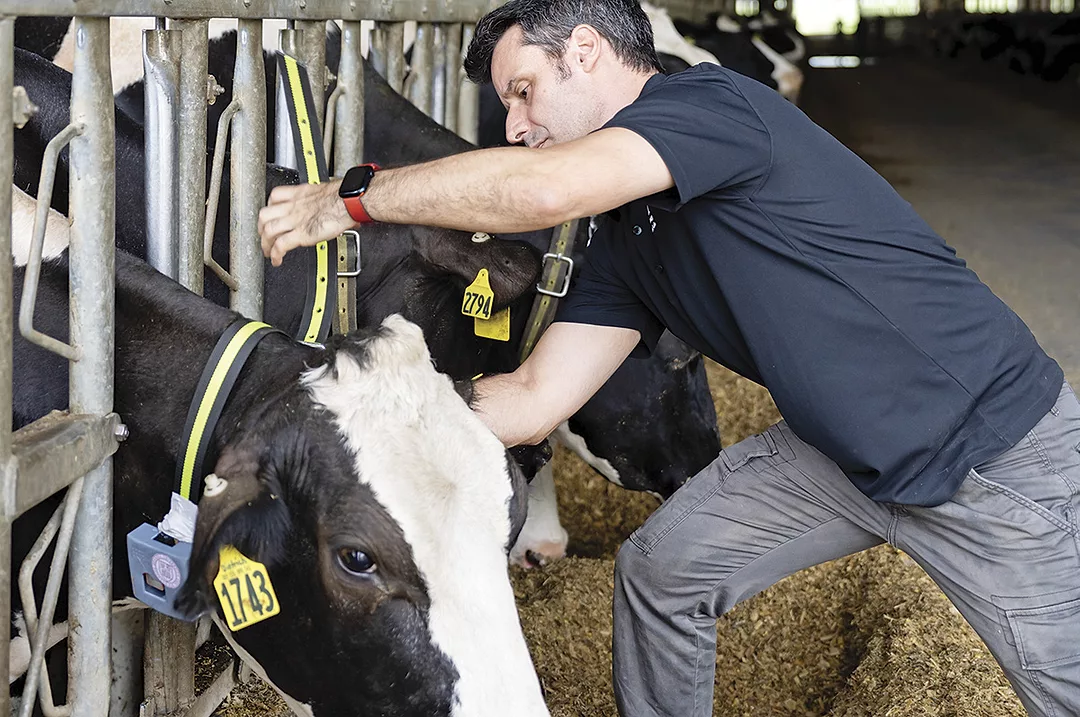
Research at CAST demonstrates the value of integrating commercially available and in-the-pipeline technologies and practices. Cornell researchers and industry partners collaborate at CAST to test, develop, and implement innovative technologies for:
- Dairy cattle health management
- Dairy cattle reproductive monitoring and management
- Dairy cattle feeding and nutritional management
- Precision management of crop inputs
- Cover cropping
- Soil amendments
- Environmental monitoring
Methods are being developed to integrate, research, develop, and demonstrate outputs from 20 technologies and 40 data streams into decision-making tools. By leveraging combined data, farm owners and managers can strengthen their ability to manage animals, people, soils, and crops more effectively.
Ultimately, the goal is to provide accurate, actionable analytics and reporting tools developed and validated at CAST.
Barn air quality
One example of a collaborative, data-driven approach is CAST’s partnership with PRO-DAIRY’s Dairy Environmental Systems (DES) team. Equipment is being installed in the milking barn to monitor and evaluate natural-ventilation air exchange, in-barn air quality and emission rates of methane, ammonia, carbon dioxide, hydrogen sulfide and particulate matter. The goal is to improve management of in-barn air quality and minimize impact of cattle housing systems on the environment.
Manure additives and storage emissions
Manure storage research that is difficult to host on a commercial dairy is conducted at CURC. The DES team constructed 12 experimental-scale manure storages (mesocosms) integrated with a multi-gas analyzer to test the ability of manure additives to enhance nutrient retention and reduce storage emissions at a farm-relevant scale.
Additives have great promise as a scalable strategy to improve stewardship of plant-available nitrogen while simultaneously reducing odors and greenhouse gases. DES focuses on identifying products that work without unintended consequences and on sharing dosing and cost information with dairy farmers.
PRO-DAIRY DES also fitted CURC’s manure storages with equipment that continuously monitors methane emissions across the full length of pits. Ultimately measurements will expand to include other emissions, like ammonia, to inform models and improve emissions inventories, and to build infrastructure to accurately quantify interventions. This data will be critical to inform farm decision-making and to validate emission reduction strategies so they can be better marketed and valued.

Field crop research
Cornell’s Nutrient Management Spear Program (NMSP) is focused on improving the profitability and competitiveness of New York dairy, livestock and cash grain operations while maximizing environmental protection. NMSP partners with PRO-DAIRY’s nutrient management program, farmers, crop advisors, nutrient management planners and state agency partners to enhance crop production and build climate resilience in field crop systems. NMSP conducts on-farm research to help farmers maximize use of manure to build soil carbon and microbial health, improve yields and optimize manure nutrient recovery.
The NMSP team conducts research at CURC, including:
- Value-of-manure trials and manure sensor technology evaluation
- Within-field and zone-based management approaches evaluation
- Whole farm sustainability assessments for nutrients, greenhouse gas emissions and biodiversity
Technology is a key component to conduct on-farm research and advance site-specific management. Yield monitor data are processed into farm-specific reports that include yield stability zone maps, identifying where yields are consistently above average, consistently below average or variable from year to year. Sensing technology and advanced data processing methods (machine learning, deep learning, spatial statistics) are used to:
- Evaluate crop performance
- Monitor manure nutrient applications
- Conduct efficient on-farm research
- Identify barriers to production and drivers for yield and yield stability
Cropland at CURC is also important for PRO-DAIRY’s forage systems program. CURC is part of a network of on-farm research locations where statewide and long-term yield, agronomics, forage quality and performance are tracked.
CURC in action
To learn more about research at CURC, visit cals.cornell.edu/cast-farm-future/curc.
 |
This article appeared in PRO-DAIRY's The Manager in November 2025. To learn more about Cornell CALS PRO-DAIRY, visit PRO-DAIRY. |