DATA-DRIVEN DAIRY MANAGEMENT
Why numbers matter more than ever
In today’s dairy industry, the difference between thriving and surviving might come down to one thing: data. Data quantity, quality, and consistency are the pillars of effective herd management. It’s not just about having numbers, it’s about having the right numbers, collected the right way, and interpreted correctly. Whether it’s milk yield, feed intakes, reproduction rates, or disease management, the ability to collect, interpret, and act on data has the power to transform how farms operate.
Dairy farms are complex systems. Every day, managers face decisions that impact productivity, profitability, and the lives of cows and people working on the farm. Should we change the feeding program? Is our colostrum feeding protocol working? Did the new stalls reduce disease in fresh cows? Without data, these questions are answered with guesswork. With data, dairy managers can answer these questions with confidence.
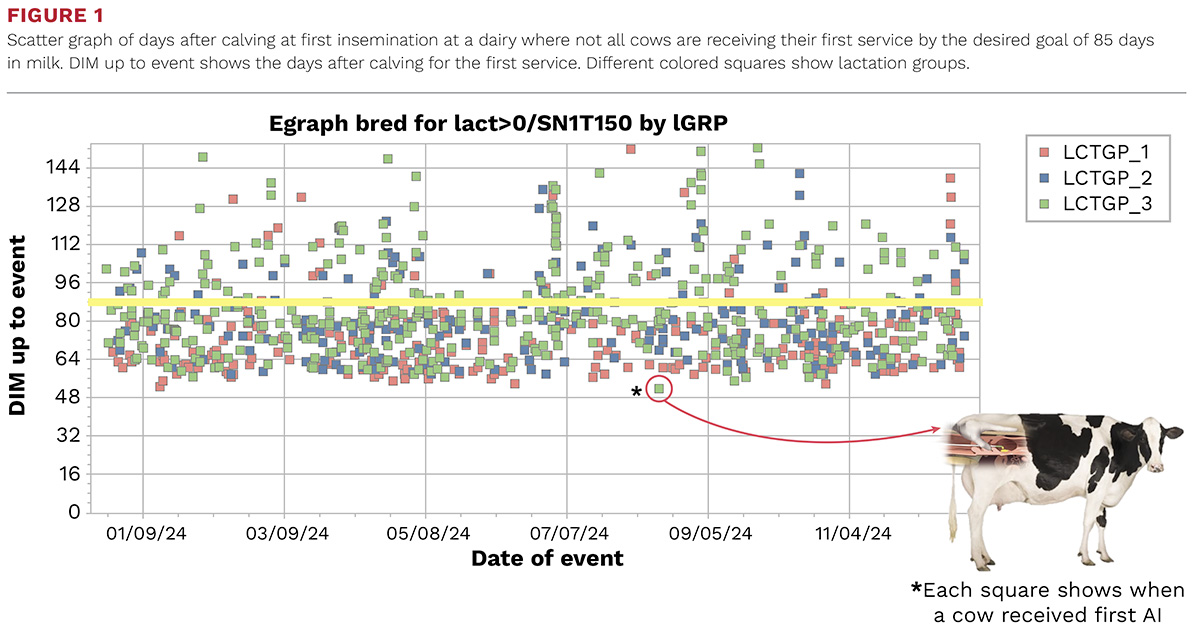
Data can also uncover unseen issues or unplanned management practices with negative consequences. No matter how much time we spend in the barn working with cows, some issues can only be observed through data. Take for example a dairy in which cows are falling through the cracks of their first service program. While on paper every cow was supposed to have received first service by 85 days in milk, way too many cows were inseminated past this mark (Figure 1). In most dairies, this type of issue can only be identified if the right type of data is recorded, summarized, and evaluated on a regular basis, especially as herds continue to get larger.
IMPORTANT DISTINCTIONS FOR TYPES OF DATA
Quantitative versus categorical
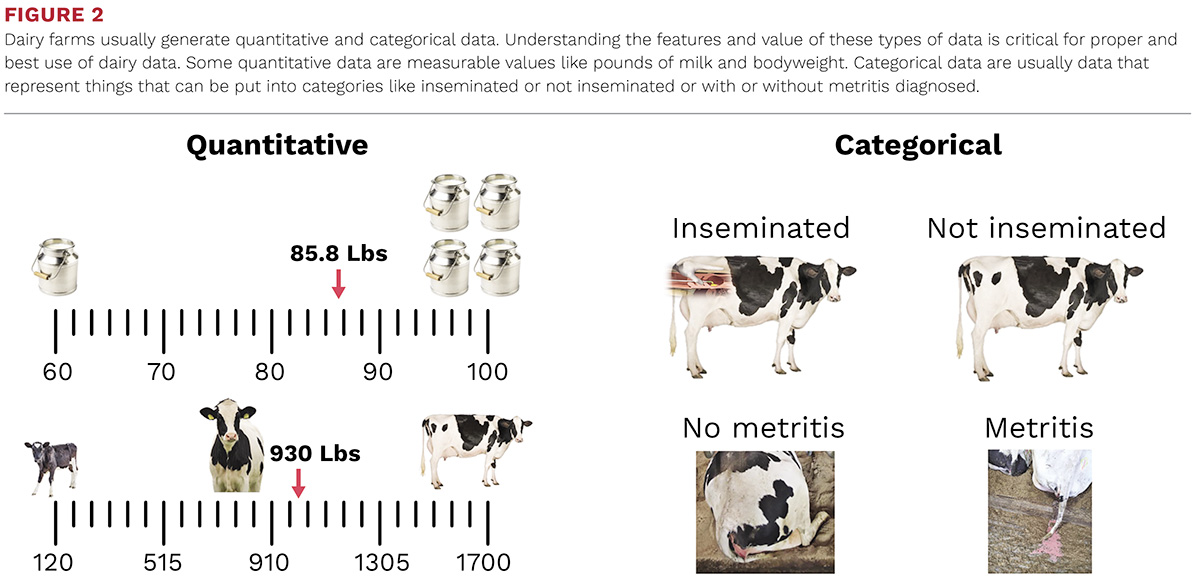
While there are many types of data and ways to classify data, dairy farms usually generate and deal with two major types of data:
Quantitative: These are measurable values like pounds of milk, bodyweight, days of age, or percent fat in milk. These values, which have units of measurement, allow for detailed analysis and comparisons. An important characteristic of quantitative data is that in many cases, tens or a few hundred observations (e.g., milk yield for cows in a pen, heifer weights) are needed to make the decision whether something makes a difference or not. For example, to determine if a new feeding program improves heifer weight at weaning, you might need data from just 10 to 20 heifers per group, depending on the difference of interest and the variability among heifers. Other examples of quantitative data are discrete values such as the number of cows in a herd or calvings per month.
Categorical: These are usually data that represent things that can be put into categories. e.g., “pregnant or open,” “dead or alive,” or “metritis or no metritis.” These data are usually expressed and interpreted as percentages, proportions, rates, or ratios. Those working with this type of data must be aware of an important issue when working with categorical data. Most of the time, much larger sample sizes than those needed for quantitative data are needed to detect meaningful differences or make sense of metrics. For instance, evaluating a five percent improvement in conception rate might require data from 1,200 cows per group, and knowing if a new treatment for metritis reduces its incidence by 50 percent (e.g., from 20 to 10 percent), ~175 cows per group are needed. Thus, making decisions based on categorical data may require patience until a good number of observations are collected. Often, people arrive at conclusions using a limited amount of categorical data, which can be dangerous and counterproductive for the dairy.
DATA QUALITY STARTS AT THE SOURCE
Clear definitions, consistent monitoring routines, and accurate data entry are essential. Fortunately, many herd management software systems make this easier than ever. Farm personnel should explore the wide range of features available in software tools to make data capture, processing, and analysis easier. Consistency is also key because it allows farms to compare performance over time, between groups, or across locations. Without it, data loses its meaning. For example, if at some point we define retained placenta as failure to expel the placenta by 12 hours and then we change the definition and use 24 hours, the rates of retained placenta that we will obtain are not comparable. Similarly, changes in a routine, like eliminating fore-stripping during milking, can affect metrics like mastitis rates. If the change leads to fewer diagnoses, it doesn’t mean the problem went away; it might just mean no one’s looking for it.
FROM DATA TO ACTION
Collecting data is just the beginning. To make it useful, farms must:
- Define how to obtain data – What are we measuring? How often? Who’s responsible?
- Define metrics and goals – What does success or failure look like? For example, keeping retained placenta rates below six to seven percent or triggering a data alarm when milk yield goes below 90 lbs. per cow per day.
- Define actions based on data – Data can confirm that we are on the right track, and nothing should change or should trigger actions when we are not hitting desired goals. Data should trigger questions. Should we change a protocol? Retrain staff? Invest in new equipment?
WHAT TO KNOW ABOUT DAIRY DATA
Not all data is created equal. Beware of bias, variability, lag, and momentum
Those working with data must be aware of “bias,” which occurs when data doesn’t fairly represent the group being measured. For example, if one farm aggressively tests for clinical ketosis and another doesn’t, comparing their disease rates is misleading.
“Variability” in dairy data is another challenge. Even under identical conditions, metrics like conception rate can fluctuate weekly. Factors like breed, age, technician skill, equipment, season, and even software can influence outcomes. However, there are many other less-well-known or unseen factors that also drive these metrics. Recognizing and accounting for these sources of variation is key to accurate interpretation.
Data doesn’t always tell its story immediately. Some metrics, like daily milk yield, respond quickly to changes. Others, like days open, have what is called “lag.” Lag means that it takes time for the effects of a new protocol or procedure to show up.
Another issue for some dairy data is “momentum.” Simply put, it means that data from the past can have an influence on a metric for a long time. As time goes by, more recent data takes over and has a larger influence on the metric of interest. Eventually, data from the past will no longer influence a metric. For example, the treatment for scours that was used up to more than a year ago will no longer influence the percentage of calves that recovered from scours in the last year.
Thus, managers must be patient and understand the timeline of different metrics to avoid misjudging the impact of their decisions.
TAKEAWAYS
Managing a dairy herd without data is like driving blindfolded; you might get somewhere, but it won’t be efficient, safe, or profitable. By embracing computerized herd management and committing to high-quality, consistent data collection, farms can make smarter decisions, improve the lives of cows and people on the farm, and boost productivity and profitability. Understand data to make the most out of it. Dairies should focus on generating large volumes of high-quality, consistent data to support informed decision-making.
 |
This article appeared in PRO-DAIRY's The Manager in November 2025. To learn more about Cornell CALS PRO-DAIRY, visit PRO-DAIRY. |