The “big boys” say that a sign of a good mechanic is the ability to get it tight without breaking it off. My father told me of a group of guys buying an old car with a worn-out engine. Plan was to overhaul the engine, sell the car and each have a wad of cash for their work.

He said it went back together nicely, then one of the guys in the group said he wanted to make sure all the head bolts were properly tight. In a few minutes they heard an ominous “Ping!” followed by a blue streak that would make a Marine drill sergeant blush. Uh huh. He had broken off a head bolt.
How tight is tight? Let’s talk about clamping force. In an application such as a head gasket, that gasket has to withstand the repetitive pressure of the piston’s power stroke about 41 times a second in a four-cycle engine turning at 5,000 revolutions per minute (rpm). That requires a steady force squeezing the head gasket as the engine block and cylinder head are joined together.
Place a toothpick between your lips. Pull it out. Now replace it. Press your lips together tightly, until it gets difficult to pull the toothpick out. Note that it doesn’t take any more or less space between your lips whether it’s just there, or if you’re trying to prevent it from being removed. The difference is clamping force. Your lips will slightly change shape to apply clamping force versus just holding the toothpick.
A head bolt, or any other fastener in an engine, is slightly elastic. Without distorting the metal of either the engine block or the cylinder head, the elasticity of the fastener maintains the clamping force depending on how tight it’s tightened.
How tight? When an engine manufacturer, for example, makes an engine, they want to be sure it stays together and that it doesn’t leak. The last thing they want is to have an engine family failing when put into service because some part of it is leaking or breaking or falling apart. By the time a new engine family hits the showrooms, it will have been torture tested to the point of self-destruction to make sure that what isn’t supposed to leak doesn’t and what’s supposed to stay firmly united remains so.
The makers closely specify the material making the fasteners, as in the head bolts. They will have proven those fasteners to maintain adequate clamping force throughout the life of the engine or machine to prevent leakage.
A torque wrench is a tool to properly tighten a fastener to the correct amount of tightness, which produces the “stretch” or elasticity of the fastener to keep that clamping force constant.
Since the reputation of the manufacturer remains on-line for repaired or overhauled engines and machinery, the torque specs for each critical part are usually included with the owner’s, operator’s or shop manuals for each engine or machine.
Look at more than just the bare torque numbers. The higher the pressures and heat of a machine, the more intricate the torque methods specified become. These are not suggestions.
Notice things like “clean dry threads” or “clean oiled threads.” That makes a noticeable difference.
Some applications will direct you to never reuse a bolt. That is because the material of the bolt used will not consistently maintain the sustained clamping force for another cycle of use. The sequence of tightening does matter. Some applications will want fasteners torqued first to a lower figure, then retorqued to a higher figure and some to a third final figure.
It gets better. When the specification states that after tightening the fasteners to the final specified torque, to go back and give each an additional 90 degrees, or quarter turn. Yes, that final amount of twist is critical. These are the applications that most frequently specify never reusing a fastener, sometimes called “torque to yield.”
The manufacturer is saying, once the fastener has been stretched (torqued to spec, then turned the specified degrees further) it will not reliably hold the needed clamping force another time. Believe them.
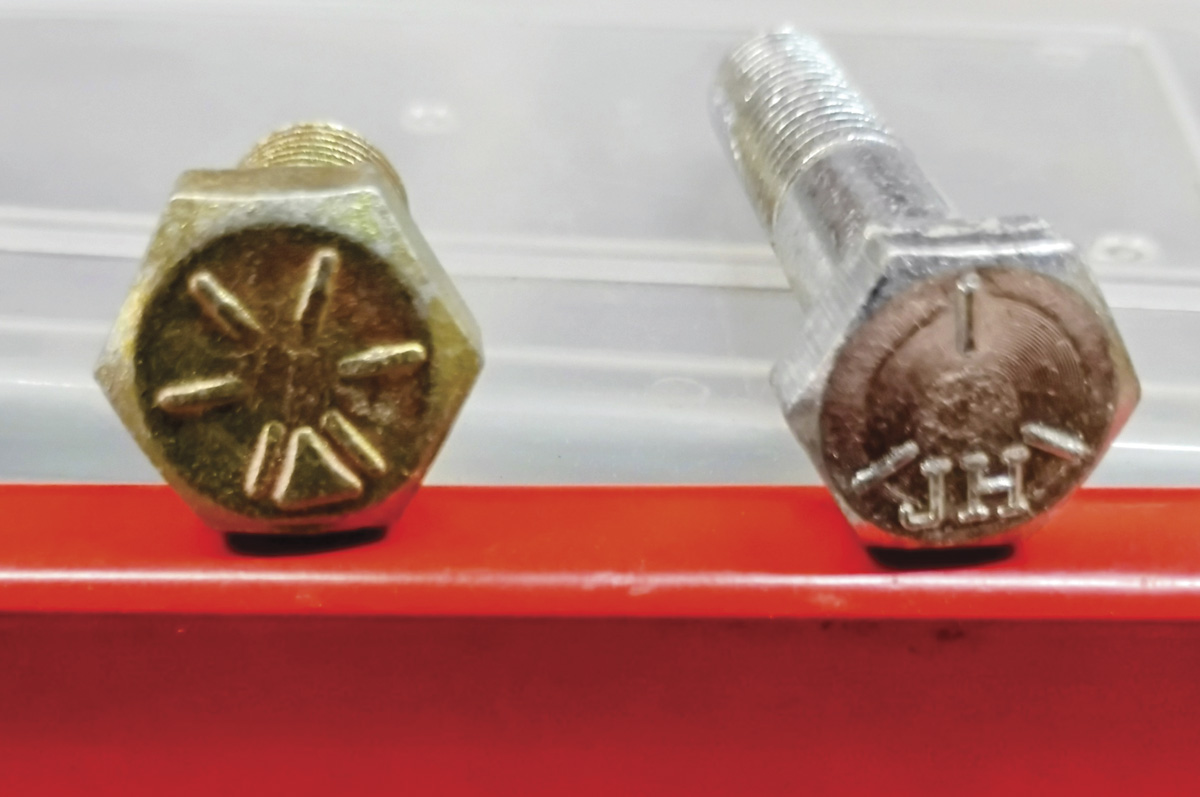
These are typical grade 8 (left) and grade 5 (right) bolt head markings, the higher number being the strongest. A grade 2 will usually have a plain head. Image by Brad Nelson.
There are torque spec charts available for “standard” fasteners. A standard fastener is an off-the-shelf fastener in grade 2, grade 5 or grade 8. These are for standard or “inch” bolts. As in 1/4 inch, 5/16 inch, 1/2 inch, etc., the head of a grade 2 bolt will generally have no markings. A grade 5 will generally have three lines from center to outside, similar to a three-pointed star. A grade 8 bolt will generally have five lines, from center to the outside.
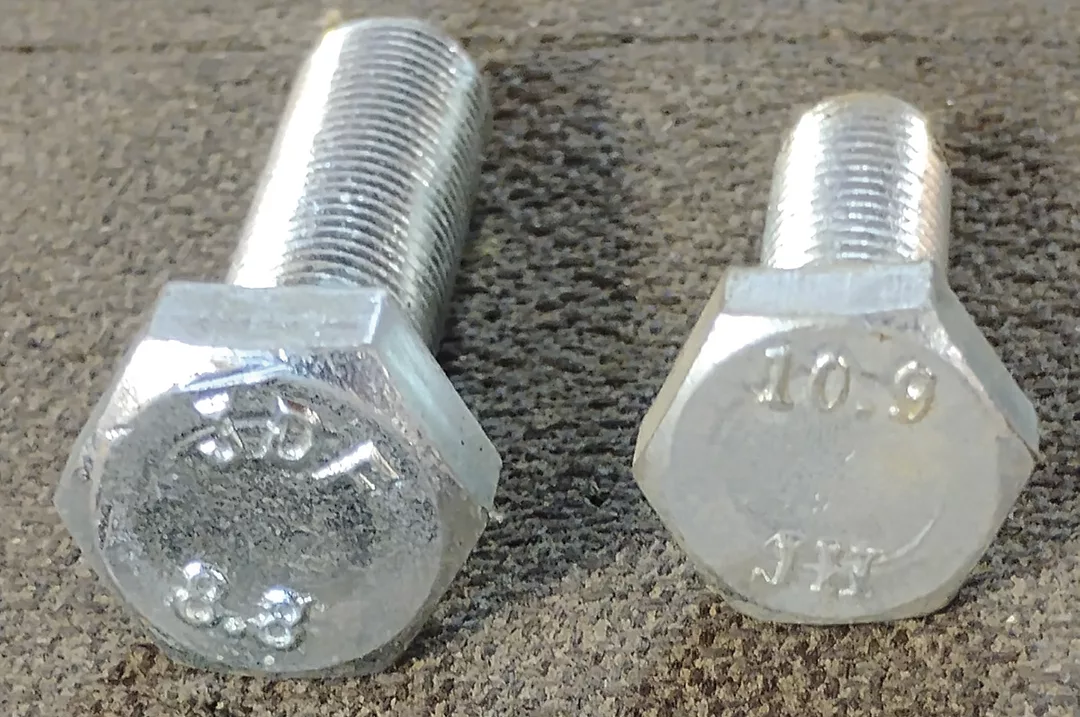
Metric bolts will have a number, usually a pair of numbers separated by a period. Charts are available also for standard metric fasteners.
Unless you are sure that what you are putting back together is using standard fasteners, do not use these specifications.
Also, note that the same size studs or bolts holding a tire and wheel to a vehicle may have different torque requirements. (I have two vehicles with the same size and thread pitch studs but very different torque specs from the manufacturer. Why? Perhaps there’s a difference in the makeup of the studs. Whatever the reason, the torque spec from the manufacturer is “golden” without a bulletin from said manufacturer correcting it.)
Too much torque will stretch the fastener beyond its capability to spring back. Sometimes called "losing its temper," the fastener will not behave as intended to keep a constant clamping force. Similar to heating a leaf spring on a vehicle and bending it. The heat treatment used to temper the spring steel will have been destroyed, unless it is properly reheated and tempered by the correct heat and cooling process.
Overtorquing the lug nuts on a trailer or vehicle can destroy the elastic properties of the wheel studs or lug bolts, making it not possible to keep the wheel firmly clamped to the axle hub.
Note that the elasticity of a fastener is not the same as the elasticity of the rubber working part of a slingshot. The amount of the stretch under torque is barely measurable. But that elasticity has been proven by the engineers to the corporate lawyers to be failsafe when the correct torque is applied to the dry or oiled threads, as specified, before it is released to the public. Yes, too tight can be as dangerous as too loose.