This is a continuation from our earlier discussion in the article “Equipment Hub: Too tight or too loose” about the proper torque.

Let's talk about the types of tools available to measure how tight you’re tightening that fastener. Probably most commonly used is the instrument my father-in-law referred to as the “German method.” He would mimic a European accent and say, “Goot un tight.” This is also called the “arm-strong” method.
These methods don't use torque-measuring tools, but instead guess by “feel” how tight is tight enough. There are some places where this may be acceptable. Who owns what you’re working on? Are you or your employer going to have to deal with the blowback if the part falls apart or warps from overtorque?
Fasteners found on a bargain-store garden cart may be the same as those holding parts attached to the plastic intake manifold of an automobile. On the former, my experience has been that the manufacturer only tightened things enough to hold together until it arrives at the home of the end user. I usually retighten everything, using no torque-measuring tool. The maker’s goal is to get it out the door fast. When I get it home, my goal is to keep it from falling apart, so I check the tightness of anything I don’t trust the factory on.
Moving on to the plastic intake manifold – the manufacturer doesn’t want warranty claims on anything, so an established method of correctly tightening fasteners will have been used. That plastic intake manifold is designed for a serviceable life of 100,000 to 200,000 miles. When these things finally crack and leak coolant, or are upgraded by the car’s owner, the torque specs need to be closely followed.
Plastic crushes and distorts more easily than metal parts. The torque specifications on something such as a wheel lug nut or a cylinder head bolt will be towards the minimum acceptable tightness, while specs for that plastic intake manifold will be closer to the maximum, so overtorquing will not destroy that shiny new part.
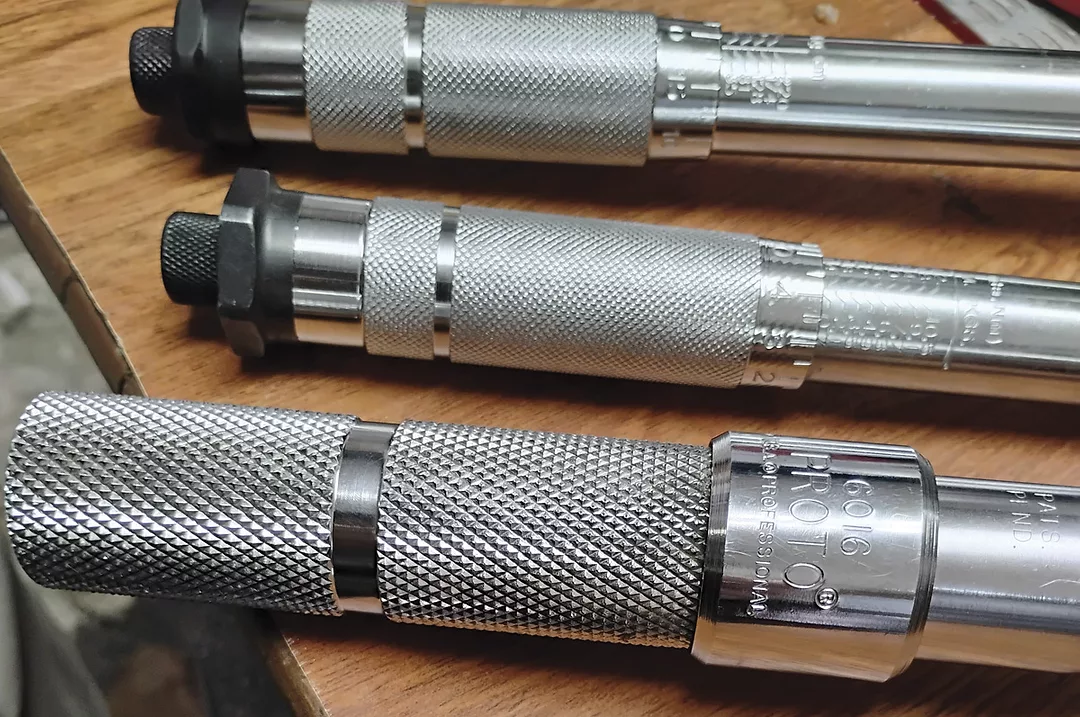
The tools available measure the torque as foot-pounds or Newton-meters, usually on opposite sides of the same tool. The “click-stop” type of torque wrench is the most common. A stiff internal spring is the heart of these tools. It is adjustable and anchored to a lever that clicks audibly and is also easily felt when the desired torque has been reached.
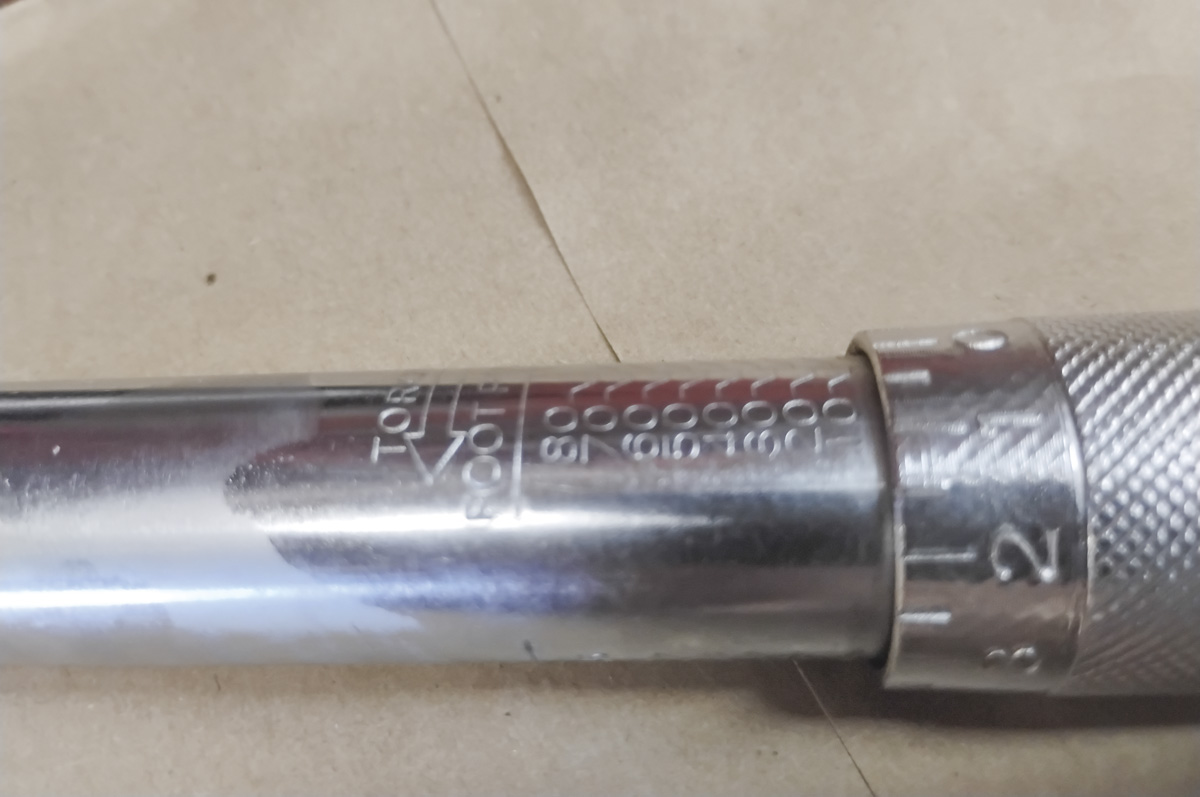
This budget-friendly 3/8-inch torque wrench is rated for 10 to 80 foot-pounds, perfect for light-duty precision work. Image by Brad Nelson.
On the handle, there is an adjustment that tightens the spring to increase the torque indicated by stretching the spring. There is a scale on the end of the handle that is part of the adjusting mechanism that shows the torque level at which the wrench will click.
After use, the adjuster needs to return the internal spring to a no-tension state because a spring constantly under tension will lose its ability to be accurate. It’s routine for a busy shop to have its torque wrenches sent in for recalibration, which allows mechanics to trust the tools. And, the warranty and liability lawyers are happier.
A torque wrench will state the range of torque it is suitable for. One of mine is rated for 30 to 150 foot-pounds. The other is rated for 10 to 80 foot-pounds. If something I’m working on calls for 30 or 35 foot-pounds, I’m going with the smaller of these two.
Things such as the main bearing caps on a heavy-duty diesel engine will require a more robust torque wrench, usually around 300-foot-pounds capacity. On the other end of the scale, some torque specs are stated as inch-pounds. Yes, you really need an inch-pound tool for anything listing the torque as inch-pounds.
For the correct perspective here, a shotgun is adequate for hunting flying things, such as pheasants, ducks and geese. Even for doves. But if the flying thing that you’re hunting is a mosquito parked on a delicate part of your body, then a more delicate hunting tool may be in order.
Other types of torque-limiting tools
There are color-coded parts made for impact wrenches, such as air impact drivers. They look similar to an extension for a socket wrench and flex when under impact to limit the torque applied to the fastener. This device would be useful to prevent overtorquing on an assembly line.
Consider carefully what you’re working on and how critical exact torque is for the application.
As in most of the world, digital torque-measuring tools are available. My move in this area would be to ask a dedicated tool retailer (not an auto parts store that also sells tools) what their experience with the digital units has been. I would insist on finding an end user with a high enough volume of work and ask what their experience has been with the digital units.
Whatever you buy, know what torque ranges you will most often be dealing with. Then, select a tool rated so that your normal usage would be in the middle of the range that the tool works at.
As to price, consider your usage. There is a wide range of prices for torque wrenches. If you’re building race car engines, this is not an item to shop for the lowest price. A product from a name-brand maker will be a wise investment, but the price may make you swallow your gum.
If your usage will be mainly lug nuts and an occasional head gasket on a nonexotic engine, then something priced above the cheapest should last your lifetime.
Keep in mind that any half-hour repair can turn into a three-day nightmare with one broken bolt. As with many things, the common sense of the operator has more to do with success than the capability of the tools used.
Think you don’t need a torque wrench?
Trials have been run with seasoned mechanics claiming they have an educated enough “feel” to not need a torque wrench in most applications. No mechanic was ever found who could consistently be close to the target torque specifications.