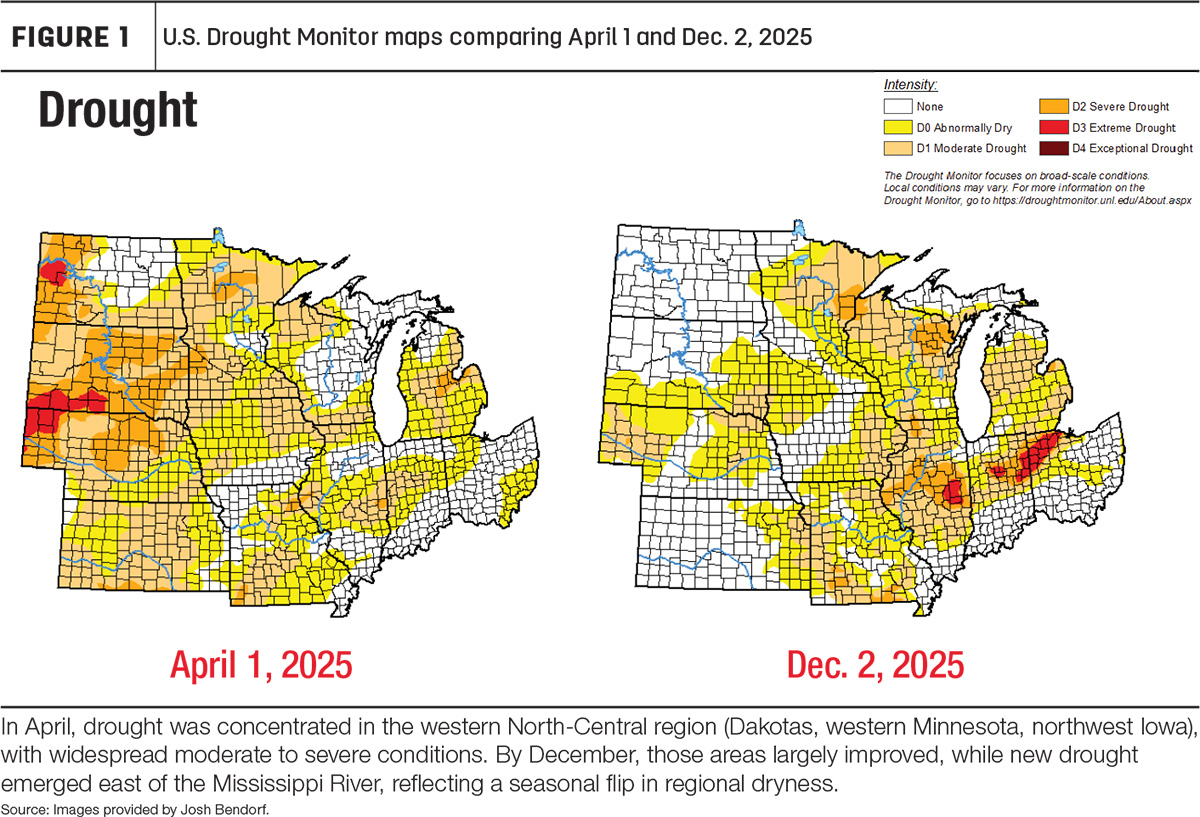
The 2025 growing season told a story of shifting drought and rainfall patterns across the North Central region, with impacts that reached directly into farm fields and feed supplies. In early April, drought was concentrated on the western side of the region. South Dakota, western Minnesota and northwestern Iowa were locked in moderate drought, with pockets of severe and even extreme conditions. At that time, eastern areas were largely spared from drought (Figure 1).

Josh Bendorf, a climate outreach specialist with the Wisconsin State Climatology Office, discussed the 2025 growing season, highlighting drought and precipitation changes during the Dec. 4 Forages Webinar hosted by the I-29 Moo University, a collaboration of land-grant university extension dairy specialists from Iowa, Minnesota, Nebraska, North Dakota and South Dakota, and representatives from the dairy industry and the Northern Plains Forage Association.
“By December, the picture had changed dramatically,” says Bendorf. “The High Plains and the I‑29 corridor had mostly recovered, with only scattered areas of lingering drought. But east of the Mississippi River, new drought has taken hold.”
Bendorf shared how state-level drought histories show how quickly conditions shifted: South Dakota began the year with nearly the entire state in drought, eased through spring and then saw a small rebound in fall. Minnesota followed a similar trend – moderate drought early on, improvement midyear and localized dryness late in the year. Iowa mirrored that pattern, with early drought, summer relief and renewed dryness in autumn.
These cycles remind us that drought is not static – it ebbs and flows with seasonal precipitation, says Bendorf.
Rainfall added another layer to the story. From April through August, much of the Dakotas, northern Iowa and western Minnesota experienced one of the top five to 10 wettest periods on record, dating back to 1893 (Figure 2).
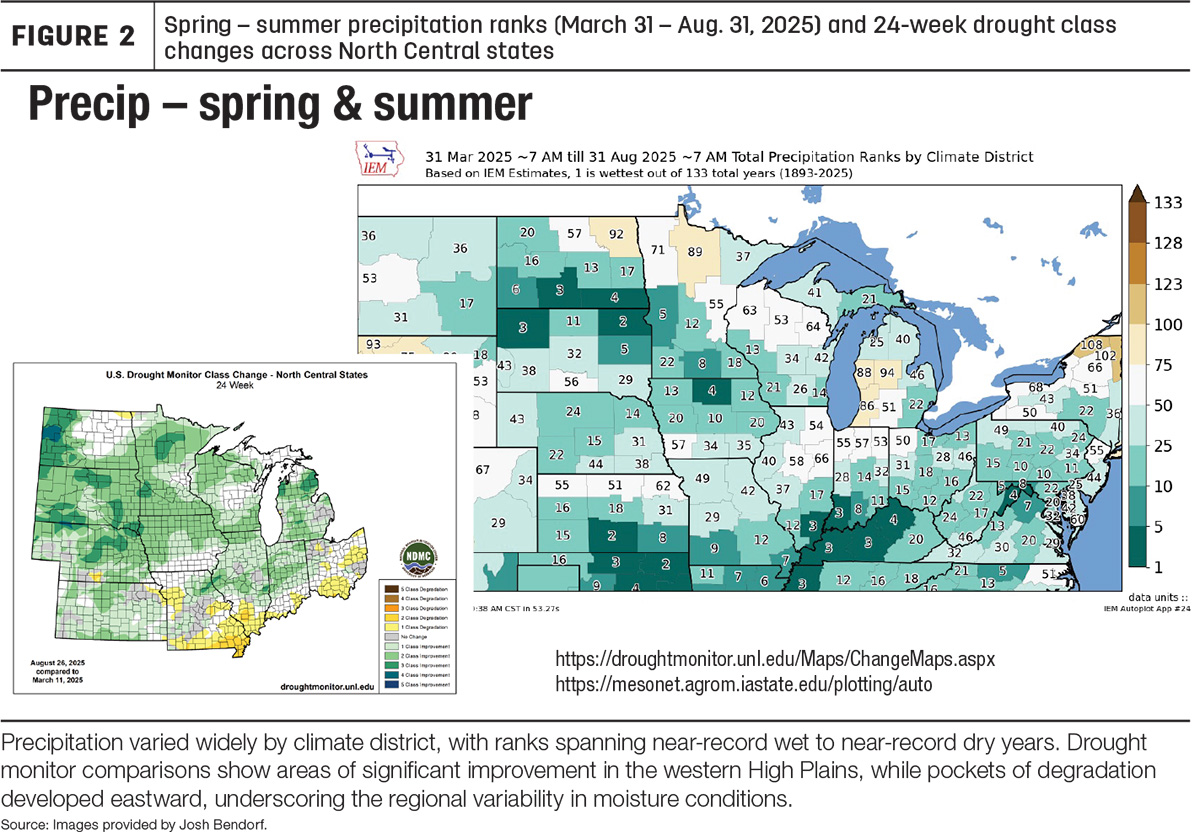
For farmers, that meant muddy fields, delayed haying and heavy silage tonnage, though often at the expense of forage quality.
“The lessons of 2025 is that weather can pivot quickly, and staying nimble is essential for managing surplus and shortage,” says Bendorf.
Turning to temperatures this past fall, everything from the southern part of the region was in the middle to upper 50s, all the way up to the northern part of our region, which was about upper 40s to lower 50s – below-normal precipitation, above-normal temperatures.
“This was one of our warmest falls on record,” adds Bendorf. “Basically, no matter where you were, you were kind of in that 2- to 4- or 4- to 6-degree range above normal temperatures for the last 30 days.”
So what does this mean for soil moisture?
“Across much of the region, conditions appear well below normal soil moisture for what we would expect for early December,” says Bendorf. “In contrast to the area in the Dakotas, which might actually be a little bit wetter than normal due to late‑fall precipitation.”
He adds that the winter outlook suggests below-normal temperatures and near-normal precipitation, with a mild to moderate La Nina influence.
Bendorf explains that El Nino and La Nina are two phases of the same climate system, the El Nino-Southern Oscillation (ENSO). It is the natural cycle of sea surface temperatures and atmospheric circulation in the tropical Pacific Ocean.
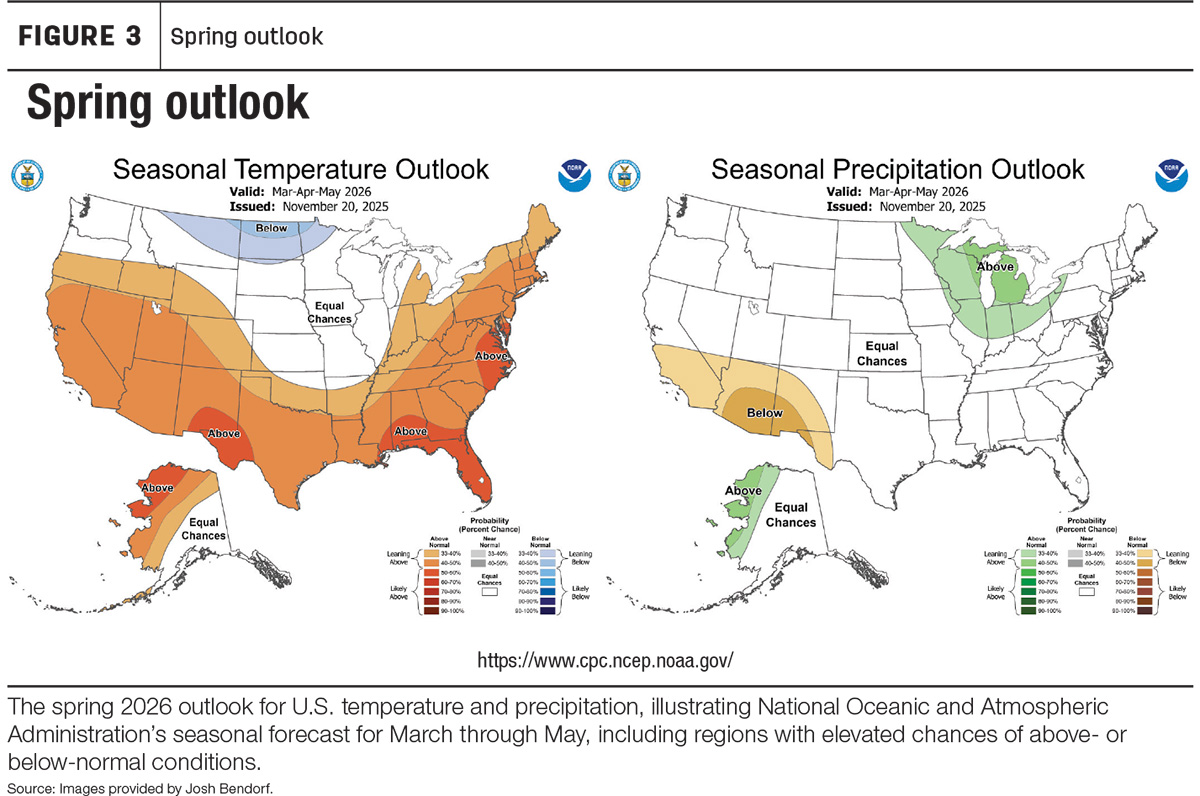
As winter settles in across the Upper Midwest, the National Oceanic and Atmospheric Administration’s maps are leaning toward colder-than-normal conditions. Bendorf explains it this way: “These maps are not showing how much below normal you’re going to be. It’s the probability that you’re going to be above, near or below.”
Looking at the broader winter season, now through February reflects the familiar La Nina pattern. Josh notes a “lean towards below-normal temperatures across the I‑29 region, more so as you get to the points further north and west.”
At the same time, there’s a slight tilt toward above-normal precipitation in northern and western areas, while southern South Dakota and western Iowa remain in the “equal chances” category.
Spring outlooks, covering March through May, show no strong signals yet. North Dakota carries a slight lean cooler, but most of the region sits in equal chances for both temperature and precipitation. Bendorf cautioned that “the further out you get from a time period like this, the smaller the target that you’re trying to aim at.” (Figure 3)
“Winter tends to be our climatologically driest time of the year compared to the other three seasons,” he adds. “So we don't expect a lot of change and drought during the winter months, and we need some, we need this snow to melt and percolate into the soil for those soil moisture levels to replenish.”
For drought, little change is expected during the winter months. Snowpack will be the key. Moisture recharge won’t happen until meltwater percolates into the soil in spring. Areas further east, where precipitation leans above normal, could see some improvement, but Bendorf sums it up: “We’re not expecting a lot of change over the next three months.”