Early cuttings offer the first real read on new‑crop performance, and results are mixed. Quality is strong where spring moisture held, but lighter‑than‑expected tonnage in several regions tempers confidence. Movement is steady, demand firm and prices mostly unchanged, still shaped by wide quality spreads and selective buying.

Moisture remains the dividing line. The Midwest and Northeast show uneven recovery, the Southeast moves further from supplemental feeding and the West enters summer with a snowpack that favors the southern Rockies and Southwest but leaves the Pacific Northwest and Great Basin exposed. With first‑crop yields replacing spring speculation, markets now focus on second‑cutting potential, early‑summer supply signals and the staying power of seasonal moisture.
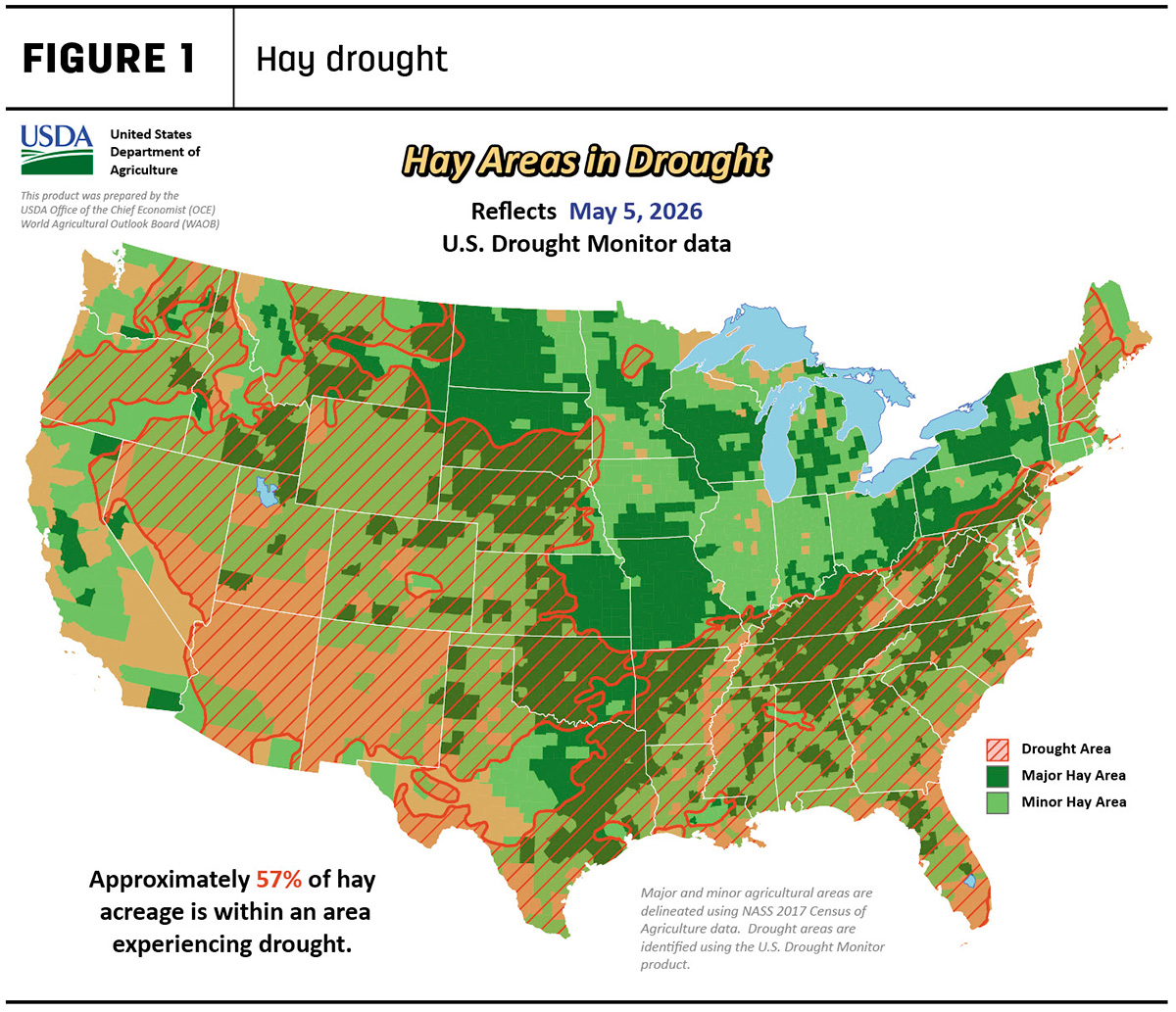
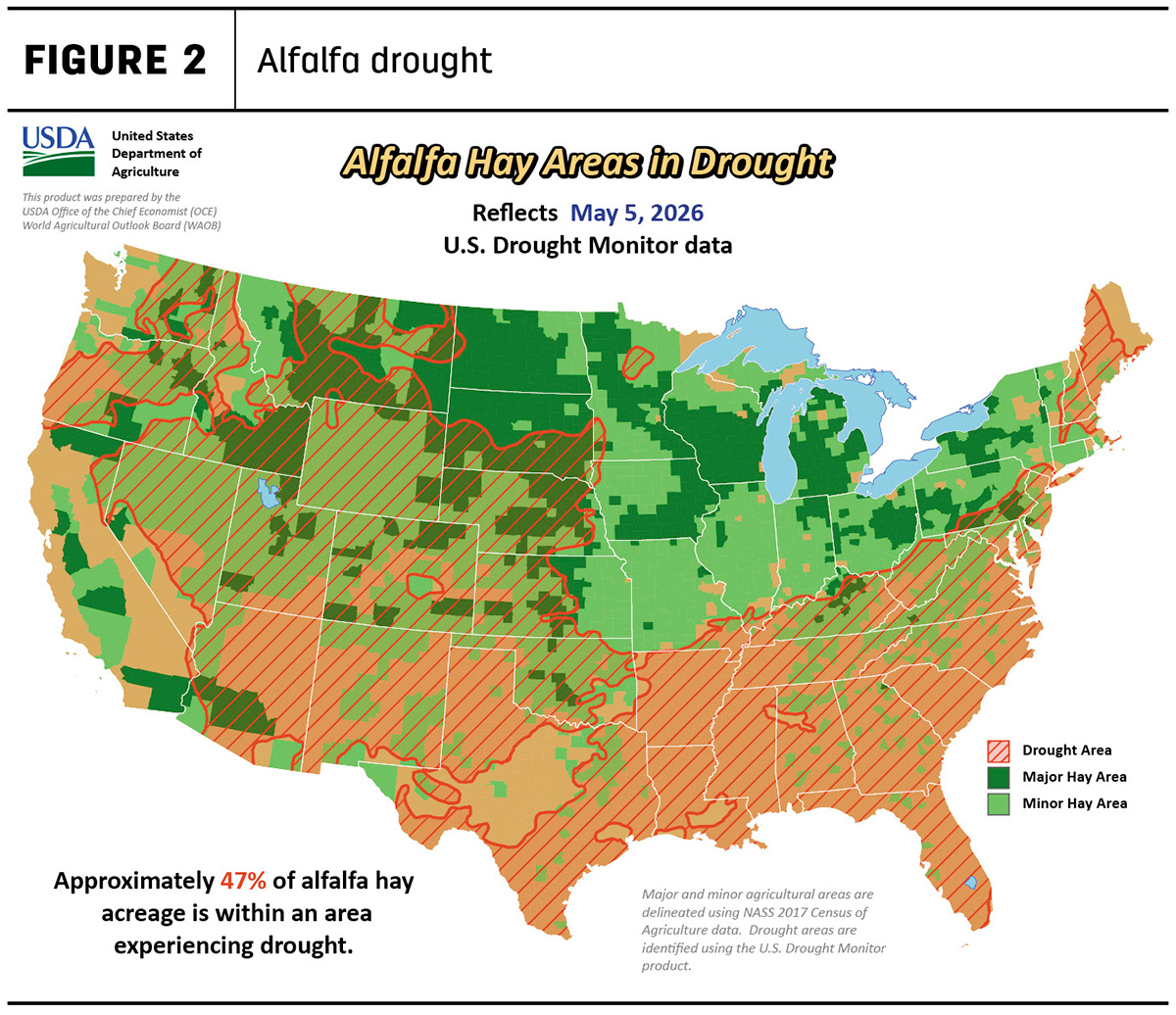
As of May 5, approximately 57% of U.S. hay-producing acreage (Figure 1) was considered under drought conditions, an increase of 1% from a month earlier. The estimate of alfalfa hay-producing acreage (Figure 2) under drought conditions increased to 47%, 1% more than a month earlier.
A snapshot of hay prices
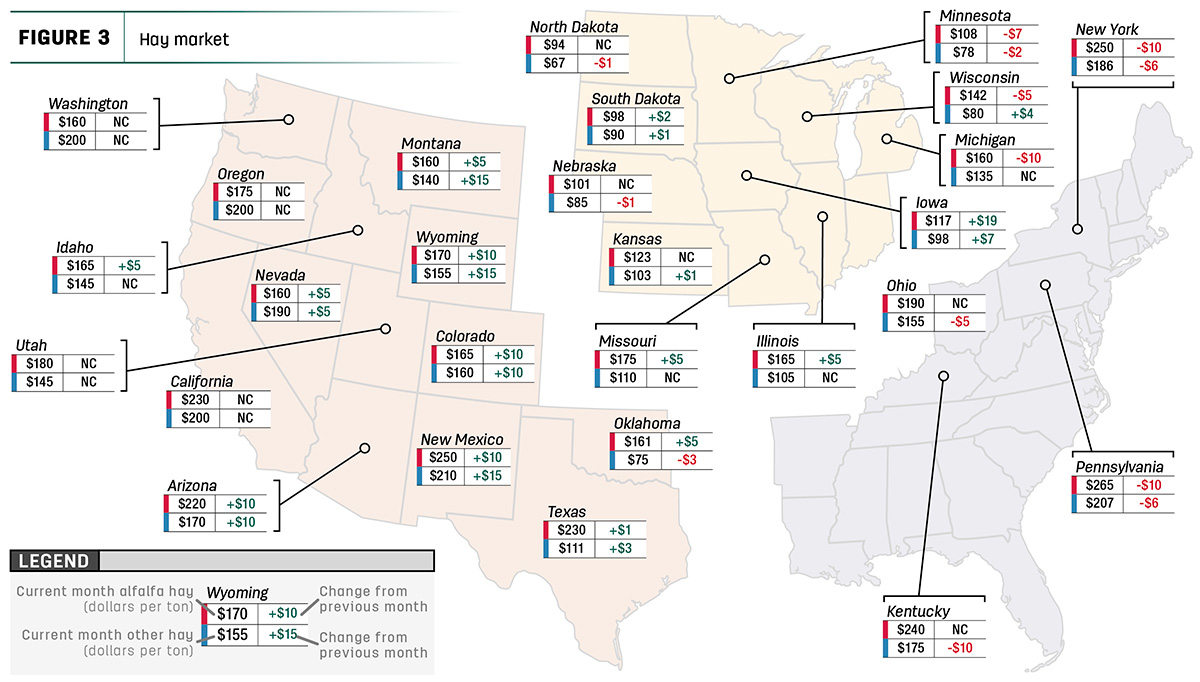
USDA price data for 27 major hay-producing states is mapped in Figure 3, illustrating the most recent monthly average price and one-month change. The lag in USDA price reports and price averaging across several quality grades of hay may not always capture current markets, so check individual market reports elsewhere in Progressive Forage.
Dairy hay
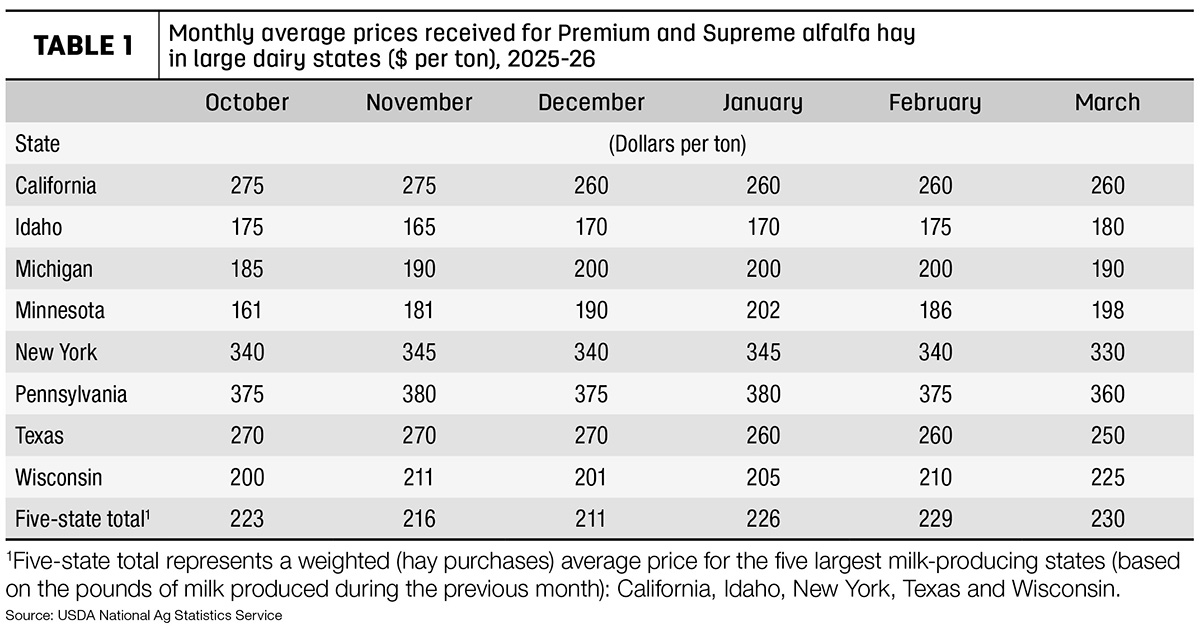
The top milk-producing states reported an average price of $230 per ton for Premium and Supreme alfalfa hay in March 2026, a $1 increase from February 2026 (Table 1). The average price was $12 lower than March 2025.
Alfalfa
The U.S. average price for all alfalfa hay increased $7 in March to $166 per ton. Compared to a month earlier, prices were lower in five of 27 major forage states, with the largest declines in Michigan, Minnesota, New York, Pennsylvania and Wisconsin. Prices were up in 13 states including Arizona, Colorado, Idaho, Illinois, Iowa, Missouri, Montana, Nevada, New Mexico, Oklahoma, South Dakota, Texas and Wyoming.
With few exceptions, year-over-year alfalfa hay prices were down, with the U.S. average about the same compared to March 2025.
Other hay
At $138 per ton, the March 2026 U.S. average price for other hay was down $1 from February. Prices decreased in eight of 27 major hay-producing states, with the largest month-to-month decreases in Kentucky, Minnesota, Nebraska, New York, North Dakota, Ohio, Oklahoma and Pennsylvania. Increases were recorded in 12 states including Arizona, Colorado, Iowa, Kansas, Montana, Nevada, New Mexico, South Dakota, Texas, Utah, Wisconsin and Wyoming.
Expanding the timeline, the March 2026 U.S. average price for other hay was $6 less than a year earlier.
The gap between average U.S. alfalfa and other hay prices was about $28 per ton in March.
Exports
At deadline, March 2026 exports held steady, with buyers remaining selective as currency pressure, freight costs and uneven dairy margins kept broader movement in check. Volumes stayed close to late‑winter levels, reinforcing a cautious tone as key markets waited for clearer early‑summer supply signals. With no major shifts in demand, trade flows remained steady but restrained, defined by targeted purchasing and persistent cost sensitivity.
At 151,272 metric tons (MT), March alfalfa hay exports increased. China remained the top buyer at 67,685 MT, accounting for about 45% of total shipments. Sales to Japan increased at 33,257 MT, shipments to South Korea increased to 25,721, but shipments to Saudi Arabia decreased to 12,032 MT – representing just over 21%, 17% and 8% of the month’s total, respectively.
Exports of other hay increased to 84,633 MT in March. As usual, Japan and South Korea led buyers in the other hay category: Japan purchased 41,770 MT during the month, or about 49% of the total, followed by South Korea’s 29,189 MT, 35% of the total.
U.S. exports of most categories of alfalfa cubes and meal were lower in March, totaling about 11,688 MT. Japan imported about 65% of the total.
Regional markets
Regional hay markets are holding steady as early‑season supplies firm and only top alfalfa draws selective premiums. Movement remains slow but improving as moisture, freight and fuel continue to shape delivered prices heading into June.
- Midwest: Nebraska hay markets moved higher across most classes, with alfalfa in the Platte Valley and central regions firmer and grass hay steady. Western ground and delivered hay, pellets and baled alfalfa all posted clear gains. Demand is strong, with buyers contracting hay ahead of baling as dryness, irrigation pressure and recent fires elevate early‑season needs. Pasture and range conditions remain sharply worse than last year, adding urgency to procurement, and some higher‑priced trades remain unconfirmed.
In Kansas, demand surged this past week as drought deepened across much of the state, but producers remain cautious about marketing inventory amid uncertain forage prospects. Alfalfa conditions have slipped as dryness and insect pressure slow new‑crop development. Warm, dry spring weather continues to push conditions downward. Reported prices reflect averages; some higher trades remain unconfirmed.
In Illinois, comparable hay sold mixed, with large packages trending lower and small squares showing slight mixed movement. Trade was active with moderate to good demand, as buyers continued to step in despite softer undertones in some classes.
In Iowa, all grades of hay were firm on an increase in quality offerings this week. Trade was very active with very good demand and good buyer attendance.
In Missouri, planting progress has improved, but low areas saw flooding and will require some replanting. Haying has begun in small grains, with only limited new‑crop alfalfa baled so far and the market not yet tested. High fuel costs are limiting trucking, keeping movement local. Hay prices are steady, demand light and supplies moderate.
In South Dakota, demand for grass hay remains strong, while alfalfa interest is light to moderate. Beef operations are actively seeking grass hay, but alfalfa buying has softened as large dairies continue to rely on haylage, keeping the alfalfa market under pressure.
- East: In Alabama, hay prices were steady. Trade was moderate, and supply and demand was light to moderate.
In Tennessee, hay supplies remain limited, with most of last season’s crop already used, and trucking constraints continue to restrict out‑of‑state movement. Ongoing dry conditions are expected to limit first‑cut yield and quality as harvest begins in the coming weeks.
- Southwest: In California, trade activity is strong with very good overall demand. Export and dairy interest is especially firm, while retail demand remains solid. Dairies are actively seeking high‑quality alfalfa, adding noticeable strength to that segment. Retail and large‑package prices are trending higher, and frost damage in northern California is reducing yields, adding additional pressure to the market.
In Oklahoma, movement is moderate and typical for the season, with 2026 new‑crop hay beginning to sell as growers work to establish pricing. Significant volumes of 2025 hay remain unsold, and producers continue to navigate weather, pests and persistent drought.
In Texas, hay prices and demand remain steady.
- Northwest: In Montana, hay sold mostly steady to slightly higher as supplies continue to tighten and many producers are already sold out. Some are holding back hay for personal use as drought conditions linger. Lower‑quality hay remains in strong demand as ranchers look for feed until turnout. Ranchers report needing more hay than last year as herds expand, while short irrigation seasons and ongoing drought raise concerns about summer production.
In Utah, most producers are sold out of 2025 hay, and very few recent sales were reported, though limited trades showed firmer undertones. Demand for feeder hay remains strong as ranchers look for feed until grass or new‑crop supplies arrive. Dry conditions and severe drought continue to stress both producers and buyers, raising concerns about how much hay can be produced this season. Water availability is a major issue, with Utah relying heavily on snowpack and seeing little this winter.
In Idaho, demand for all types of hay is moderate. Movement is slow, and people are saying that they are having a hard time finding hay for their needs. Most people are sold out, and the hay that is moving down the highways is hay sold from previous contracts.
In the Washington-Oregon region, export hay is steady and retail hay is firm, with new‑crop harvest beginning in the South Basin and most producers starting first cutting next week. Retail supplies at feed stores are thin and demand is strong, though trade remains slow to moderate as many producers are sold out and waiting on shipping or payment.
In Wyoming, most contacts are sold out of 2025 hay and expect new‑crop harvest to begin if conditions allow. Irrigation water remains the main concern, with some districts expecting normal supplies while others face restrictions on volume and timing.
In Colorado, trade activity is very light, but demand remains good to very good for both old‑crop and new‑crop hay. Feedlots in northeast Colorado are contracting new‑crop alfalfa at notably higher levels than typical standing values.
Other things we’re seeing
- Dairy: Milk output holds steady as early heat trims gains, while Northern herds stay consistent. Cheese and butter continue to be firm, but Class III and IV prices remain sluggish, keeping margins tight. Export interest is steady, domestic demand uneven, and producers stay disciplined as summer sets in.
- Cattle: Cattle supplies stay tight in June, keeping prices supported as feedlot placements remain below last year. Feeder numbers are still limited, moisture uneven and herd rebuilding slow. Cow retention holds, but high costs and caution continue to mute expansion, leaving margins narrow as early‑summer heat builds.
- Fuel: National average fuel prices were significantly higher to start May, according to the U.S. Energy Information Administration (EIA). The U.S. retail price for regular-grade gasoline averaged $4.45 per gallon on May 4, up 32.9 cents from the previous week, $1.31 cents higher than the same week a year earlier. The average U.S. on-highway price of diesel was $5.64 per gallon, up 28.9 cents from the prior week and $2.14 more than early May 2025.
- Trucking: Spot flatbed prices were significantly higher to start May, averaging $3.44 per mile nationally, according to DAT Trendlines. Regionally, average spot prices per mile were: Southeast – $3.78, Midwest – $3.56, South – $3.59, Northeast – $3.28 and West – $3.01.
- Other costs: The prices paid index holds firm as livestock, machinery and fuel costs stay elevated, keeping overall expenses above year‑ago levels. Cost pressure remains persistent, with little relief across most non‑feed categories as producers continue to manage narrow margins.
- Total feed prices: Total feed costs hold mostly steady, with firm feed grains and complete feeds continuing to support the index. Hay, forages and supplements remain soft, and easing energy prices offer only limited relief. Ration management stays central as producers move into early summer with feed markets still firm.
- Interest rates: USDA Farm Service Agency (FSA) interest rates for direct farm operating loans (4.75%) and direct ownership loans (5.75%) stayed the same for May.