Depending on your geography, the 2025 forage season is underway. Regardless of where you crop, questions regarding ag and trade policies, input costs, labor, planting, production and prices are front and center. Here’s a review of what we know about hay and forage markets as you continue to look for answers.

U.S. Drought Monitor maps indicate regional moisture conditions changed some at the beginning of April, with the percentage of areas under moderate or more intense drought slightly higher than they were one year ago.
As of April 3, approximately 39% of U.S. hay-producing acreage (Figure 1) was considered under drought conditions, up 2% from a month earlier. The estimate of alfalfa hay-producing acreage (Figure 2) under drought conditions declined slightly to 48%, down 3% from a month earlier.

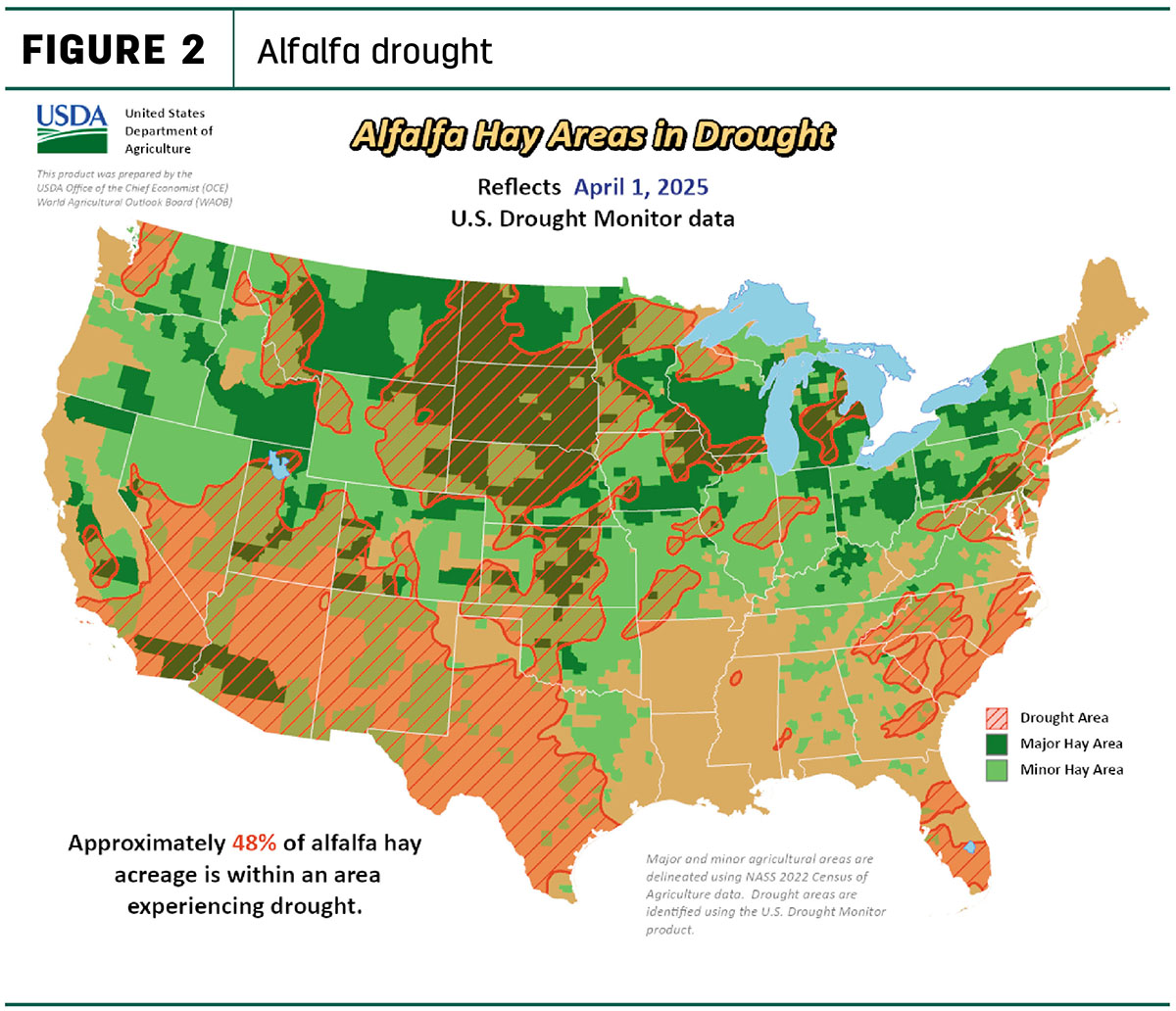
Arizona, South Dakota, Nebraska and New Mexico remain the states with highest drought ratings.
A snapshot of hay prices
USDA price data for 27 major hay-producing states is mapped in Figure 3, illustrating the most recent monthly average price and one-month change. The lag in USDA price reports and price averaging across several quality grades of hay may not always capture current markets, so check individual market reports elsewhere in Progressive Forage.

Dairy hay
The top milk-producing states reported an average price of $243 per ton for Premium and Supreme alfalfa hay in February 2025, a $1 increase from January 2025 (Table 1). The average price was $35 lower than February 2024.

Alfalfa
The U.S. average price for all alfalfa hay dipped $2 in February to $159 per ton. Compared to a month earlier, prices were lower in 20 of 27 major forage states, with the largest declines in Illinois, Iowa, Montana, Nevada, New Mexico and Utah. Prices were up in three states including Arizona, California and Washington.
With few exceptions (Kentucky, Missouri, Nevada, New York, Ohio and Pennsylvania), year-over-year alfalfa hay prices were down substantially, with the U.S. average down $42 compared to February 2024.
Other hay
At $143 per ton, the February 2025 U.S. average price for other hay was up $3 from January. Prices rose in just seven of 27 major hay-producing states, with the largest month-to-month increase in Arizona. Declines were recorded in 16 states, led by Colorado, Kansas, Kentucky, Nebraska, Nevada, New Mexico and Oregon.
Expanding the timeline, the February 2025 U.S. average price for other hay was $29 less than a year earlier, with declines of $73 or more in Colorado, New Mexico, Texas and Wisconsin. In contrast, prices rose slightly in Arizona, New York and Ohio.
The gap between average U.S. alfalfa and other hay prices was about $16 per ton in February, maintaining the narrowest monthly spread in five years.
Exports
As of deadline, tariff implementation on Canada and Mexico continues, but tariffs were imposed on 90 countries, some of which have been paused for 90 days, except for China with a total tariff rate of 145%.
At 152,065 metric tons (MT), February exports of alfalfa hay remained fairly steady since last June. China remained the top buyer, importing 73,870 MT during the month, about 49% of the total. February shipments to Japan also maintained a steady eight-month trend at 23,716 MT, 16% of the total for February.
Exports of other hay were also steady at 80,085 MT in February. As usual, Japan and South Korea led buyers in the other hay category: Japan purchased 37,742 MT during the month, followed by South Korea’s 22,918 MT.
U.S. exports of most categories of alfalfa cubes and meal were mostly lower in February, totaling about 10,648 MT. Japan imported about 57% of the total.
Regional markets
Regional hay sales and the USDA Ag Marketing Service market reports have been light in some regions, with sale schedules reduced due to rain and snow.
- Midwest: In Iowa, there was not enough of any one class for accurate market trends. Trade was light to moderate demand for light offerings.
In Kansas, demand was light and trade remained slow. Prices were mostly steady with some downward pressure as the new hay season is approaching.
In Illinois, hay sold much lower. Trade was active with soft demand.
In Missouri, the roller coaster ride of the changing seasons continues along with strong storms. Hay prices were steady to weak. The demand of hay was light as feeding season draws to an end and the supply of hay was moderate.
In Nebraska, alfalfa hay, grass hay and alfalfa pellets sold steady and ground and delivered hay was steady. Demand was light to moderate. Lots of bales of feed are still waiting to be sold.
In South Dakota, the movement of hay was light at the beginning of April.
- East: In Alabama, hay prices were steady and trade was moderate with moderate supply and moderate-to-light demand.
In Tennessee, there was a noted decline in demand for hay commodities, primarily on high-quality alfalfa being bought/sold within the state. The movement of grass hay continued to be slow.
In Pennsylvania, hay sold with a weaker undertone. Demand was light.
- Southwest: In California, trade activity and demand were moderate. Retail hay demand was good. Dairy hay demand was steady to $10 higher. Export hay demand was light. The first cutting of new alfalfa was approaching.
In Oklahoma, demand and prices for hay remain steady. There was still a lot of holdovers and barns full of hay.
In Texas, hay prices were mostly steady across all regions, with some weaker prices noted in south Texas.
- Northwest: In Montana, hay sold fully steady. Demand for large quantities of hay is dwindling as green grass is seen in the southern portion of the state. Market activity was mostly active with heavy receipts.
In Utah, producers were selling out of hay from last season, with most sales to ranchers buying multiple loads in fear of a drought. Cubes coming out of Utah are still in good demand.
In Idaho, hay movement was steady, especially for feeder hay, as more farmers were selling supplies to get ready for the next growing season.
In the Washington-Oregon Columbia Basin, all grades of hay sold steady. Trade remained slow to moderate. Demand was light to moderate.
North-central Oregon showed a slight increase. There seems to be high demand for feeder hay, with demand being greater than supply.
In Wyoming, demand picked up with more hay moving in small loads. Horse-quality hay was steady.
In Colorado, trade activity and demand were light. Prices remained unchanged on all hay types.
Other things we’re seeing
- Dairy: The 2025 March milk production forecast is raised on larger cow inventories and slightly higher milk output per cow. Estimated at 226.9 billion pounds, it was raised 700 million pounds from last month.
- Cattle: Cattle prices are raised on reported data throughout the first quarter.
- Fuel: National average fuel prices were slightly lower to start April, according to the U.S. Energy Information Administration. The U.S. retail price for regular-grade gasoline averaged $3.24 per gallon on April 7, up 8.1 cents from the previous week and 35 cents less than the same week a year earlier. The average U.S. on-highway price of diesel was $3.64 per gallon, up 5 cents from the prior week and almost 42 cents less than early April 2024.
- Trucking: Spot flatbed prices were mostly higher to start April, down in the West but higher elsewhere and averaging $2.54 per mile nationally, according to DAT Trendlines. Regionally, average spot prices per mile were: Southeast – $2.73, Midwest – $2.67, South – $2.57, Northeast – $2.51 and West – $2.20.
- Other costs: The USDA’s February index of prices paid for commodities and services, interest, taxes and farm wages were mixed. Machinery costs were unchanged from January but up 1.2% from February 2024. Compared to a month earlier, fertilizer prices were mixed, with higher prices for nitrogen, mixed fertilizer and potash and phosphates.
- Total feed prices increased 1.2% from January but decreased 2.5% from last February. Since January, higher prices for complete feeds, feed grains, hay and forages, and supplements more than offset lower prices for concentrates.
- Interest rates: Fourth-quarter 2024 interest rates reported by Federal Reserve districts were down, but USDA Farm Service Agency interest rates for farm operating loans (5.375%) and direct ownership loans (5.75%) were higher for April.