
After a strong start to the federal funds rate-cutting cycle in 2024, the Federal Reserve paused reductions for the first eight months of 2025. This pause allowed time to assess the inflationary effects of new U.S. tariffs. However, renewed concerns about a slowing labor market prompted the Fed to resume rate cuts, beginning with a 0.25% reduction in September, followed by additional 0.25% cuts at the October and December Federal Open Market Committee (FOMC) meetings. In total, these actions have lowered the Federal Funds rate by 1.75%.

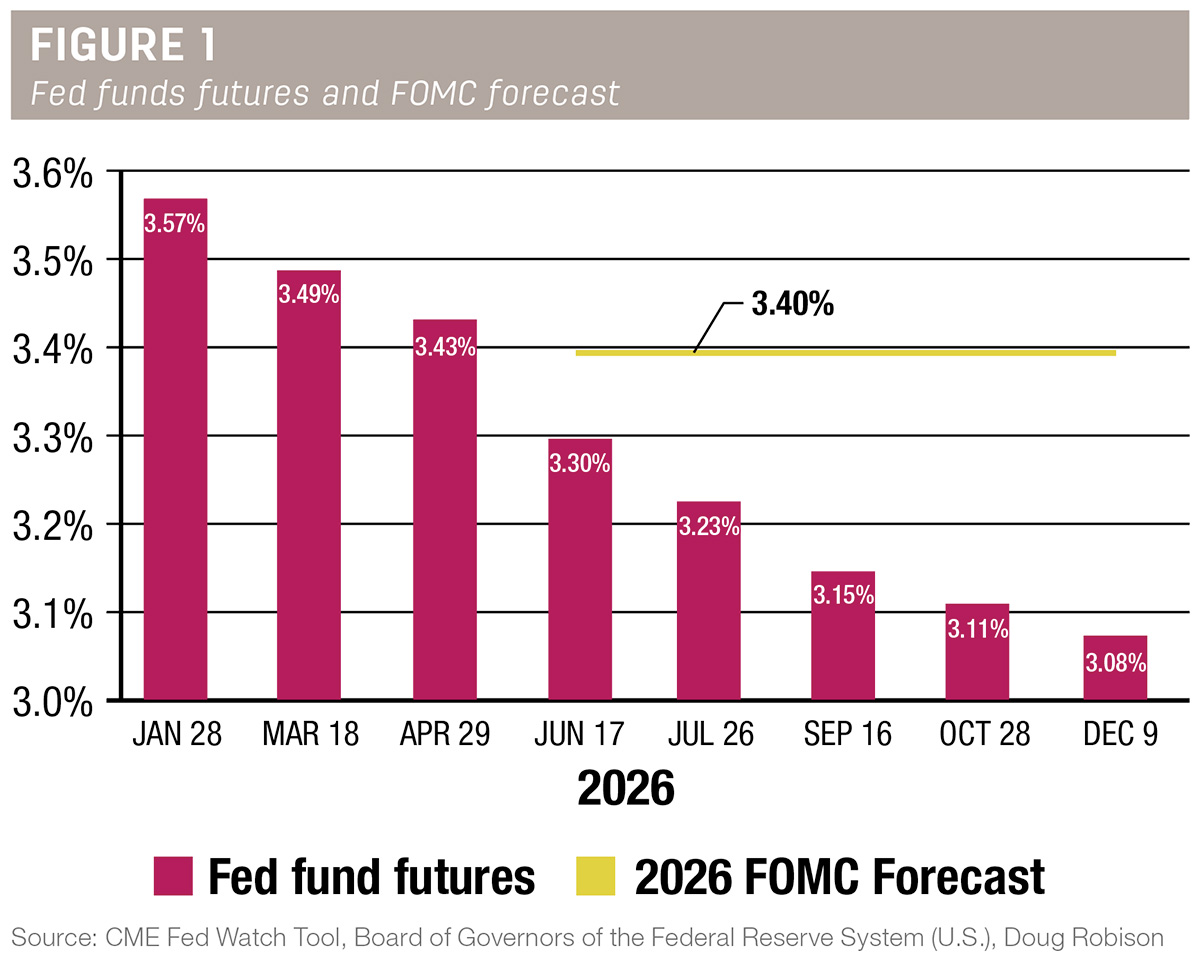
Looking ahead, current Federal Reserve forecasts project only one more 0.25% rate cut in 2026 and a final 0.25% cut in 2027. In contrast, CME fed fund futures anticipate two rate cuts in 2026, with the first likely at the March or April FOMC meeting. If market expectations are correct, 2026 could mark the end of the current rate cutting cycle, with the possibility of higher interest rates beginning in 2027 and beyond.
The Fed chair
Jerome Powell is the current chair of the FOMC, with his term expiring in May 2026. Although markets have formed expectations about the future path of U.S. interest rate policy, the next Fed chair, who will be nominated by President Donald Trump, could significantly influence future decisions regarding the federal funds rate. Trump has indicated that the nominee will be announced after the first of the year.
Since the beginning of his administration, the president has advocated for lower interest rates and is expected to select candidates for Fed chair who share this accommodative stance. However, the Federal Open Market Committee consists of 12 voting members, including the chair. Seven permanent members – the board of governors – serve 14-year terms and are appointed by the president, but none of these terms conclude until 2030 except for one, the current Chair Jerome Powell. The remaining four voting members are Reserve Bank presidents, who serve five-year terms and may be renominated.
Due to this structure, a new Fed chair will face challenges in immediately shifting the direction of interest rates. Over time, the chair can influence the selection of Reserve Bank presidents and may encourage committee members to align on key policy decisions. This gradual process underscores the challenge Trump faces in directly influencing interest rate policy at the Federal Reserve.
The fiscal deficit
One of the most significant challenges facing the next Fed chair will be maintaining financial market stability amid record-high peacetime fiscal deficits. The U.S. fiscal deficit, now exceeding 6% of gross domestic product (GDP), remains near historic highs and is growing faster than the nation’s nominal GDP.
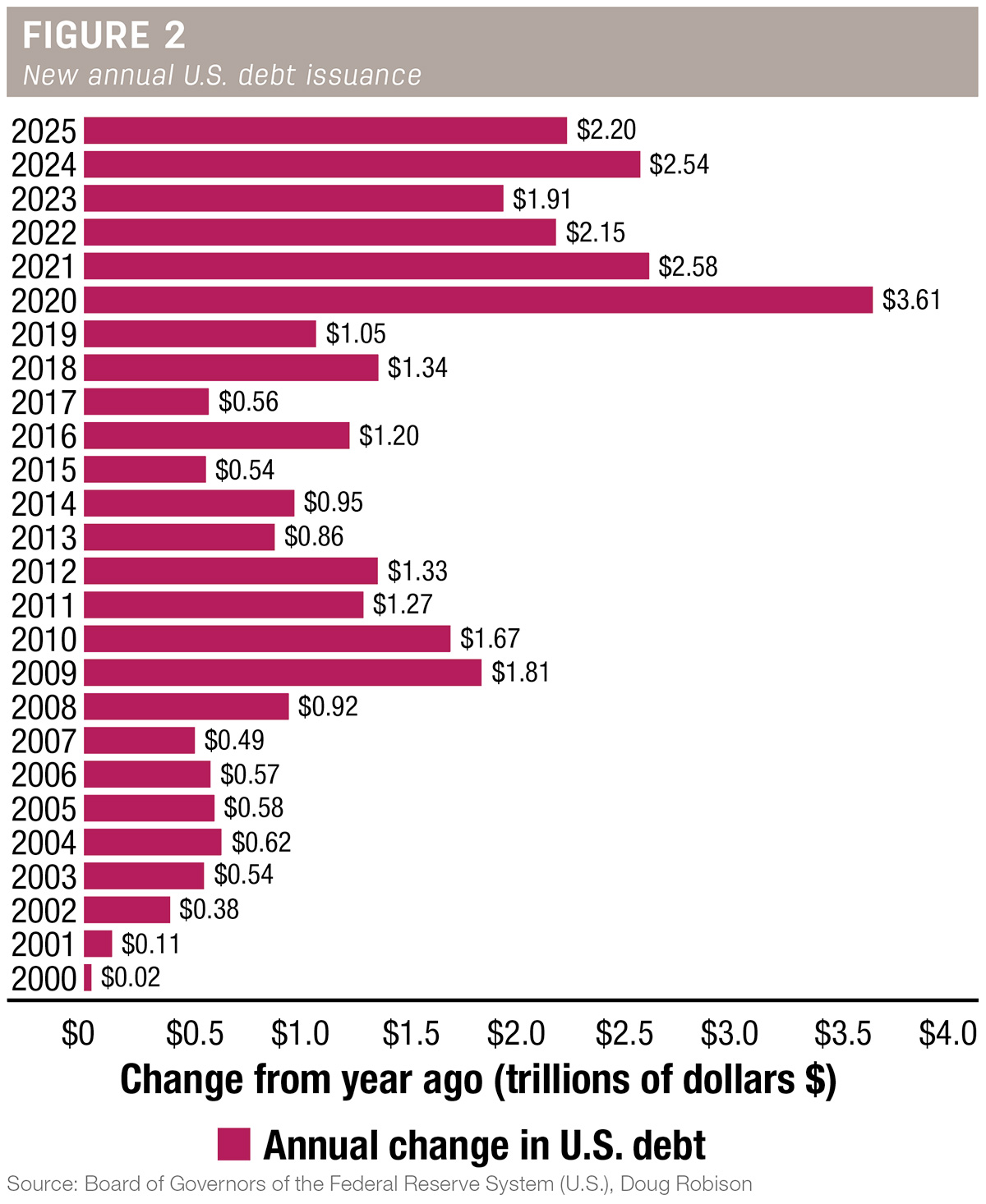
Elevated interest rates have contributed to larger deficits by increasing the government’s borrowing costs. In fact, interest payments on the federal debt are projected to become the second-largest category of federal spending in 2026 – surpassing both Medicare and Defense, and trailing only Social Security. To finance these persistent deficits, the U.S. Treasury is issuing substantial amounts of new debt, pushing the total federal debt above $38 trillion as of December 2025. This surge in debt issuance places additional pressure on financial markets, creating liquidity challenges and intensifying competition with the private sector for available funding.
Fiscal dominance
Fiscal dominance occurs when a country’s government debt becomes so large that the Central Bank is compelled to keep interest rates low, primarily to help the government manage its debt burden. Some economists argue that the U.S. is approaching fiscal dominance, with the Federal Reserve lowering interest rates before reaching its 2% inflation target in order to stabilize the fiscal deficit.
After the most recent FOMC meeting, the Federal Reserve announced a program to purchase $40 billion per month of short-term U.S. government securities. This initiative aims to support overnight funding markets and boost bank reserves, which have come under mild stress due to substantial U.S. Treasury debt issuance. The resulting strain is evident in widening spreads between key funding benchmarks, such as the secured overnight financing rate (SOFR) and the effective federal funds rate. This program will modestly expand the Federal Reserve’s balance sheet.
When the Federal Reserve expands its balance sheet, it effectively creates new money, which flows into the banking sector, lowers interest rates and encourages bank lending. However, this process can also be inflationary. As of September 2025, the consumer price index (CPI) stood at 3%, still above the Fed’s 2% target. Notably, September’s CPI is the latest available data due to the recent government shutdown.

Conclusion
- The Fed’s forecast calls for a single 0.25% rate cut in 2026 and a final 0.25% cut in 2027.
- In contrast, fed fund futures anticipate two 0.25% rate cuts in 2026, likely beginning in March or April.
- The federal funds rate is expected to fall by 0.25% to 0.5%, reaching a range of 3% to 3.25%.
- This level remains well above the rates seen in the 2010s, when the federal funds rate was typically 1% to 2% lower and inflation hovered near the 2% target.
- While rates are likely to be lower next year, they will not be low by historical standards.
Looking ahead, the future path of interest rates in 2026 will be shaped by the Federal Reserve’s dual mandate: supporting labor markets and managing inflation. Increasingly, however, a third consideration – the need to maintain financial stability in bond markets – is influencing policy decisions. This “shadow mandate” is gaining importance as the U.S. fiscal deficit and national debt continue to grow, adding new complexities to the Federal Reserve’s decision-making process.






.webp?height=auto&t=1783636475&width=285 "63802-Thomas-GPS-equipment--Automated-Magnum-Tractor--Matt-Skinner-photo(1).jpg")
