Management of cows during the 60-day period prior to calving and the 30-day period after calving are most critical to ensure a successful lactation. When a cow is off to a good start, it is more likely she will do well during the rest of her lactation versus if she is off to a poor start and requires additional care and costs. Four key areas are used to monitor and determine if your herd transition cow management program is successful. These include comparison of actual performance against predicted performance, fresh cow udder health, fresh cow turnover and death rates and dry period analysis.

There are many single measurements that you can monitor like gestation length, dry period length, calving ease, abortions, etc. However, combining all these into a single easy-to-understand measure will save time and will be easier to track over time. The new Fresh Cow Index (FCI) is a single measure that was developed by Dr. Albert DeVries at the University of Florida in collaboration with our organization.
What is FCI?
FCI is the actual energy-corrected milk (ECM) on first test-day divided by the predicted ECM times 100. It is calculated for cows with a first test-day between five and 40 days in milk. The predicted ECM is calculated using 25 different cow variables that cover genetic, production, udder health and reproduction data. Data used to calculate the index is obtained from Dairy Herd Improvement Association (DHIA) milk testing, Council on Dairy Cattle Breeding (CDCB) and Dairy Records Management Systems (DRMS) data.
Cows that score 100 or above indicate that they performed as expected or better, while cows with an index value below 100 underperformed.
A milk only version of it is available for herds that that do not collect DHIA fat and protein component data on test day.
How to use FCI?
Most producers’ initial reaction would be “Give me a list of the low-FCI cows so I can check them out and address any issues.” Although looking at an individual cow’s index value will give you an indication of which cows are off to a good start and those that are not, the real value is in combining data from cows calving in the same month and tracking monthly changes over time. This approach allows a user to measure impacts of changes they made knowingly or spot issues with unknown causes.
Figure 1 below shows the index distribution by calving month for first-lactation cows. Ranking the cows from lowest index value to highest for any given calving month, the bottom of the blue bar represents the 25th percentile value and the top of the blue bar represents the 75th percentile value. The line indicates the 50th percentile value (median). A narrow bar indicates more consistency and is more desirable and having a bar that is at or above 100 indicates more cows are performing as or better than expected.
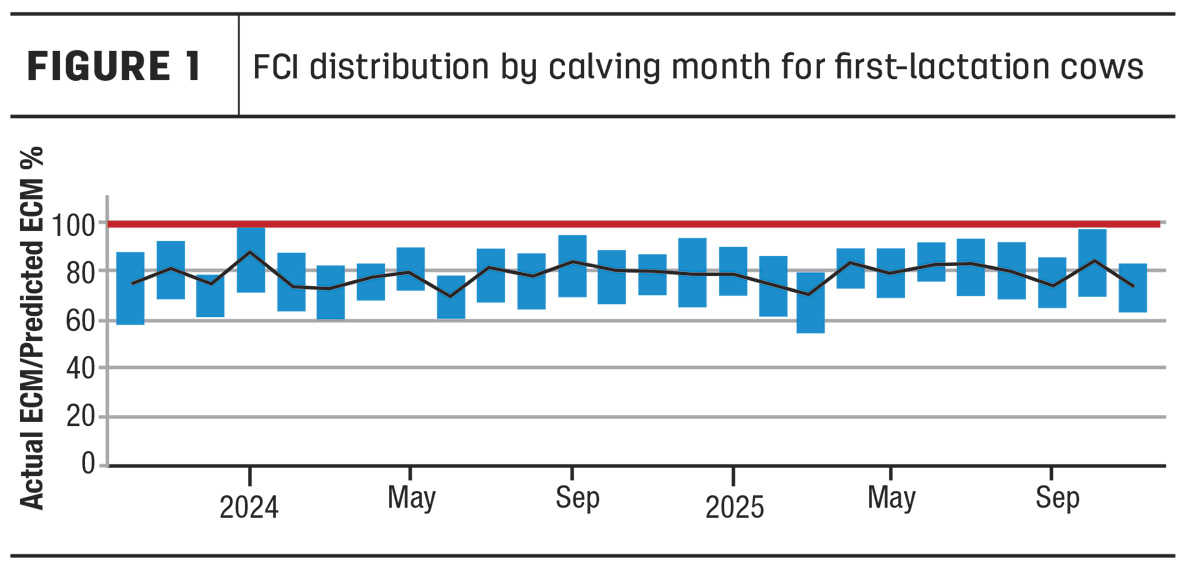
Tracking the index distribution over time and relating this back to weather, feed changes, ration changes, changes in housing, heifer raising, etc., will give you a single measure to see how these changes have impacted fresh cow performance.
When index trends are observed that are not meeting expectations, additional information such as twinning, abortions, calving ease, dry period length and fresh cow health events can be very valuable to drill down deeper into the actual causes of low performance.
What is the relationship of FCI with future performance?
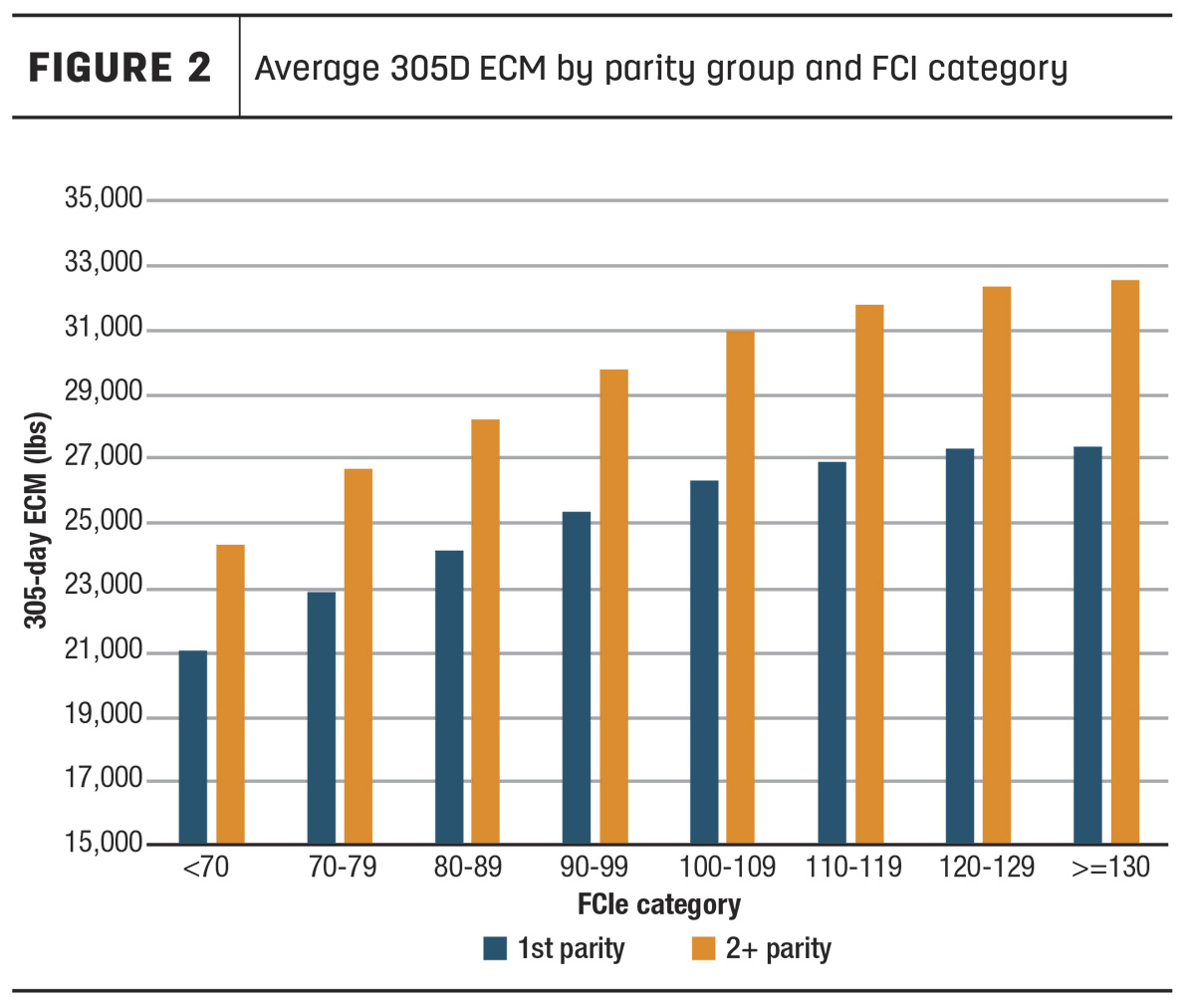
Although it is calculated based on comparing the predicted first test-day ECM with actual first test-day ECM, one might ask, how predictive is the index regarding the cow’s future performance for the remainder of the lactation. Utilizing data from about 4 million lactation records, Figure 2 shows the average 305-day ECM values for the completed lactation based on FCI groups. Categories were grouped based on increments of 10. Based on data shown, it is clear that when cows are off to a better start, they end up producing more throughout the remainder of the lactation.
Another key measure to evaluate is the percentage of cows leaving the herd based on the index. Figure 3 shows the percent of cows that were culled involuntarily starting with cows that had an index less than 70 up to cows with an index greater than or equal to 130. Categories were grouped based on increments of 10.
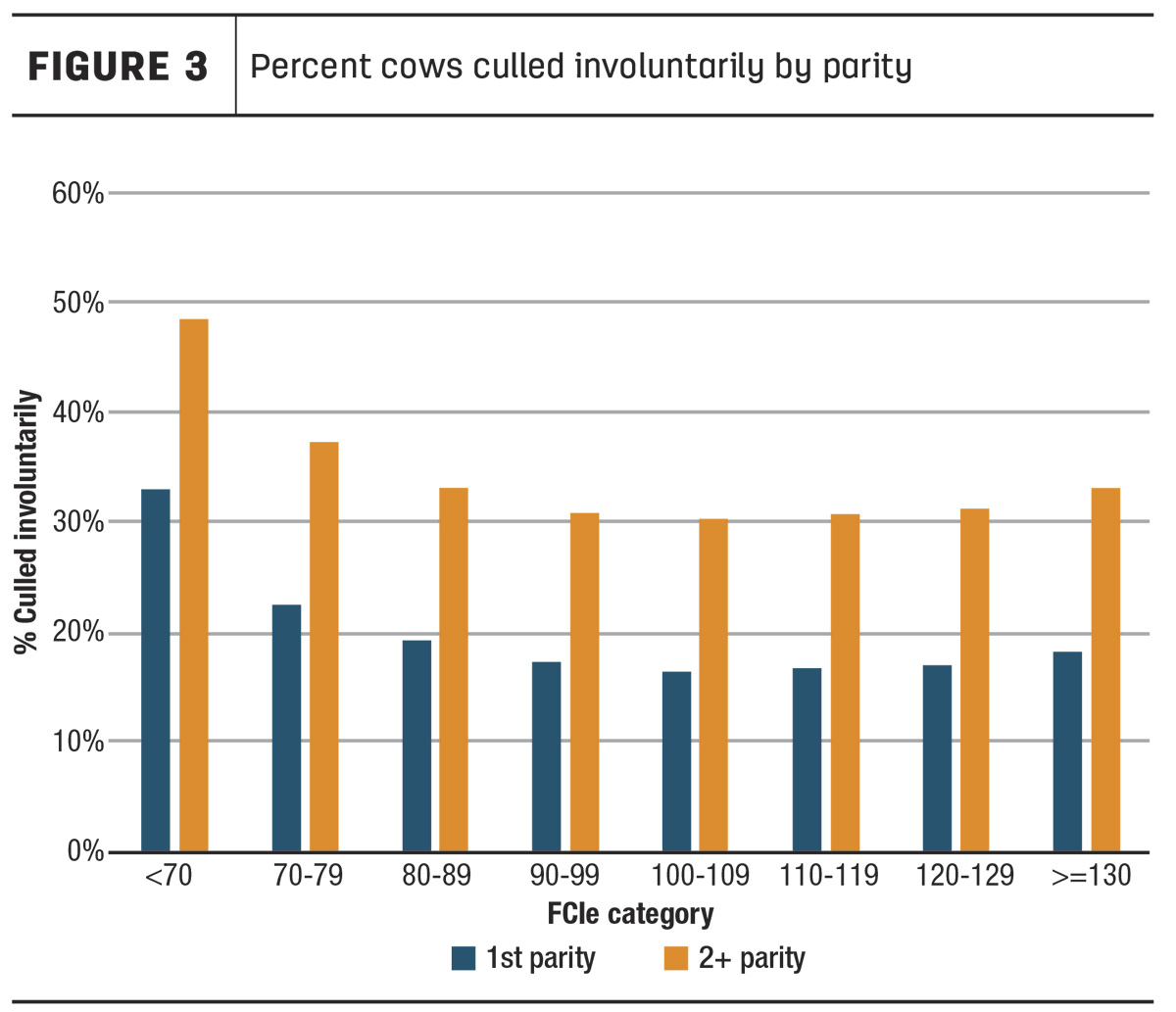
Based on the data shown, cows that scored an index value below 90 are more likely to leave within that lactation. Additional analysis shows that if cows who scored an index value below 90 and continue for a next lactation, there is a higher likelihood (50% to 54%) they will underperform (FCI less than 95) for the subsequent lactation. While cows that performed as expected or above are more likely (55% to 66%) to perform close to expected or above on their next lactation (95 or higher FCI).
The trends mentioned above are based on data from over 9,000 dairies. Using our data, a producer can evaluate the annual impact on their herd. Table 1 shows an annual summary for a herd.
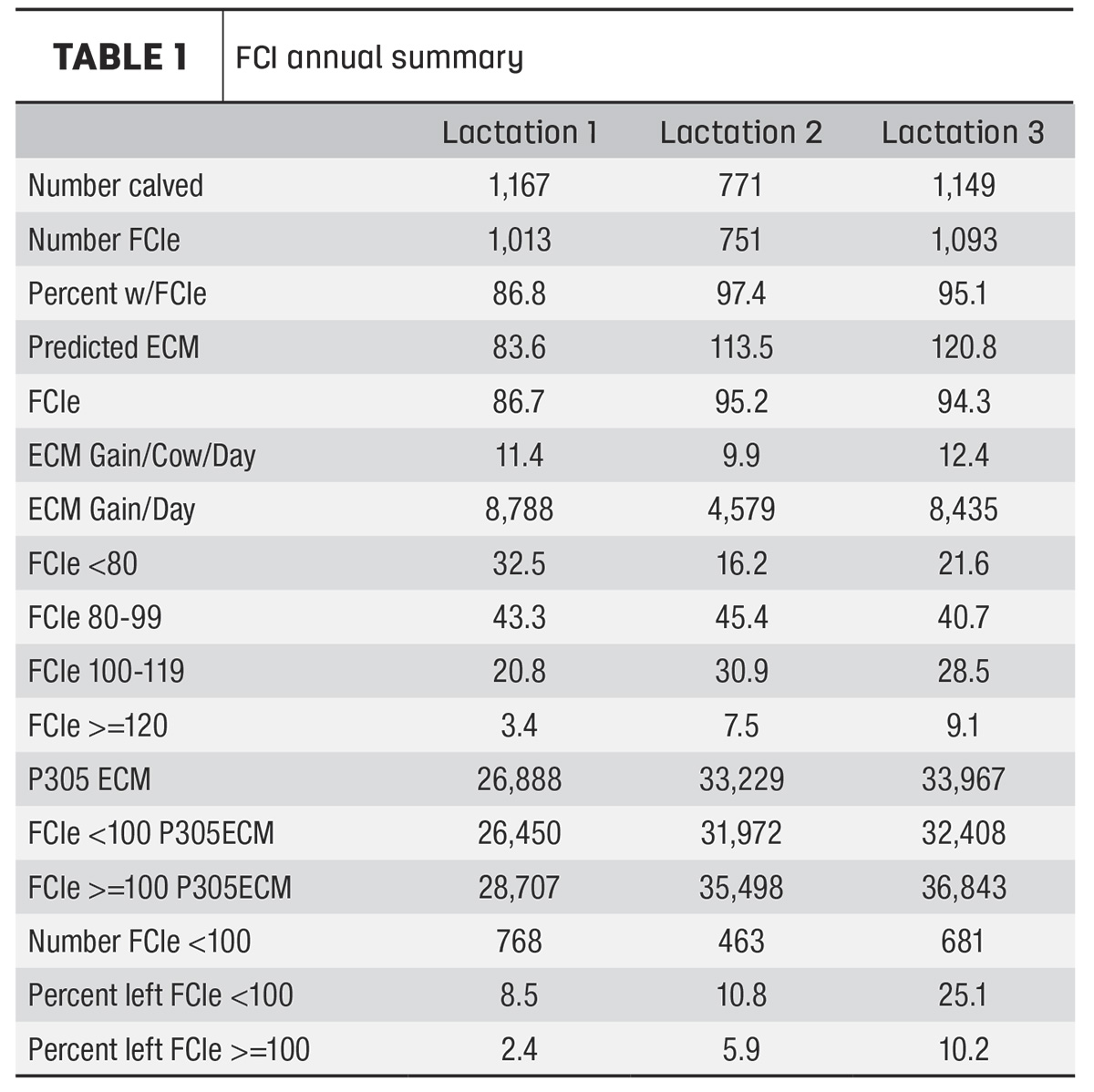
Based on the data in Table 1, this herd average index values for cows calving in the past year are below 100, indicating there are opportunities to improve. Averages do not always tell the full story, so evaluating the distribution of percent of cows performing less than 80, 80 to 99, 100 to 119 and 120 or greater is important. In this herd, 32.5% of first-lactation cows performed at less than 80% of predicted and additional 43.3% at 80% to 99% of predicted. On the opposite side, 20.8 plus 3.4% of cows performed at 100% of predicted or above. The second- and third-and-greater-lactation cows also show a higher distribution of underperforming cows, but less severe than first-lactation cows.
The economic impact in the herd shows that cows with FCI of 100 or greater have higher milk production throughout the rest of the lactation and lower culling rates.
The combined economic opportunity based on the past year milk production for cows that had an index below 100 is 8,788 pounds of milk per day for first lactation, 4,579 pounds for second lactation and 8,435 pounds for third and greater lactations. Although it is unrealistic to expect every cow to perform at 100% of predicted, lowering the number of cows with an index less than 100 could bring a significant boost in milk production.
The use of the FCI in combination with other herd data provides a powerful new tool to evaluate transition cow management in a herd. The index is highly responsive to changes in herd management, weather, nutrition, etc., and can point out problems at an early stage that could be invisible to the producer.