Construction and insurance costs are rising for Canadian dairy producers, as provinces implement the new National Building Code (NBC) 2020 Part 2 for large farm buildings. The primary changes for agricultural facilities focus on fire protection, structural integrity and occupant safety.

“It’s costing dairy producers more money, so in some cases it’s going to influence their decision to build or not,” says Paul Fallis, vice president of Canadian agriculture at Canarm.
Structural requirements – such as reducing truss spacing, adding more fire exits, increasing snow/wind/seismic load requirements – are all making construction more expensive than before.
“There are a lot of variables, but at the end of the day, building is requiring more lumber, labour, fasteners, studs, trusses, etc.,” says Ken Worsley, chief operating officer, Nova Mutual Insurance Company.
Bram Van den Heuvel, general/sales manager and vice president of business development at Stonecrest Engineering, says they anticipated building costs would increase 10% to 15% due to the new requirements, primarily due to increased structural costs.
Insurance costs are also rising.
“We are seeing increased insurance premiums based on higher building limits that are now required to rebuild to comply with the new building code,” Worsley says. “This is causing insurance to increase 10 to 25 percent on average, with values to rebuild a barn averaging 15 to 20 percent more due to new requirements. Over the last few years, dairy producers have seen rate increases based on loss ratios in the segment, and now this is having an impact, too.”
While the new code requirements only affect those producers building new facilities now and in the future, increases to insurance affect everyone regardless of when their facilities were built.
“If a barn was built in December 2024 and it burns down today, it must be rebuilt with new code requirements. There is an increase in premiums due to an increase in insured value. Farmers may not see it this way, but they are actually getting more coverage. While rates alone are not increasing 15 to 20 percent, the limits are and that rate is applied to the new higher limit,” Worsley says.
Uncertainties around trade and tariffs also have the potential to increase costs even further. Worsley recommends producers invest in risk management and evaluate their prevention efforts.
Higher deductibles can also help control costs.
“I never want to see producers go without coverage and self-insure unless they really understand what that means,” Worsley says. “Some deductibles can be raised and that helps offset some of the premium increases because now they are participating in more of the loss that would happen.”
He encourages dairy producers to talk with their broker or agent well in advance of their renewal to ensure they understand what they are buying and that they have all assets valued appropriately.
“I recommend that producers ask their insurance broker or agent about some of the systems that can help protect them from risk. Hay bale moisture monitoring to electrical monitoring to farm machinery monitoring – for example – and how those things can impact their deductible and their insurance policy,” Worsley says.
Changes to facility design, fire safety and building classification
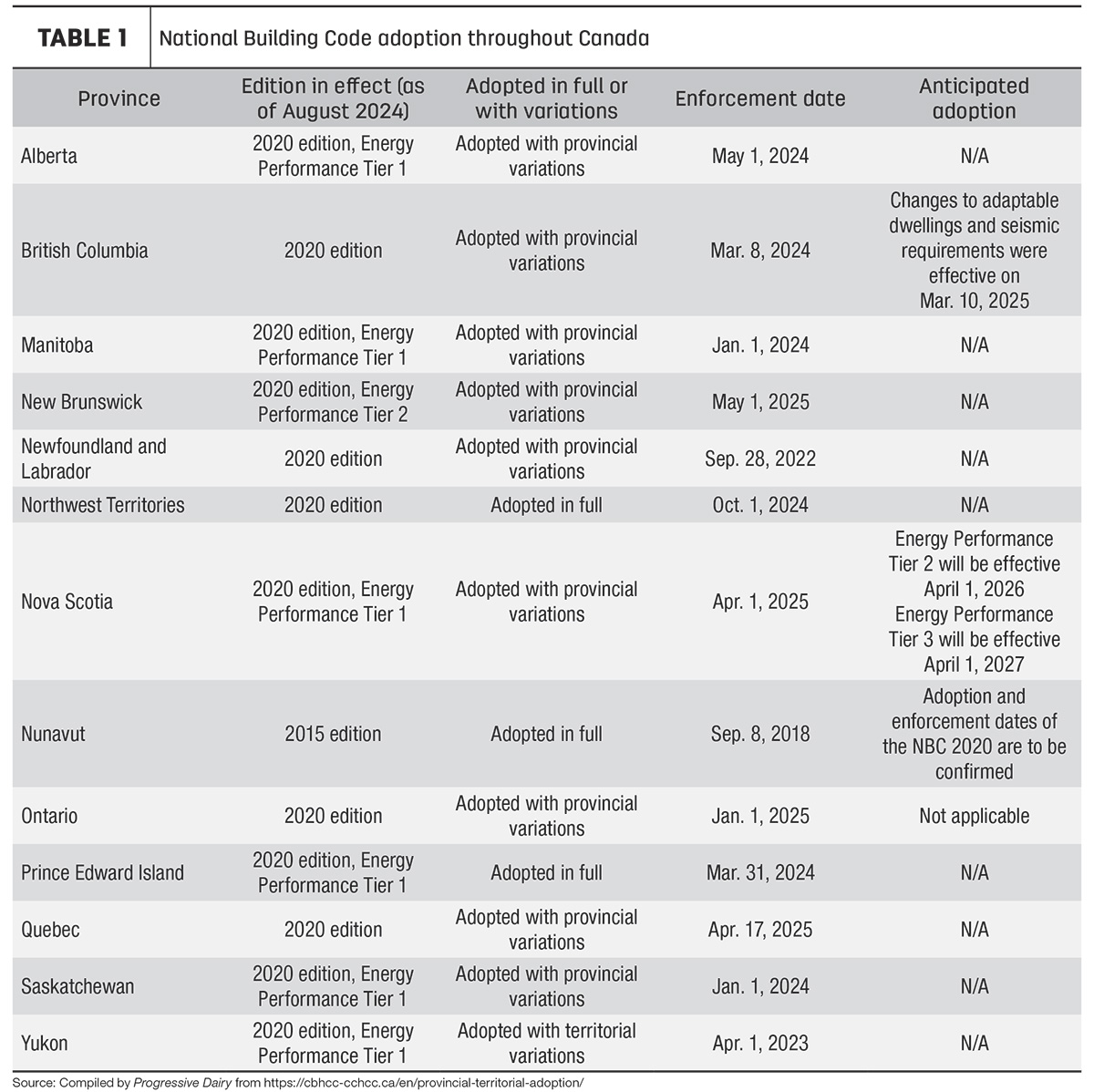
Implementation is not on a one-size-fits-all timeline for all provinces, and some are selecting to adopt the new code to varying degrees (Table 1). Some provinces have adopted the integration of the new part 2 into the National Building Code, some may operate under older NBC models and some have opted to keep the old 1995 NFBCC, although this is now largely obsolete. Ontario largely adopted the national model and also has separate pieces of legislation different from other provinces.
Structural integrity
The new code increases requirements for snow load by 15% to 20% and wind load by 30% to 40%. In addition to these loads, larger farm buildings now also need to consider seismic loading. Farm buildings, as it relates to seismic design, were previously exempt under the old 1995 National Farm Building Code of Canada. In Ontario, it has been introduced categorically in the 2024 Ontario Building Code (OBC) Part 2 and impact is derived by locations and zones.
“There are some exemptions available pending seismic categories such as SC1 which would cover areas with very low seismic activity, for example,” Van den Heuvel says. “The other exemption for seismic category SC2, which is still a lower seismic zone and has a RdRo factor greater or equal to 3, essentially having a higher seismic force resistance system for ductility. As a result, some buildings will require additional bracing to counteract these loads and inevitably affecting cost to build. Further geotechnical support may be beneficial for such projects to obtain a better site classification to alleviate seismic impact.”
New farm building classification
While the national and provincial code previously ended with Category F (industrial), there is now a new Category G for farm buildings.
Here is what is included within the new Category G:
- G1: High-hazard farm buildings, including slatted barns with below-floor liquid manure storage, feed mills, grain elevators, bulk storage of flammable liquids, reactive materials and flammable or compressed gases
- G2: Typical livestock facilities
- G3: Greenhouses
- G4: Unoccupied buildings, such as those used for manure storage, silage bunkers, etc.
“The intent of the code is to increase occupant safety so provisions for controlled atmosphere storage and silo gases has been added as well as liquid manure storage tank below barn ventilation requirements to control explosive risk,” Van den Heuvel says. “Lastly, fuel-fired appliance separation requirements are also provided. This remains an item where more clarity on design requirements is needed in terms of design submission requirements with the authorities having jurisdiction. I suspect in time that this will become further standardized and that more clarity surrounding this will become available.”
General design
Under the old code, farm buildings were required to be compartmentalized with fire separations. These requirements are more relaxed in the new code.
“The new 2024 OBC generally has been helpful to have the facility less compartmentalized over its 1995 national counterpart. In this sense, the new code changes have recognized the evolution of farm buildings in terms of the size and overall scale of some farm operations,” Van den Heuvel says.
Now, compartmentalization will focus more on intended use of areas, storage requirements and utility rooms, and fire separations implemented in areas where walls are already planned. However, fire separations would be applicable for non-farm use, such as subsidiary or other major occupancies, that are integrated into the facility design.
More fire exits along the outside barn walls means there will be shorter sections of curtains, instead of having one curtain covering a larger section. This will increase costs since there will be more doors, framing and actuators for the curtains, in addition to more labour required for installation.
“The primary cost increase for natural ventilation systems will be the additional curtain sections required on the sidewalls,” Fallis says. “A secondary cost may occur if the building requires trusses spaced at 32 inches o/c. In that case, smaller chimneys – 5 square feet instead of 9 square feet per chimney – would be required, which increases the total number of chimneys required to achieve the same ridge exhaust area for winter ventilation. No significant changes are anticipated for a power ventilation system.”
Other requirements include:
- Emergency lighting to be installed with exits clearly identified with signage
- Back-up power source required
- Fire extinguishers
- A plan for how fire trucks can access farm buildings during an emergency
- Doors that provide access to exits can no longer be overhead doors
- Two egress doors required from each room/area
- Travel distance requirement between exits is based on the building classification
- Fire alarms are required in two-storey buildings.
Why was there a change in the code?
Farm buildings have been increasing in size and complexity with no changes to the standards for design for more than 25 years. During this time, the farm building code has not kept pace with the requirements and changes in the farming industry.
“The intent is for the new code requirements to be implemented across Canada. Most provinces have adopted it, but not all at this point, with some sticking with the old code. Our hope is that everyone is using the new code requirements,” Van den Heuvel says.
New farm structures smaller than 600 square metres are exempt from new code requirements. However, there is no one-size-fits-all adoption for the entire country since provinces are making amendments to fit their needs. They also have different timelines for adoption. The previous version of the building code for large farm building went into effect in 1995, and this code is presently used predominantly for smaller farm buildings under 600 square metres.