Pasture is an important crop in the U.S. and Canada and is an essential resource for sustaining livestock. It provides crucial energy and nutrients for millions of animals and supports the production of meat, dairy and other agriculture products. Appropriate nitrogen fertilization influences consistent pasture yields, livestock nutrition, pasture stocking rates, stand life and the overall sustainability of the pasture system. Understanding how nitrogen (N) drives both forage yield and crude protein is key to managing pastures effectively.

Why pastures need nitrogen
Energy transformation
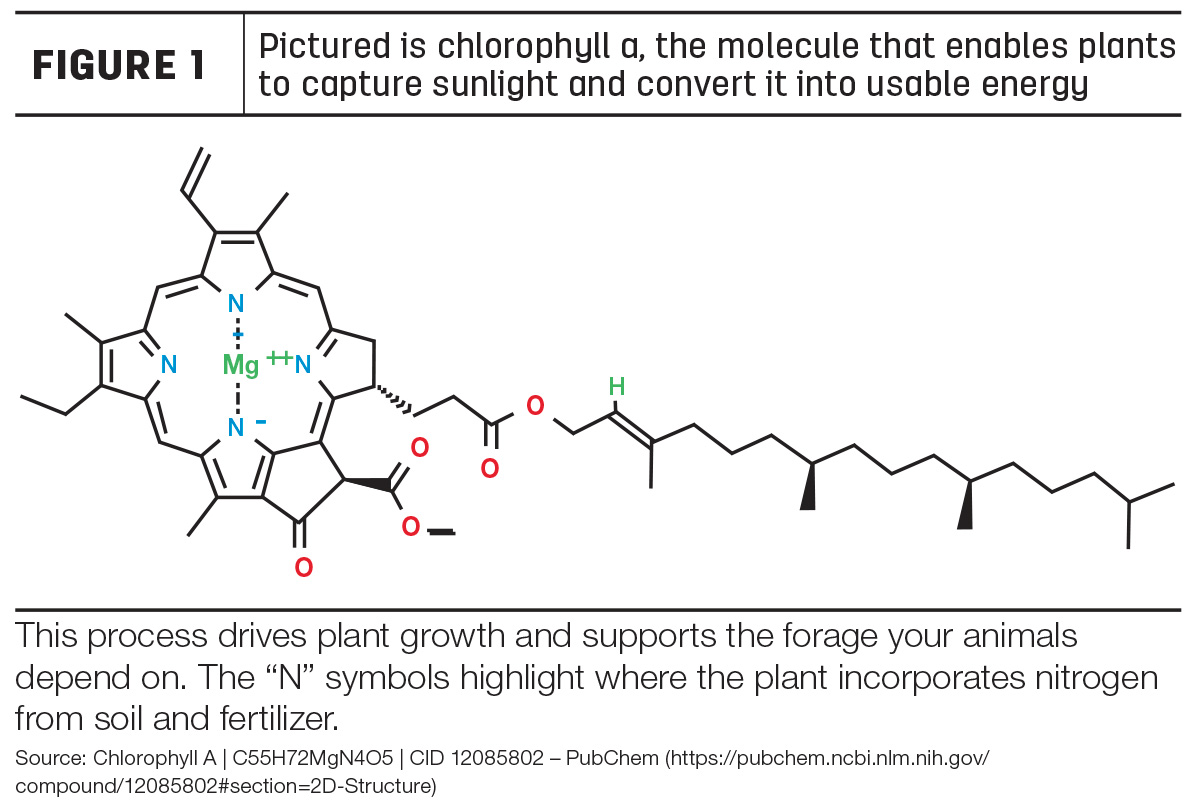
A productive pasture can be defined by rapid growth and the ability to rebound after an animal or herd feeds. A key factor that determines that grow rate of the pasture is crop available N. Nitrogen can become available to the crop by several pathways, whether delivered by natural soil cycling of organic matter, fixed by legumes, recycled from manures and decaying plant parts or applied as supplemental fertilizer. The key message is that N can be converted by the plant into a special molecule that lets the plant take sunlight energy and turn it into productive growth in the roots, shoots and other edible parts that your animals can feed on.
Upon close inspection of the chemical structure of chlorophyll, you can see exactly where the pasture crop is depositing the N (Figure 1 – look for the N). With enough N, the pasture can continue to manufacture chlorophyll and use the photosynthetic process to generate energy to promote future growth. Without enough N, chlorophyll cannot be manufactured by the pasture crop and growth will suffer. Thus, your animals may not be able to stay on the pasture for long if fresh plant growth and re-growth does not match their dietary intake needs.
Crude protein (amine group)
When we think of pasture forage quality for livestock, we think of crude protein (CP). Pasture with higher values of CP help the animal create more muscle tissue, which contributes to final carcass weight and profitability. A nutrient management system that focuses on N allows the pasture to build protein in the tissues because N is a fundamental building block of the amino acid. Amino acids link together in a manner that results in protein that does useful work in the plant. These basic same materials turn into animal protein when the plant is consumed by livestock and are transformed into the meat products we enjoy.
Assessing pasture nitrogen availability
Nitrogen plays an important role in the yield and quality of your pasture. Because N is needed to support so many critical plant growth processes, a pasture might run short of N if the soil cannot supply enough to the crop during the peak growing season. Moreover, N is also highly prone to losses from the crop – soil ecosystem and can leave the pasture with water via leaching below root zone, running off into local streams or by gassing up to the atmosphere. Due to the influential role of N on overall pasture productivity and the relative ease of N losses from the system, it is important that pasture soil be periodically tested for N content and soil organic matter to double check the N in the soil and to make the proper fertilizer recommendation. A quick call to your extension office will put you on the right track for measuring your pasture soil in more depth.
Improving pasture nitrogen availability
There are a variety of options for adding N to the soil to help fuel proper growth and quality. The three listed below discuss how to improve nitrogen availability to the crop.
Incorporate legumes into stand: Special plants (legumes) have the cellular machinery to turn atmosphere gas (N2) into a more available ammonium form (NH4+), which can be transformed into nitrate (NO3-), which is the preferred uptake type by crops. By incorporating legumes into a stand, one allows the root system and special soil bacteria to work together to slowly increase the N content of the soil system, which can help feed the entire pasture.
Add nitrogen fertilizer: If ample amounts of manure are not available to apply to fields and a mixed legume stand is not able to establish, N can be applied with commonly found fertilizers. These forms of N are readily available for crop growth and can be a crucial partner in the pasture management playbook. Refer to your local state guidelines to dial in the correct amount of N fertilizer recommended for application in your area to optimize growth and avoid nutrient losses.
Add manure: Manures can be an N source for pastures, but care must be exercised to ensure that enough N is being applied in the manure application and that the N is available for crop growth. Nitrogen release rates from manure tend to slow down during cool – wet and hot – dry conditions and could cause a deficiency in the soil.
Livestock production economics and good pasture stewardship requires managing many critical factors, including how much N is available to the growing crop. In this article, we highlighted how N influences the growth of pasture (yield and calories produced for animals) and the quality (CP). A quick look at soil test conditions may help reveal how you can make your pasture more productive through the judicious use of N fertilizer.
For more information on N and pasture topics, please visit the website.