A productive spring pasture does not guarantee strong forage performance all season long. By early to midseason, repeated grazing, nutrient removal and rising environmental stress can begin to limit pasture productivity just as forage demand remains high.

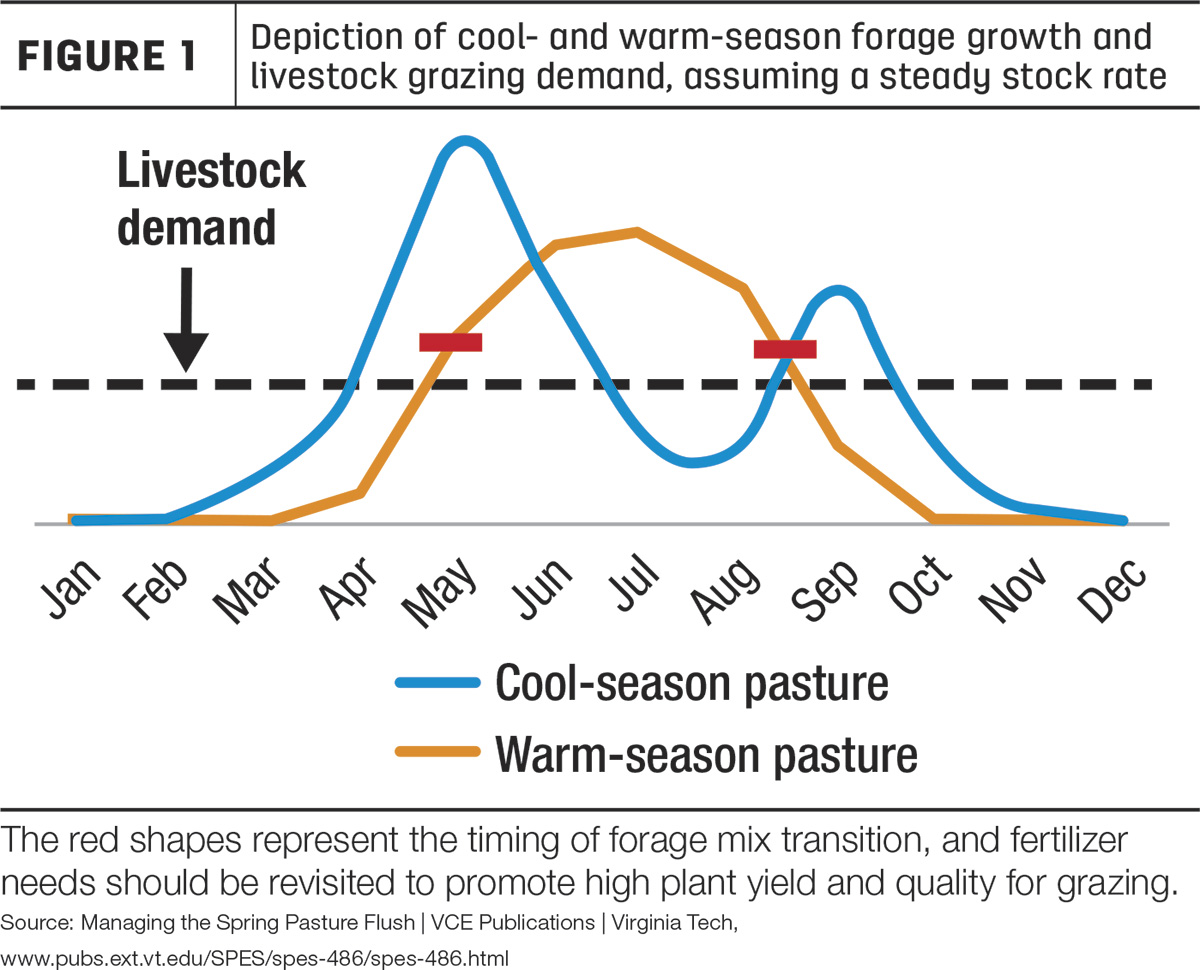
In many grazing systems, spring growth is abundant during the spring flush, a period of rapid forage growth fueled by favorable temperatures and moisture conditions. By early to midseason, however, the pasture has already experienced repeated grazing pressure and may be transitioning from cool-season to warm-season plant mixes. At the same time, higher temperatures, drought and increased plant water demand can create more challenging growing conditions and cause an uptick in nutrient demands from the soil (Figure 1).
A well-timed fertility program can help maintain pasture growth, improve the quantity and quality of grazing fodder and extend the period when pastures supply high-quality feed. Here, we review the role of nitrogen (N), phosphorus (P) and potassium (K) in a midseason pasture fertilizer program and discuss why it may be time to revisit your nutrient management plan as growing conditions shift beyond the spring flush.
Nitrogen
Nitrogen is the nutrient that most directly affects grass yield and crude protein (CP). It also improves plant vigor and stand density, which can help suppress weeds during the height of the growing season.
Similar to traditional row-crop production, N fertilizer remains available for only a limited period following spring application. As a result, a single early-season application often cannot sustain productivity throughout the summer. This is especially true in pastures transitioning from cool-season to warm-season plant communities, where two distinct growth periods can create two peaks of nitrogen demand as the new forage community becomes established.
For this reason, split N applications are commonly recommended in intensively managed grass mix systems, particularly where a warm-season flush of growth is expected. Applying N closer to periods of active growth can help maintain forage production and support season-long stand performance.
Cool- and warm-season forage needs
The value of midseason N also depends on knowing when not to apply it. For cool-season grass mixes, midseason N applications are often discouraged during hot and dry conditions because yield response may be limited. Under these conditions, canopy closure may not happen and weed growth may be stimulated instead.
For warm-season grasses or irrigated systems, midseason N can be highly valuable in driving new growth and grazing value.
Phosphorus
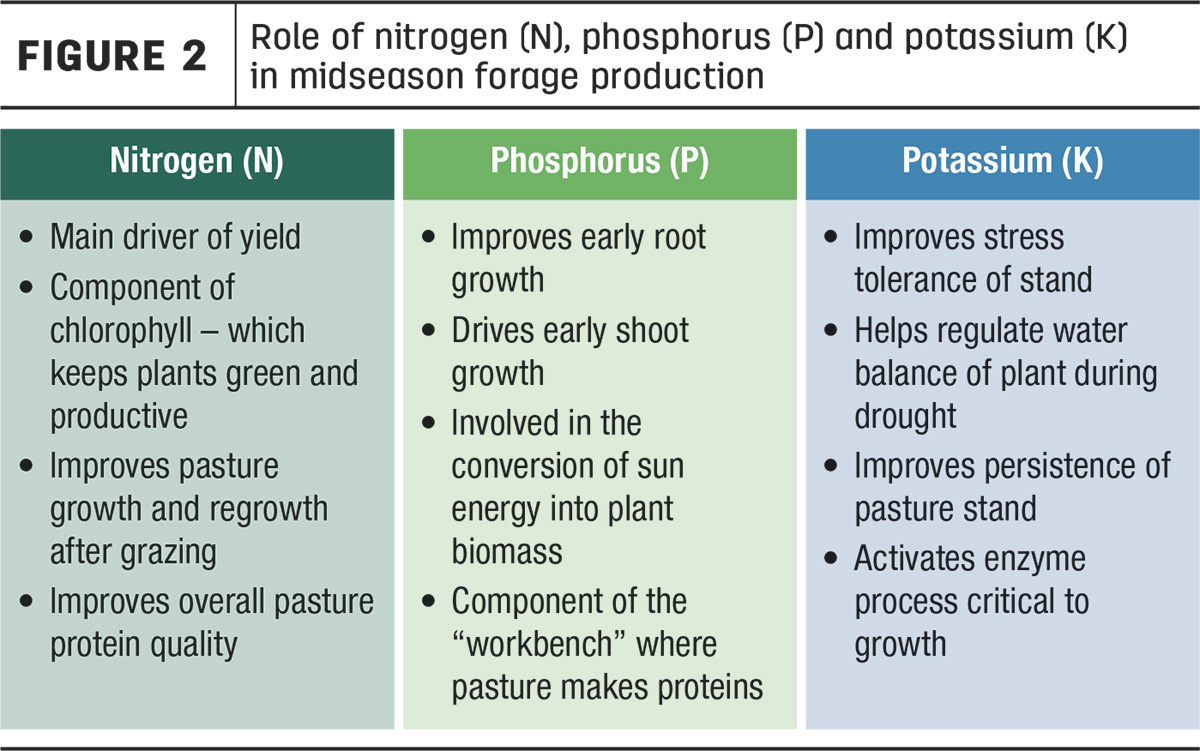
Phosphorus is equally important in a midseason fertility discussion, even though its timing is usually less urgent than N. Phosphorus supports proper root development, energy transfer in the plant, increased cell division and overall plant recovery following grazing or cutting.
This is especially important during midseason, when pastures under repeated grazing pressure rely on strong root systems and efficient regrowth to recover between grazing events. When P is deficient, plant growth may be stunted and pasture recovery can slow considerably.
Potassium
Potassium is often the overlooked nutrient in pasture systems, despite being required in large quantities by forage crops, often on par with N. Its importance during midseason is frequently underestimated, even though K plays a critical role in water regulation, stress tolerance, root activity, disease resistance and stand persistence. Potassium is especially important in:
- Systems with high warm-season forage production
- Soils that are inherently low in exchangeable K (parts per million)
- Pastures where hay is occasionally removed, which can remove large quantities of K
If pasture paddocks are “double-used” for both grazing and hay, a midseason fertility review becomes even more important because potassium depletion can occur faster than many producers realize.
The importance of K is also tied to pasture resilience in stressful periods, including high temperatures and limited moisture. Adequate K helps plants tolerate drought and recover from defoliation, both of which are critical during midseason when temperatures rise and grazing pressure can intensify.
In alfalfa and legume-containing systems, K is strongly associated with root nodule formation (biological N fixation), plant persistence and stand survival. When legumes become deficient in K, their ability to fix nitrogen can be reduced, limiting the amount of free N they can contribute to the pasture system.
Even in grass pastures, inadequate K can reduce vigor and make forage less responsive to rainfall or applied N. Because midseason is often when environmental stress begins to build, K status can influence whether a pasture merely survives or continues to perform.
Putting midseason fertility into practice
The importance of midseason pasture NPK fertilization lies in sustaining forage production after spring flush, supporting regrowth after grazing, maintaining season-long feed quality and protecting long-term stand persistence (Figure 2).
The most effective midseason strategy is not applying more fertilizer. Instead, it involves using soil test results, understanding nutrient recycling patterns, accounting for species composition and matching nutrient applications to actual pasture growth demand. This is especially important in pastures transitioning between cool-season and warm-season plant communities.
Before making midseason fertility decisions, take time to evaluate pasture growth and current soil fertility levels. A timely adjustment to your fertility program can help maintain forage production, stand persistence and extend the value of your pasture through the grazing system.
For more information on N, P, K and pasture fertility topics, visit online.
References omitted but are available upon request by sending an email to the editor.