In the news related to dairy farming as we begin February 2026:

- IDFA holds elections, presents awards at annual Dairy Forum
- USDA shifts sterile fly dispersal efforts to defend U.S. border
- NMPF: Milk supplies weigh on prices despite export gains
- CoBank: Dairy poised to help meet consumers growing demand for protein
- NMC honors Pamela Ruegg with its Award of Excellence
- Top BAA herds for 2025 recognized by Holstein Association USA
- Michigan State University honors De Grins Oer Dairy as 2026 Dairy Farm of the Year
IDFA holds elections, presents awards at annual Dairy Forum
The International Dairy Foods Association (IDFA) hosted Dairy Forum 2026, Jan. 25-28, in Palm Desert, California.
More than 1,200 executives from dairy processors, cooperatives, retailers and suppliers convened for insightful sessions, engaging keynotes, interactive panels, exclusive sponsor presentations, receptions, meals and vibrant networking opportunities.
At the forum, IDFA announced new members of the organization’s Executive Council as well as new directors for the group’s five Industry Segment Boards, representing fluid milk, ice cream, cheese, yogurt and cultured products, and dairy-derived ingredients. Together, the Executive Council and Industry Segment Boards make up IDFA’s governance structure and ensure that IDFA represents and engages all segments of the growing dairy industry in the U.S.
IDFA Executive Council officers
- Chair: Daragh Maccabee, CEO, Idaho Milk Products
- Vice chair: Joe Diglio, president and CEO, Michigan Milk Producers Association
- Secretary: Louie P. Gentine, chairman and CEO, Sargento Foods Inc.
- Treasurer: Rich D. Draper, CEO, The Ice Cream Club Inc.
- Immediate past chair: Terry Brockman, SVP operations, supply chain, dairy procurement, ingredients and industry affairs, Saputo Dairy Division USA
For complete listings of IDFA Executive Council and Segment Board members, visit here.
IDFA Laureate Award
IDFA also recognized the extraordinary leadership of David Ahlem, board adviser and former CEO and president of Hilmar, and Mike McCloskey, co-founder and CEO emeritus of Select Milk Producers, chairman and CEO of Fair Oaks Farms, and founder of fairlife, with the IDFA Laureate Award. Now in its seventh year, the award is given to leaders in the dairy industry who have made significant, prolonged contributions to the development and growth of dairy. Candidates from across the dairy industry as well as suppliers and academics are eligible, and the awardee is chosen by a panel of industry professionals.
Innovative Dairy Farmer of the Year
Apple Shamrock Dairy Farms LLC of Townville, Pennsylvania, was recognized as the 2026 Innovative Dairy Farmer of the Year. Apple Shamrock Dairy Farms is a high-tech operation with a holistic approach to managing its expansive 3,500-acre operation, which supports a 1,250-cow milking herd producing an impressive 38 million pounds of milk annually.
The dairy farm is a family operation, founded in 1976 by Robert and Lorna Waddell, along with their son Robert J. They remain true to this family legacy today, with Apple Shamrock Dairy Farm now led by third-generation farmer Josh Waddell. This family commitment and involvement in the business also extends to Josh’s brother Joe who is a farm partner, his mother, Christine, who manages the books, and his father, Robert J., who oversees the milk hauling side of the business.
USDA shifts sterile fly dispersal efforts to defend U.S. border
The USDA Animal and Plant Health Inspection Service (APHIS) is announcing a shift in its 100 million per week sterile fly dispersal efforts to stop the northern spread of New World screwworm (NWS).
The USDA will reallocate aircraft and sterile insects to reinforce coverage along the U.S.-Mexico border. The new dispersal area, or polygon, will include operations about 50 miles into Texas, along the U.S. border with the state of Tamaulipas, Mexico.
Mass production and targeted dispersal of sterile insects are critical components of an effective strategy to fight NWS. Other tools including import protocols and surveillance continue to support these robust efforts to keep NWS out of the U.S.
NMPF: Milk supplies weigh on prices despite export gains
Strong milk production remains the central driver of milk markets, with Sept.-Nov. 2025 production up 4% year over year on a liquid basis and 4.9% on a milk solids basis. The abundance is driving increased product production, which is outpacing domestic demand, according to a report from the National Milk Producers Federation (NMPF).
Summarizing dairy markets in the January 2026 Dairy Management Inc./NMPF Dairy Market Report, butter, anhydrous milkfat and cheese export growth are providing some relief, but excess supply continues to weigh on producer prices. As milk prices fall, feed costs are rising, leading NMPF to anticipate DMC payments to fall below the $9.50 per hundredweight (cwt) coverage level in December and continue at lower levels into 2026.
The consumer price index held steady at 2.7% annually in December, with grocery prices rising 2.4%. Meanwhile, retail dairy product prices moved in the opposite direction, falling slightly in December compared to a year ago. However, commercial use of most dairy products fell slightly year over year as food service foot traffic falls and retail gains fail to bridge the gap.
For more information on commercial use, dairy trade, milk production, product inventories, prices and margins, view the January 2026 Dairy Market Report.
CoBank: Dairy poised to help meet consumers growing demand for protein
Consumer demand for foods and beverages with high protein levels continues to surge as a growing percentage of Americans focus on increasing their dietary protein. The sharp rise in demand is shifting buying habits and could ultimately transform the retail grocery space.
According to a new report from CoBank’s Knowledge Exchange, this strong consumer demand for protein bodes well for the U.S. dairy industry, given the high protein levels and nutritional qualities in traditional dairy products like milk, cheese, yogurt and cottage cheese. But for dairy processors, the opportunity extends well beyond staple products in the retail dairy case. Dairy-based ingredients are increasingly being used to boost protein content in a wide variety of products including baked goods, protein bars, ready-to-drink protein shakes and whey powders.
“The dairy industry is in a great position to help consumers meet their protein intake goals,” said Corey Geiger, lead dairy economist with CoBank. “Dairy products have a unique advantage because they contain all nine essential amino acids required in a human diet, making it a complete protein source. We expect more food and beverage manufacturers will take a cue from formulators that have already incorporated dairy-based ingredients into protein-centric product areas outside of the retail dairy case.”
Consumers of virtually all ages associate protein with an expanding array of health benefits, and the momentum behind protein has been building in recent years. In 2022, 59% of American consumers reported trying to consume more protein in their diet, according to the International Food Information Council. By 2023, the percentage had grown to 67% and in 2025, seven in 10 American consumers wanted their diets to include more protein content.
NMC honors Pamela Ruegg with its Award of Excellence
NMC: The Global Milk Quality Organization presented Pamela Ruegg, David J. Ellis professor of antimicrobial resistance and large animal clinical sciences, College of Veterinary Medicine at Michigan State University (MSU), with its 2026 Award of Excellence for Contribution to Mastitis Prevention and Control. Her previous roles include associate veterinarian, Kiel Veterinary Clinic, Kiel, Wisconsin; assistant professor, health management, Atlantic Veterinary College, University of Prince Edward Island, Canada; assistant professor and program leader, veterinary extension, large animal clinical sciences, MSU; technical service manager, Monsanto Company; assistant and associate professor and extension milk quality specialist, University of Wisconsin – Madison; and professor and chairperson, department of animal science, MSU. This award recognizes an NMC member who has provided sustained contributions to mastitis prevention and control through research, extension and/or education, clinical practice or service to dairy producers.
With more than 40 years of experience working on mastitis and milk quality, Ruegg has dedicated herself to answering the toughest questions the dairy industry has faced – from the impact of tail docking on milk quality to how to reduce antimicrobial use. Throughout this time, she has remained dedicated and committed to making sure her initiatives are practical for farmers while also conducting cutting-edge applied research.
Ruegg has published 173 peer-reviewed manuscripts with almost 75,000 citations and has an h-index (measurement of productivity and impact) of 50, which is impressive. Notably, in 2017 she was invited to write an article in the 100-year review issue of the Journal of Dairy Science on “Mastitis detection, management, and prevention.” This article has received 587 citations alone.
Top BAA herds for 2025 recognized by Holstein Association USA
The top Holstein Breed Age Average (BAA%) lists recognize outstanding Holstein breeders nationwide who participate in Holstein Association USA’s classification program. Herds with 10 or more cows who participate in the Classic or Standard options of the classification program receive a whole-herd BAA.
In 2025, 878 herds had a BAA value eligible for inclusion in these lists. The average number of cows included in the BAA calculation for the entire group was 66, and the average BAA% was 108.3.
Topping the 2025 highest overall BAA list is Matthew T. Mitchell from Tennessee, with a BAA of 116.4. Also earning top five honors are:
- Jeffrey Jet Butler, Illinois, BAA of 115.9
- Juniper Farm Inc., Maine, BAA of 115.6
- Triple-T Holsteins, Ohio, BAA of 115.5 (tie)
- Milk Source LLC, Wisconsin, 115.5 (tie)
- Currie Holsteins, New York, 115.5 (tie)
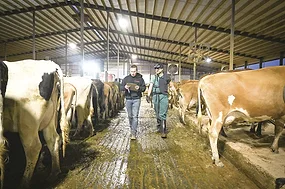
Michigan State University honors De Grins Oer Dairy as 2026 Dairy Farm of the Year
The Michigan State University (MSU) Department of Animal Science has named De Grins Oer Dairy of Blanchard, Michigan, the 2026 Dairy Farm of the Year.
Presented annually since 1958, the Dairy Farm of the Year award is the highest honor bestowed by the department, recognizing farms that demonstrate excellence in management, innovation and leadership within Michigan’s dairy industry.
“The Okkema family’s focus on milk quality and their implementation of innovative technologies have made De Grins Oer Dairy a model for the dairy industry,” said Cathy Ernst, chair of the MSU Department of Animal Science. “We appreciate their dedication to consumer and youth education programs, including hosting Breakfast on the Farm twice and also their willingness to open their farm for research and extension activities. We are excited to recognize De Grins Oer Dairy as the 2026 Dairy Farm of the Year.”
De Grins Oer Dairy – translated from Frisian as “Over the Border Dairy” – was founded in 1999 by Tjerk and Ramona Okkema, whose shared backgrounds in dairy farming molded the operation from the start. Ramona grew up on a dairy farm in New Hampshire and met Tjerk, who was raised in the dairy industry in the Netherlands, through a 4-H exchange. After living and working together in the Netherlands, the couple decided to immigrate to the U.S. and establish their own dairy farm. The family arrived in Michigan in 1999 and began building De Grins Oer Dairy from the ground up.
Today, Tjerk and Ramona, along with Evelyn Okkema-Damveld, Aaron Damveld, Cora Okkema and Dirk-Thomas Okkema, all contribute to the farm that now milks approximately 690 cows three times daily in a 40-stall rotary parlor and grows crops on 1,800 acres. The herd’s rolling average is 32,230 pounds of milk, with 4% fat and 3% protein, and an average somatic cell count of 49,000 – well below state averages.