
To be economically viable, alfalfa varieties need to have some level of genetic resistance to major diseases and pests. Without resistance, the cost of production increases substantially, as the producer must rely on chemical controls to maintain stands or protect forage yield and quality.

Disease and pest resistance expression varies among crop species.
Crop species
Depending on the crop species, disease and pest resistance can be expressed in different ways. Self-pollinated crops, such as wheat, are pure lines, making all the plants in the field genetically the same. Therefore, if the variety is resistant to a pest, all the plants in the field are resistant to that pest. This would also be the case for hybrids. That is not the case with Alfalfa.
Alfalfa pest resistance
Alfalfa is a cross-pollinated crop, and unlike wheat, it is not a pure line. Alfalfa varieties are a collection of individual plants, or what we call a “population.” Every plant in an alfalfa variety is genetically different from the others. Therefore, resistance may vary from plant to plant. Since alfalfa varieties are populations, we describe their resistance levels based on the population's average performance for traits such as disease and pest resistance. The level of resistance of an alfalfa variety is based on how many plants of that population are resistant. For example, one alfalfa variety might have 20% of its plants being resistant to an insect, and another variety might have 40% resistance.
In practice, percent resistance levels are generally grouped into five classes: susceptible (S) at 0%-5%, low resistance (LR) at 6%-14%, moderate resistance (MR) at 15%-30%, resistance (R) at 31%-50% and high resistance (HR) when greater than 50%. The differences between each resistant class are generally considered large enough to show a difference in economic performance.
How alfalfa pest resistance is calculated
Alfalfa resistance levels for any trait rarely approach 100%, even in HR varieties. This always raises questions with growers as to how an HR alfalfa variety with approximately 50% of its plants being resistant can be effective at controlling pests. First, if a variety has 50% resistance, it doesn’t mean the remaining 50% are all completely susceptible or dead. Since each plant is genetically different, there is generally a gradation in the severity of the plant damage in the population. When an alfalfa variety is evaluated for resistance, 100 plants are visually scored for the severity of the damage and separated into five groups ranging from resistant to susceptible. Groups one and two are comprised of plants that show little or no damage and are classified as resistant. Plants in groups three and four have damage but remain productive despite having some disease symptoms. Group five plants are severely damaged or dead. If the number of resistant plants in groups one and two totals 55, then that variety has 55% resistance to that pest and is classified as having high resistance.
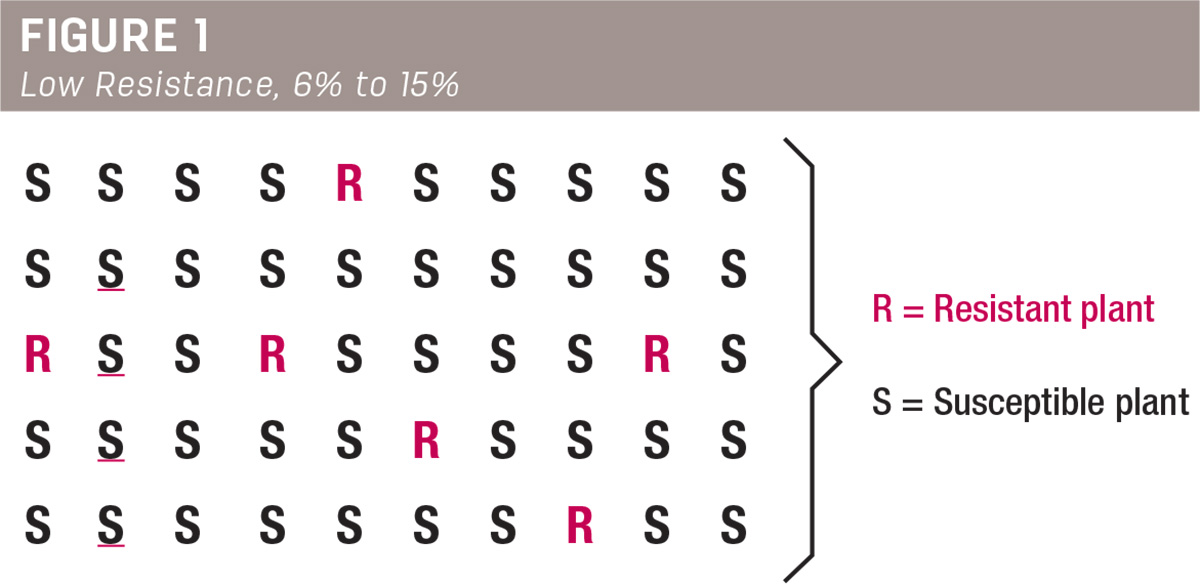
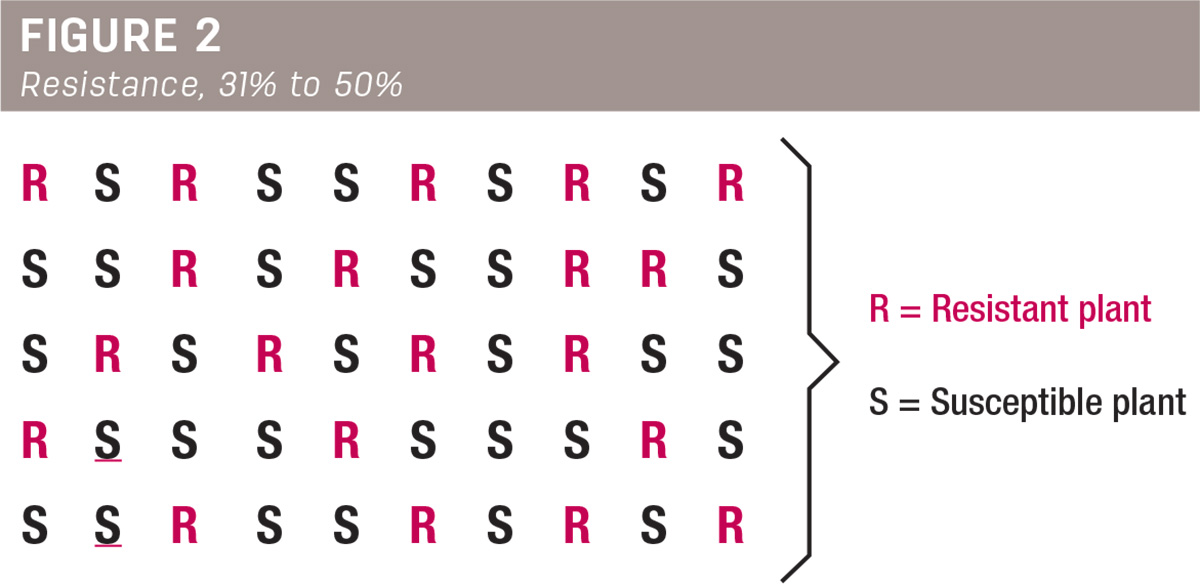
If an alfalfa variety has some resistance to a pest, regardless of the resistance category, those resistant plants are randomly dispersed within the alfalfa field. This scattering of resistant plants tends to interfere with the feeding and reproduction of insects and hinders the spread of disease inoculum. As the number of resistant plants increases from low to high resistance, the positive effect of these random plants increases. This effect, combined with the actual plant resistance, tends to provide improved performance despite not having 100% resistance to a pest (Figure 1 and Figure 2).
Picking an alfalfa variety with adequate resistance
Each year, a list of commercially available varieties is published by the National Alfalfa & Forage Alliance (NAFA). This bulletin lists varieties' fall dormancy and their disease- and pest-resistance levels. This publication can be very useful in selecting a variety that has adequate levels of disease and pest resistance for a grower’s location.
Factors to consider when selecting an alfalfa variety
- What pests are economically important to your area? Check with your local extension agent or seed supplier and learn the major pests that occur in your area. Pick a variety rated R or HR for those pests.
- What level of resistance is needed? High resistance is generally not needed for every disease or pest. Select varieties with HR or R for those diseases or pests considered to be a problem in your area.
- Some pests may require higher levels of resistance. If a disease/pest has been a problem in the past, select a variety with HR. In recent years, some pests appear to be more harmful than others, and having varieties with just R is not enough. Three of those I would consider in that category are the blue alfalfa aphid, the stem nematode and aphanomyces. If they are known to occur in your area, I would suggest getting the highest level of resistance available for those pests.
Recommended levels of resistance to major diseases, insects and nematodes
It is often difficult to find a variety with HR for all harmful pests. The following is a list of resistance levels that are acceptable if HR is not available.
- Bacterial wilt: R-HR (HR for fields in cooler Northern climates)
- Fusarium wilt: R-HR (HR for fields in warmer Southern climates)
- Verticillium wilt: R-HR (HR for fields in Northern half of U.S.)
- Anthracnose (race 1): (R-HR in areas where disease occurs)
- Phytophthora: R-HR (HR for fields grown in poorly drained soils)
- Aphanomyces (race 1-3): (R-HR for fields grown in the Upper Midwest, generally not considered a problem in western U.S.)
- Pea aphid: MR-R (least harmful aphid, doesn’t inject toxin)
- Spotted alfalfa aphid: MR-R (insect prefers warm temps, injects toxin when feeding)
- Blue alfalfa aphid: R-HR (more damage in cool temps, injects toxin; has been hard to control in recent years, so HR is advisable)
- Cowpea aphid: R-HR (more damage in cool temps, injects toxin)
- Stem nematode: HR (varieties with HR strongly recommended in the areas where pest is present)
- Northern root knot nematode: MR-R (for fields in Northern climates)
- Southern root knot nematode: MR-R (for fields in Southern climates)




.webp?height=auto&t=1783636475&width=285 "63802-Thomas-GPS-equipment--Automated-Magnum-Tractor--Matt-Skinner-photo(1).jpg")
