Manure isn’t just a byproduct – it’s a balance sheet item.

On some dairies, it’s a cash-flow generator. On others, it’s a liability that costs more to move than it’s worth. The difference isn’t in the cows – it’s how you manage the nutrients, equipment and economics between the barn and the field.
Across the industry, we’re seeing tighter nutrient regulations, higher fertilizer prices and growing expectations for sustainability. For many dairies, those pressures are pushing manure from an afterthought to a top-tier line item.
Across the Midwest and East, especially in phosphorus-sensitive watersheds, producers are being told how many gallons they can apply – and often it’s not enough to meet crop nitrogen needs. The challenge becomes “How do we capture the nitrogen value while keeping phosphorus levels in check?” That’s where segregation – not just separation – matters. Each cow produces roughly 0.6 pound of nitrogen (N), 0.25 pound of phosphorus (P) and 0.5 pound of potassium (K) per day (Figure 1). Multiply that by a few thousand cows and you’re handling more than a semi-load of commercial fertilizer equivalents every week.
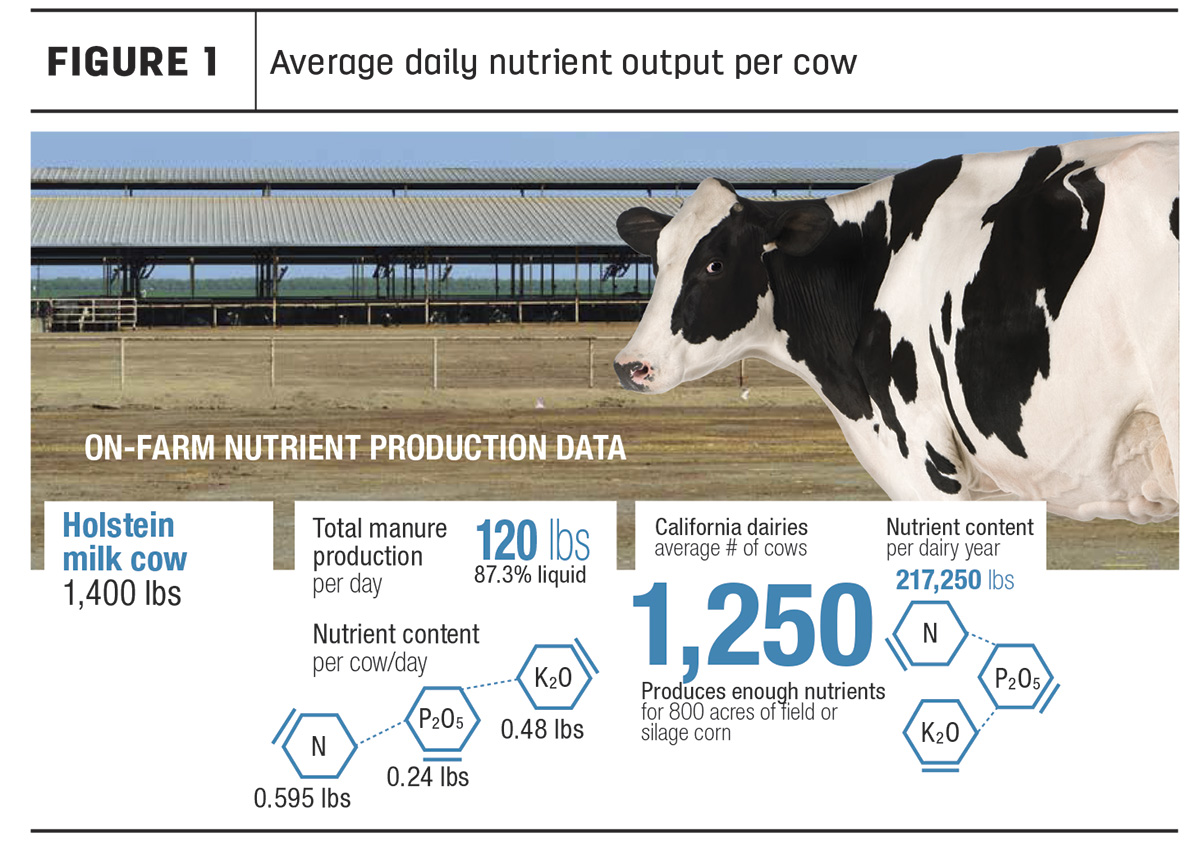
Those nutrients represent both opportunity and risk. When handled efficiently, they replace purchased fertilizers, generate renewable energy and build soil health. When ignored, they increase hauling, lagoon maintenance and regulatory exposure.
Phosphorus drives most of the regulatory pressure, and it behaves differently than nitrogen. Some phosphorus in manure is attached to fine solids between 5 and 30 microns in size. Removing or managing that fraction lowers phosphorus concentration in the liquid, allowing more gallons to be applied under nutrient limits.
Understanding particle size is key (Figure 2): Phosphorus is largely insoluble, while nitrogen and potassium are soluble. That’s why phosphorus runoff risk is tied to soil erosion and surface application – those particles move with sediment, not water. Whether a farm uses mechanical separation, chemical aids or no separation at all, the principle is the same: The more you can isolate the insoluble fraction, the easier it is to balance your nutrient plan and reduce long-term handling costs. Ammonium, potassium and sodium are very soluble, making them impossible to remove with mechanical separation.
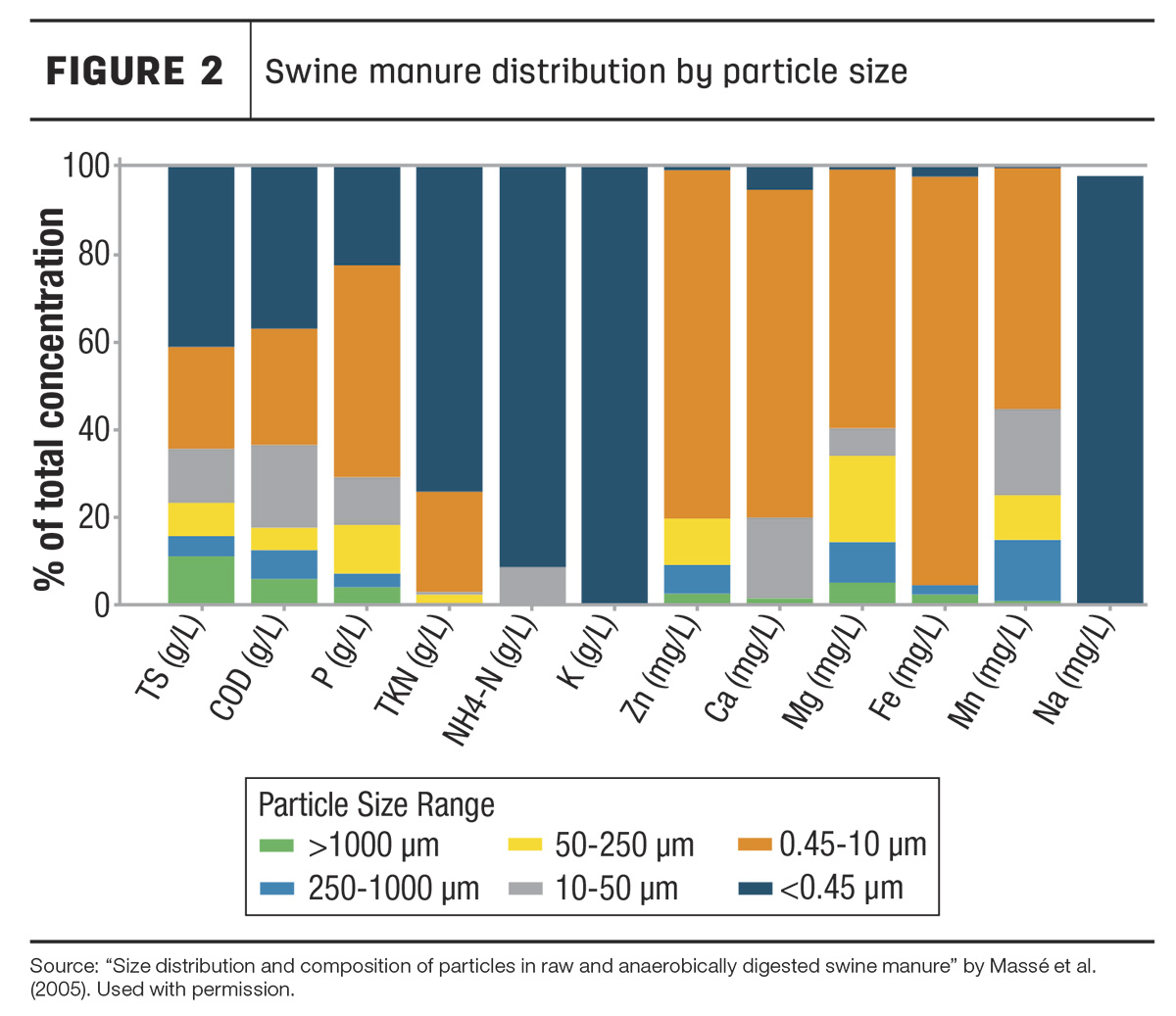
Most of the phosphorus challenge in manure isn’t chemical, it’s physical. It’s riding on fine particles that can be managed if you understand where they are.
Common separation equipment such as slope screens and screw presses removes particles down to around 500 microns (500 microns equal 0.5 millimeter.) New equipment is available as a second stage separation that will remove particles down to 25 microns. We are seeing strong phosphorus removal levels simply by adding this additional step of separation.
A well-designed lagoon should act like storage, not a settling basin. When too many solids reach storage, capacity shrinks, odor increases and agitation and dredging costs rise. Removing heavier and floating solids before the lagoon prevents crusting, reduces odor and improves biological stability. Without a crust, oxygen transfer at the surface increases, lowering hydrogen sulfide and methane emissions.
Solids management also impacts digesters. They operate best within a certain solids range – too thin and gas yield drops, too thick and flow becomes difficult. We’ve seen digesters lose several feet of capacity within two years from sand or grit accumulation. That’s not a design flaw – it’s a feedstock-preparation issue. Good pretreatment extends digester life, improves gas consistency and reduces downtime.
Application is where manure handling meets the field – and where costs can swing dramatically (Figures 3 and 4). At the low end, irrigation systems (pivots, drip or flood) can apply nutrients for tenths of a cent per gallon. Dragline systems land in the middle, while tanker hauling remains the most flexible but expensive option. The right fit depends on geography, land base and nutrient balance. In phosphorus-limited areas, thinner liquids may allow more acres to be covered without additional land purchases. In drier regions, manure irrigation can also stabilize yields by supplying both nutrients and moisture.
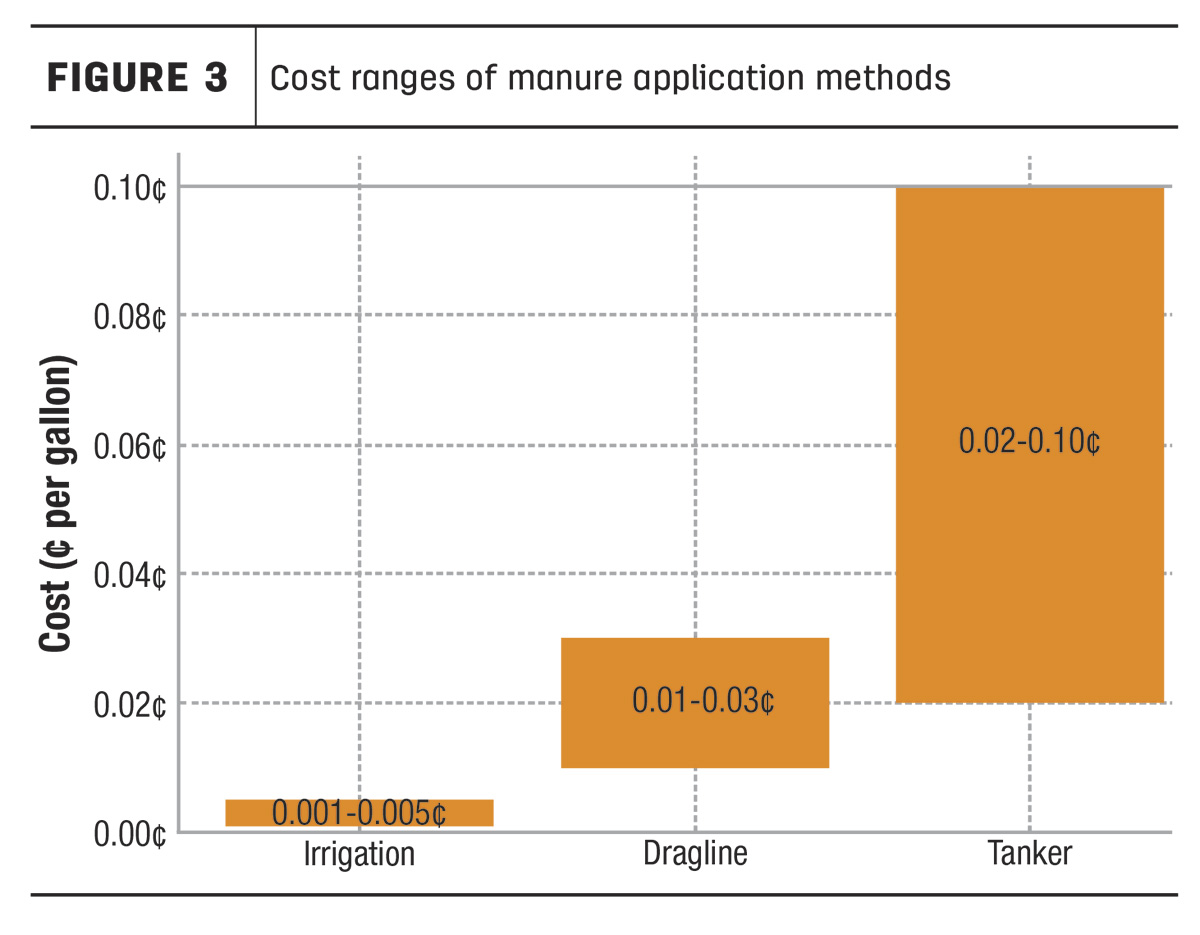
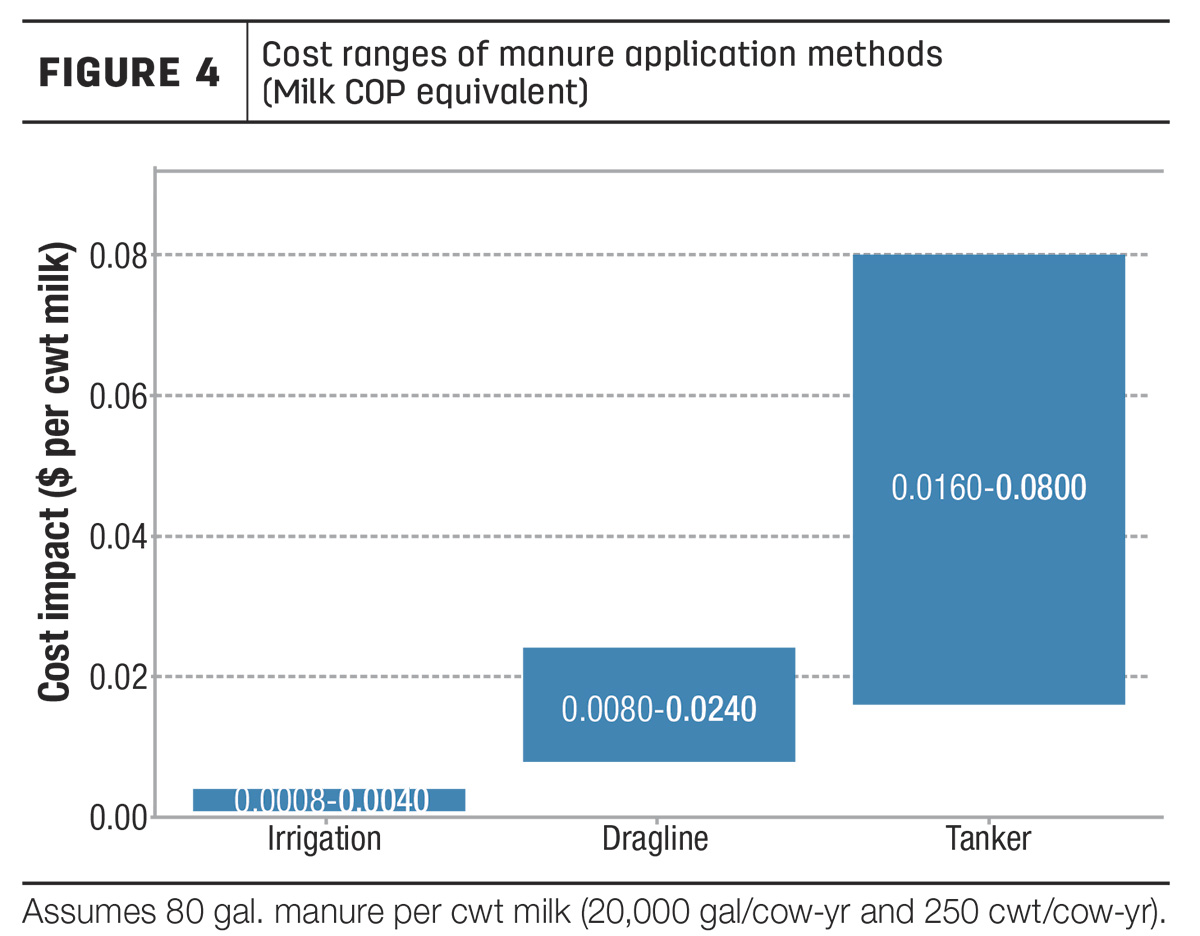
Typical pricing for manure application services (irrigation, dragline, tanker) range in cents per gallon.
When we treat manure as a fertilizer, not a waste stream, everything changes – the economics, the equipment choices, even how neighboring farmers view the dairy. Beyond the N-P-K analysis, there’s also biological value: humic and fulvic acids, organic carbon and microbial activity that commercial fertilizer doesn’t supply. Those attributes build soil tilth and long-term productivity – benefits that don’t show up on a one-year balance sheet but matter over time.
When we treat manure like a fertilizer product instead of a waste stream, everything changes – cost, efficiency and perception.
Lagoon dredging, extra land purchases or lost storage capacity all carry price tags. Some dairies have spent multiple millions on land just to have more acres to spread manure on because phosphorus levels forced expansion. Every year solids stay in the system, the problem compounds. The best time to start addressing it is before your lagoon tells you it’s too full.
Closing thoughts
There’s no one right way to handle manure, but every dairy can make improvements. Whether it’s small steps like cleaner flush water and better nutrient tracking, or larger investments in separation and storage, the key is to treat manure as part of the nutrient economy and not a disposal problem. We produce valuable fertilizer every day; our systems should reflect that value.