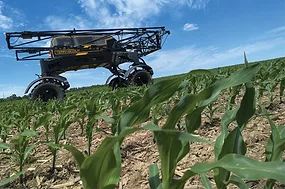
What would you think if I told you that the era of near‑unlimited flexibility in pesticide applications is coming to a close? The days of jumping into the sprayer as soon as fields are dry or calling the crop duster the moment conditions turn favorable for pests or pathogens are quickly fading. Change is coming – but why?

Driven by requirements under the Endangered Species Act (ESA), the EPA has begun implementing pesticide‑group‑specific mitigation measures designed to protect endangered and certain threatened species. In 2024, the EPA released nationwide herbicide mitigation strategies, followed in 2025 by similar strategies for insecticides. (Fungicide‑specific mitigation is still forthcoming.) While these strategies currently apply to only a limited number of products, new pesticide registrations, EPA re‑evaluations and label updates will increasingly require manufacturers to add this mitigation language. As a result, growers and applicators should expect tightening restrictions and reduced operational flexibility.
Under the Federal Insecticide, Fungicide, and Rodenticide Act (FIFRA), all pesticides must be registered and used strictly according to label directions, which carry the force of federal law. Off‑label applications – such as incorrect dosage, use on unlisted crops or pests, or failure to follow environmental safeguards – can result in civil or criminal penalties, particularly if they lead to an unauthorized “take” (harm) of a listed species.
Historically, pesticide labels have included protection measures focused on human health, worker safety and pollinator stewardship. What they rarely included, however, were detailed instructions for preventing this “unauthorized take” of endangered species. The new mitigation strategies change this significantly. They introduce a national framework aimed at reducing the potential exposure of listed species and their critical habitats through pesticide drift or runoff.
New or updated labels will increasingly feature sections such as “Endangered Species Protection Requirements” or “Mandatory Runoff Mitigations,” outlining steps applicators must take before or during application. Using two currently labeled products as examples, we can take a high‑level tour of how these strategies work.

Image provided by Oliver Neher.
Goltix 700 SC (metamitron; ADAMA) – approved under a 2026 Section 18 Emergency Exemption for selected counties in Idaho and Oregon – is one example of a label incorporating broad, non‑location‑specific mitigations. Its spray‑drift language reflects a shift toward firmer, more prescriptive wording. Phrases such as “avoid applying” have become “DO NOT apply,” and general recommendations like “apply large droplets” have become enforceable instructions to “use medium or coarser droplets.” Runoff mitigation has undergone a similar transformation. Instead of softer language such as “do not apply under conditions favoring runoff or erosion," applicators must now accumulate a required number of mitigation points from the EPA’s online mitigation menu. Options range from inherent field characteristics (e.g., certain county locations) to structural practices such as vegetative filter strips. All measures must be implemented during application.
The Pilot 4E label illustrates an even more restrictive category: products requiring site‑ and time‑specific mitigation. Applicators must consult the EPA’s Bulletin Live! Two system, select the planned month of application, and identify both the product and field location. The system then generates a bulletin outlining mandatory measures. The bulletin cannot be produced more than six months prior to application, and applicators are encouraged to save a copy – even when no measures are listed – as proof of compliance. These requirements are in addition to label‑mandated restrictions.
As these examples show, the era of less restricted pesticide application is ending – and we have not yet seen the full extent of the coming shift. Only a small number of products currently include ESA‑based mitigation language, but the list is growing. With each new addition, so too will the administrative burden on growers and applicators. Before each pesticide use, applicators will need to consult Bulletin Live! Two to confirm that requirements have not changed and that no new listed species or protected areas have been added.
The regulatory landscape is changing rapidly. We have limited understanding on how the EPA or local state agencies will assess or enforce compliance, nor are there enough training opportunities at the moment. However, associations like CropLife America, universities, your cooperatives and local pesticide retailers are stepping up to provide training and information around the mitigation strategies. Understanding this shift now – and adapting early – will be key to staying compliant and maintaining operational efficiency in the seasons ahead.

.webp?t=1687979285&width=640)



.webp?height=auto&t=1783636475&width=285 "63802-Thomas-GPS-equipment--Automated-Magnum-Tractor--Matt-Skinner-photo(1).jpg")