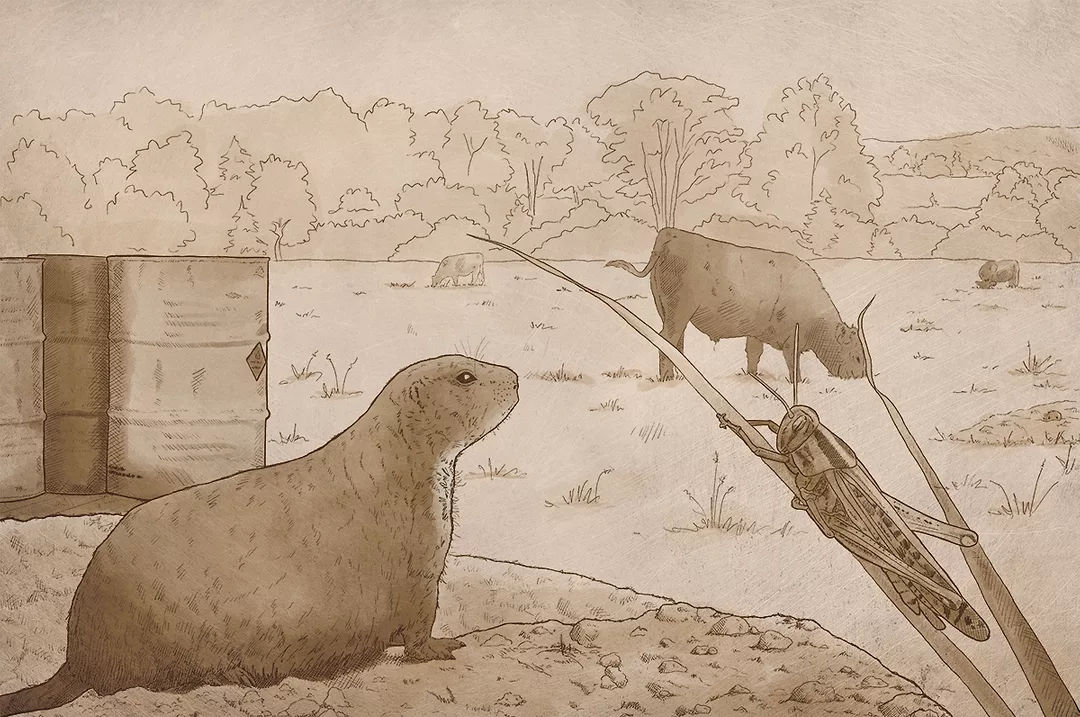
Think pesticide regulations only affect farmers? Think again. Recent changes to the federal pesticide registration process could limit how – and where – ranchers can use pesticides to manage rangeland resources. Whether you use zinc phosphide to manage prairie dog populations or malathion to control grasshopper outbreaks, these new rules may directly affect your ability to manage these pests. The issue primarily stems from a legal battle between two major federal laws: the Federal Insecticide, Fungicide and Rodenticide Act (FIFRA) and the Endangered Species Act (ESA).

Two laws, one big conflict
FIFRA, enacted in 1947, authorizes the Environmental Protection Agency (EPA) to regulate all stages of a pesticide’s life cycle, from its sale and distribution to its application. A pesticide is approved only if it is determined not to cause unreasonable harm to human health or the environment. After extensive scientific testing, the EPA reviews the active ingredients and approves the pesticide label, which outlines the required usage instructions. The label is legally binding, and each pesticide is subject to reevaluation every 15 years.
But in 1973, Congress passed the ESA, requiring all federal agencies – including the EPA – to ensure their actions do not harm endangered or threatened species or their habitats. Under Section 7, if an agency action “may adversely affect” a listed species, the agency must consult with the U.S. Fish and Wildlife Service or the National Marine Fisheries Service to determine the impact.
Here’s the problem: FIFRA seeks to balance risks and benefits, while ESA demands action if there is any potential harm. These two legal standards are inherently at odds.
EPA gets sued
The EPA faced a wave of lawsuits from environmental groups claiming the agency failed to consult under the ESA when approving pesticides through FIFRA. In one major case, Center for Biological Diversity v. EPA, No. 3:11-cv-00293 (N.D. Cal.), the agency was accused of approving nearly 400 pesticides without properly evaluating their potential impact on hundreds of endangered species.
Many cases have resulted in a settlement, and the EPA agreed to develop new procedures for ESA compliance. This led to the rollout of ESA workplans, which outline how the EPA will factor species protection into future pesticide approvals.
What’s in the workplans?
These workplans introduce a “mitigation menu” approach to pesticide registration, encouraging the EPA to add specific conditions to pesticide labels based on the potential risks to protected species. These might include:
- Buffer zones to protect sensitive habitats
- Limits on spraying during certain weather conditions
- Runoff and erosion controls
So far, the EPA has published workplans for herbicides, insecticides and rodenticides. These measures may be incorporated into pesticide labels, making them legally binding.
What this means for ranchers
These new restrictions could impact rangeland management. Products that ranchers have long relied on might soon come with new limits tied to the presence of endangered species nearby. Consider these examples:
- Zinc phosphide, used to control prairie dogs and gophers, could be restricted where species like the black-footed ferret are present.
- Malathion, used to control grasshoppers, could be limited to protect species like the prairie chicken or desert pupfish.
- Permethrin, used for Mormon crickets, might be restricted where listed frogs or salamanders are present.
Even if you’ve followed the label for years, the label is changing – and so is what’s legal.
Stay informed
While this legal clash is mostly playing out in courtrooms and agency offices, the consequences are very real on the ground. Ranchers should keep a close eye on pesticide label changes and how the EPA rolls out future workplans.
Another example to watch out for – and a great illustration of the issue at hand – is the proposed listing of the monarch butterfly as a threatened species. Milkweed, which serves as critical habitat for the monarch, is poisonous to cattle and may need to be controlled with an active ingredient like picloram. If the monarch is listed, the EPA may still find picloram is safe under FIFRA when it is time to reregister a particular pesticide product. But if the EPA determines that the use of picloram may adversely affect the butterfly, it must consult with the U.S. Fish and Wildlife Service. That consultation could lead to restrictions on picloram use – even if it is a rancher’s best tool for protecting cattle from poisonous weeds. This highlights the core conflict between FIFRA’s risk-balancing standard and ESA’s strict precautionary approach.
Ranchers do not have the luxury of ignoring these regulatory shifts – your tools and strategies for managing pests on your rangelands may depend on how the workplans shake out.