Have you ever wondered if more fertilizer could have given you higher corn yields? Most dairy farmers would reply with a solid yes, as it is a given that corn needs nitrogen (N) to grow and yield can vary quite a bit from field to field and year to year.
However, how do you follow the rules and regulations of a Concentrated Animal Feeding Operation (CAFO) permit while managing the risk of making sure you have enough without applying too much and wasting money? And, how can we become more confident with making management changes?
The Adaptive Nitrogen Management process, now in place in New York, addresses such challenging situations. The process allows N application with manure or fertilizer to exceed the foundational land-grant university (Cornell) guidelines on a field-by-field basis, if combined with yield data collection and the implementation of an end-of-season evaluation. Appropriate adjustments need to be made in the following year(s) if it turns out that the higher rates did not result in higher yields. In other words, the freedom to experiment with the responsibility to evaluate if the higher rate was warranted.
HOW DID WE GET THERE?
In 2008, representatives from the Environmental Defense Fund (EDF), the United States Department of Agriculture Natural Resources Conservation Service (USDA-NRCS), the Iowa Soybean Association, and university scientists under leadership of Dr. Tom Morris, University of Connecticut, met in Washington DC to talk about adaptive management. Conversation then and in the following years resulted in the release of NRCS Agronomy Technical Notes #6 (2011) and #7 (2013), which described adaptive management as a process that “allows for continued adjustments of the NRCS-assisted Conservation Practice Standard (CPS) Code 590, Nutrient Management, to achieve better nutrient use efficiency.” With this statement, these documents allowed and encouraged states to develop their own adaptive management programs, a major game changer.
NEW YORK’S RESPONSE
The N.Y. partnership of the Nutrient Management Spear Program (NMSP) and PRO-DAIRY at Cornell University as N.Y.’s land-grant university, NRCS, Department of Agriculture and Markets (NYSAGM), and Department of Environmental Conservation (NYSDEC), with input from farmers and Certified Crop Advisers, developed and implemented an “Adaptive Management for Nitrogen Management of Field Crops” approach, first released for use in 2013.
The initial approach required farmers who opt to apply N at rates that exceed the foundational Cornell guidelines for a specific field, to measure and document yield and either conduct replicated N rate studies to check on rates or take cornstalk nitrate test (CSNT) samples and manage CSNT levels to be below 3,000 ppm over time. Over the past 12 years, the list of end-of-season evaluation tools has been expanded and the most recent “Adaptive nitrogen management for field crops in New York” now includes five options: 1) replicated N rate studies, 2) CSNT sampling, 3) implementation of N-rich strips, 4) implementation of control strips, or 5) field balance assessments.
NITROGEN RATE STUDIES
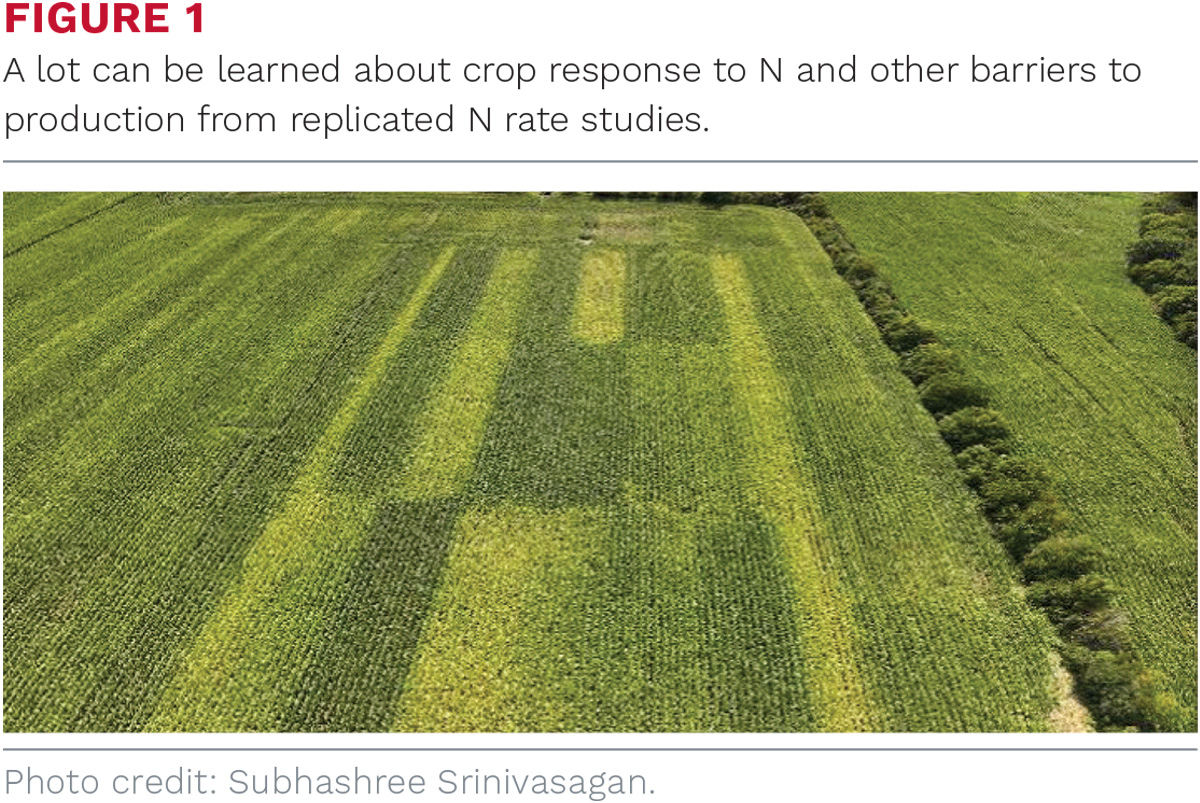
Findings of two to three years of on-farm replicated trials with five to six N rates, including a zero N control, can be used to determine if adjustments in the N rate are warranted. In this evaluation option, including elevated N rates in on-farm trials is an acceptable practice per NRCS CPS 590. Many such trials have been conducted with farmers participating in the N.Y. On‑Farm Research Partnership over the past three years (Figure 1), and while powerful in terms of learning, it is recognized that such on-farm trials take space and time and may not be feasible for everyone to conduct.
CORNSTALK NITRATE TEST
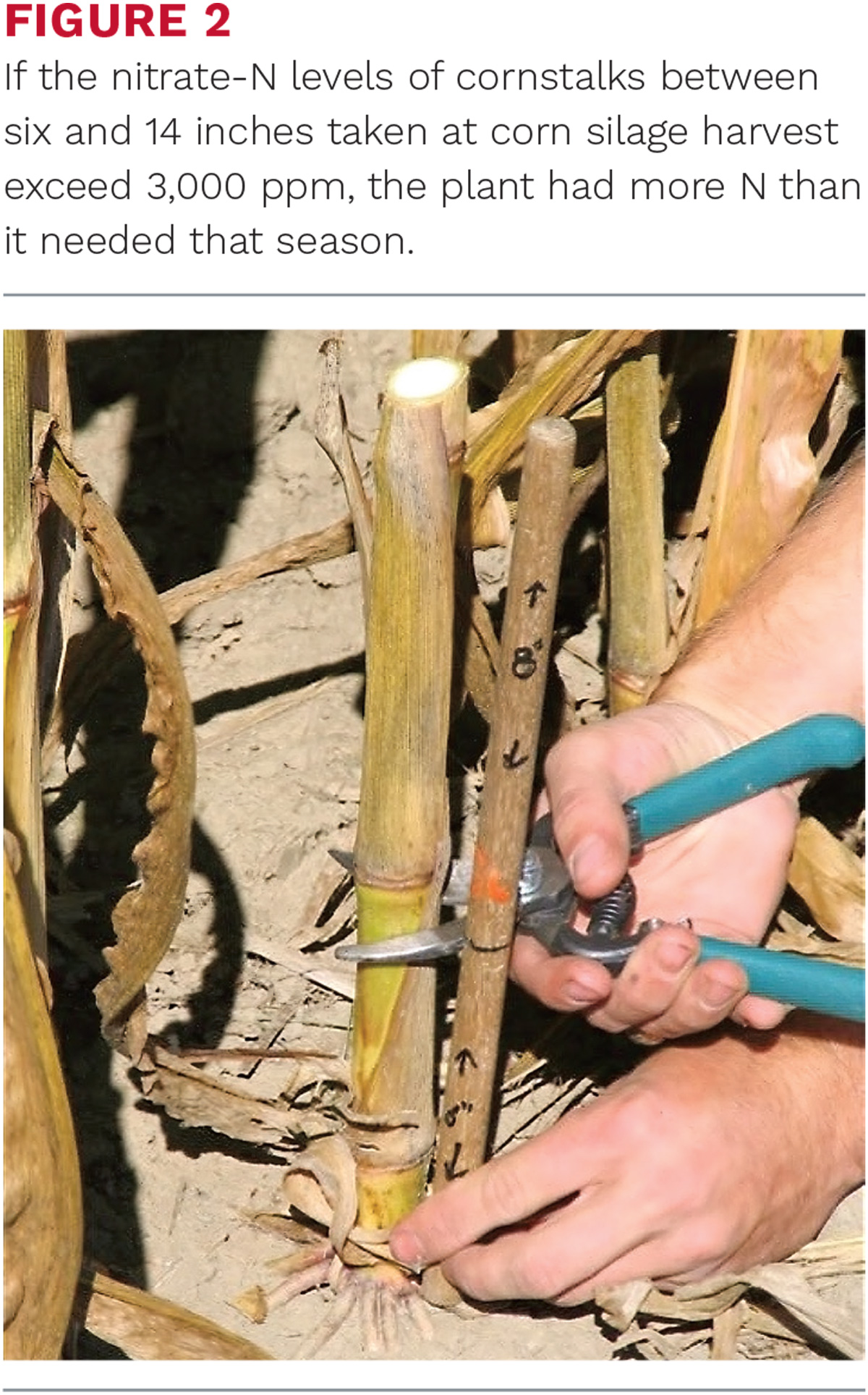
A CSNT sample taken for the purpose of evaluating a higher N rate, should consist of 10 to 20 stalks as a representative sample of the higher-yielding portions of the field (targeted sampling) and if results exceed 3,000 ppm for two years, N rates need to be reduced with continued yield and CSNT monitoring until CSNTs are routinely below 3,000 ppm. Samples can be taken using the standard 6- to 14-inch protocol (Figure 2), or the 2- to 8-inch protocol developed specifically to facilitate CSNT sampling after corn silage harvest.
NITROGEN-RICH STRIPS AND CONTROL STRIPS
Nitrogen-rich strips can receive N at a rate that can exceed the land-grant university guidelines by up to 50 to 75 pounds N per acre, either at planting or at sidedress time. If yield differences are less than two wet tons corn silage per acre or 13 bushels of corn per acre for two to three years, it signals that the extra N may not have been needed and field N management needs to be adjusted down in subsequent years. A similar approach applies to implementation of control strips at sidedress time, but here the strip receives the recommended amount and the surrounding area can receive up to 50 to 75 pounds of N per acre more than recommended. Producers who have yield monitor systems and yield stability zone maps can now also opt to use the single-strip spatial evaluation approach to possibly identify lower minimum yield difference, rather than the two wet tons or 13-bushels-per-acre difference.
FIELD N BALANCES
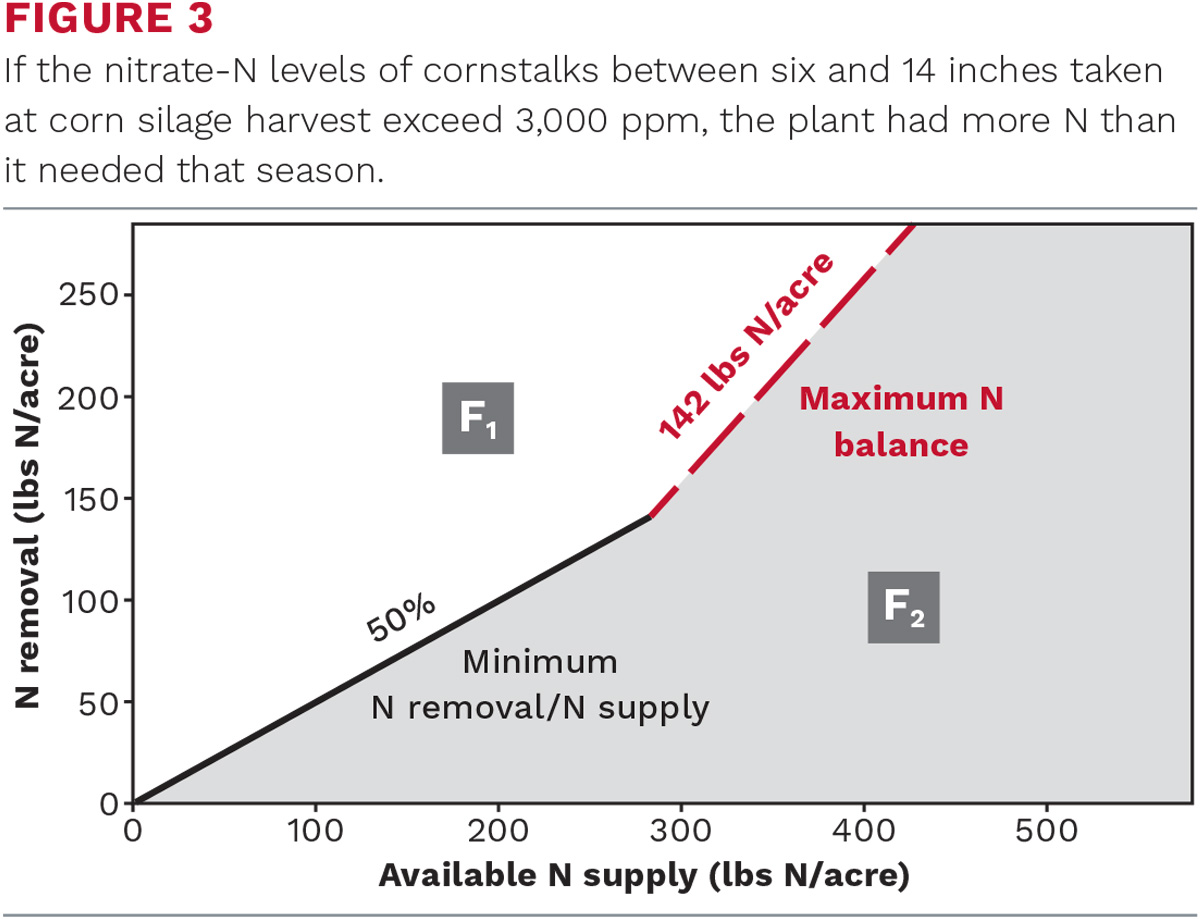
The most recent addition to the list of evaluation tools for corn silage is to conduct a field-available N balance (N supplied minus N removed). The balance is basically the amount of N applied that is not taken up by the plant. The bigger the balance, the greater the potential for N loss to the environment (and the greater the greenhouse gas emission footprint for the farm as well). Limits set for New York under the adaptive management process state that fields should be managed at or above a 50 percent uptake efficiency (N removal/N supply ≥ 0.50) and at or below 142 pounds N/acre available N balance (Figure 3). Fields that do not meet these limits over time (two to three years) should revert to the foundational guidelines.
FROM FIELD TO FARM
The N.Y. partnership agreed that if a farm can demonstrate efficient nitrogen use at the whole farm level, the goals of the adaptive management process can also be met. To reflect this, the most recent adaptive management process includes the statement that farms that maintain a three-year running average whole farm N balance at or below 105 pounds per acre meet the adaptive management guidelines and do not require additional field-specific evaluations beyond recording yield.
CAN YOU DO THIS TOO?
Adaptive management makes sense, regardless of size or regulatory requirements. Most farmers will tell you they have for ages needed to be adaptive and adjust to change. However, just as measuring milk production per cow helps a farmer make better informed herd management decisions, the adaptive management process with end-of-season crop evaluations and monitoring of yield will facilitate more informed crop nutrient management decisions. A good approach for all farms and improved N management reduces the greenhouse gas footprint for the operation too!
MORE INFORMATION
If you have questions about the adaptive management process or are interested in learning more about any of the evaluation tools, please reach out to Quirine Ketterings (qmk2@cornell.edu).
 |
This article appeared in PRO-DAIRY's The Manager in March 2026. To learn more about Cornell CALS PRO-DAIRY, visit PRO-DAIRY. |