Choosing hay equipment has never been easy, but today’s production environment has raised the bar. Higher machinery costs, tighter harvest windows and ongoing labor challenges mean equipment decisions play a bigger role in long-term profitability for livestock producers making their own hay. While the initial purchase price captures attention, it’s the long-term costs and performance that truly shape your return on investment.


Hay equipment rarely works alone. Mowers, tedders, rakes, balers and tractors all influence how efficiently forage moves from the field to storage and, ultimately, to the feedbunk. When equipment is evaluated one machine at a time, it’s easy to miss how decisions at one step affect performance and cost across the entire system.
Looking at hay equipment more holistically and through a clear set of decision-making criteria helps producers compare options more fairly and match purchases to their operation and budget. Factors like consistency, versatility, efficiency, ease of maintenance and true cost per hour or acre often matter more than the price tag alone. When those pieces work together, producers are better positioned to get more value from every acre and every hour in the field.
What return on investment looks like on a livestock operation
Return on investment (ROI) means different things for livestock producers than it does for commercial hay sellers. For operations that make hay primarily to feed their own cattle, value often shows up in day-to-day efficiencies rather than direct revenue.
Consistent forage quality supports predictable feeding outcomes. Reliable equipment performance helps producers finish fields on time and avoid weather losses. Fewer breakdowns during harvest reduce stress and limit the need for extra labor or purchased feed. Each of these pieces of the puzzle may seem small on its own, but together they drive the overall economics of a hay operation.
As operations grow, these inefficiencies become more expensive. Larger livestock producers and commercial operations face the same pressures – just at a bigger scale – making consistency and integrated systems to reduce error even more critical.
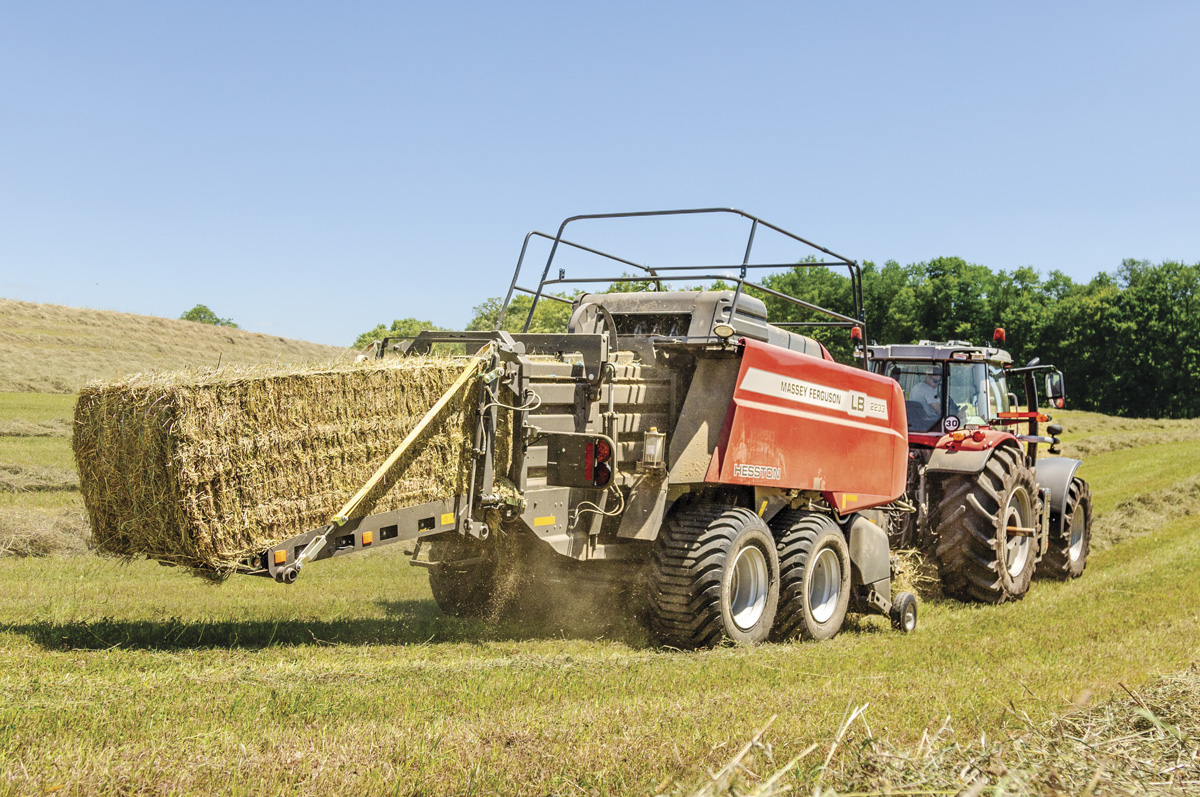
Equipment systems that deliver repeatable results allow operations to add acres or increase output without adding labor at the same rate, resulting in better efficiency and ROI. Image courtesy of Massey Ferguson.
Consistency drives efficiency
Consistency is one of the strongest drivers of ROI across hay production. Uniform cutting height helps forage regrow consistently. Consistent windrows improve crop flow into the baler. Predictable bale size and weight make hauling, stacking and feeding more efficient.
When consistency breaks down, inefficiencies follow. Inconsistent bale weights complicate feeding programs trailers and increase rehandling in storage. Transportation costs increase if space on a trailer is not maximized efficiently. Variability also puts more pressure on operators, who must constantly adjust as conditions change. Over time, these inefficiencies add up through extra labor, higher fuel use and more, ultimately resulting in lost capital.
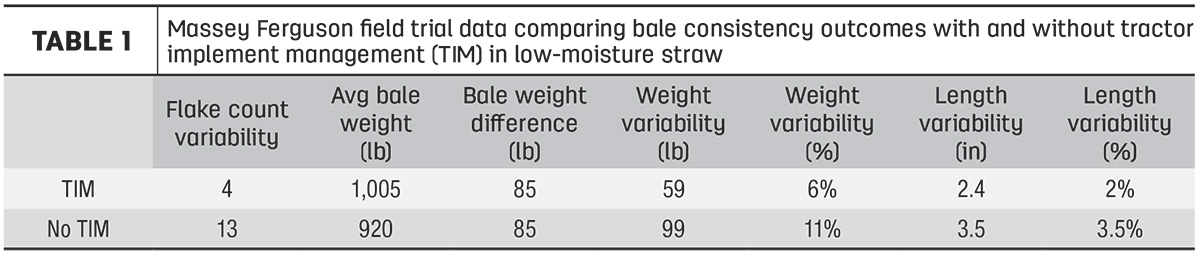
Advances in technology and automation are giving producers more control over consistency than ever before. In recent field trials with a large square baler, the impact of Tractor Implement Management (TIM) on bale uniformity was evaluated. TIM is an ISOBUS-compatible technology available from leading manufacturers that allows the implement to manage tractor speed based on a target outcome rather than relying solely on operator input.
When TIM systems were used, flake count variability dropped from 13 flakes per bale to four, even as windrow and crop conditions changed. Bale weight variability declined from 11% to 6%, while bale length variability dropped from 3.5% to 2%. That consistency turns variability into predictability, making it easier to plan loads, stack efficiently and deliver consistent feed rations.
While this example comes from baling, the takeaway applies across the entire hay system. Investments that reduce variability – from mowing and raking through baling and handling – tend to pay off downstream by saving time, fuel and labor.
Scalability, labor efficiency and system alignment
That same consistency doesn’t just improve day-to-day efficiency; it also determines how easily an operation can scale.
Labor availability remains one of the biggest challenges facing the agriculture industry. Skilled operators are getting harder to find, and owners often run the most critical machines themselves, creating bottlenecks elsewhere in the operation.
Equipment systems that deliver repeatable results allow operations to add acres or increase output without adding labor at the same rate. When machines perform predictably, less time is spent correcting mistakes and more time is spent keeping work moving.
System alignment between tractors and implements can reinforce this effect. When mowers, rakes, balers and tractors are designed to work together, integration tends to be tighter. Setup is often more consistent, controls feel familiar, and software communication is easier to manage. That familiarity lowers the learning curve, reduces errors and improves consistency during busy harvest windows.
Automation supports scalability by shifting consistency from the operator to the system itself. Technologies like TIM make it easier to rotate labor, bring in seasonal help or run multiple machines at once without sacrificing performance standards.
Rather than scaling by adding more equipment or labor, many operations improve efficiency by reducing complexity. Choosing tractors and implements that work together can make the entire hay system easier to manage as operations grow.
Versatility and whole-system utilization
Once a hay system is consistent and scalable, versatility becomes a powerful contributor to ROI.
For most operations, tractors are rarely used for just one job. Tractors that power mowers, rakes and balers during hay season often feed livestock in winter, move bales, handle manure or support daily chores. Equipment that transitions easily between tasks allows producers to get more work out of fewer machines.
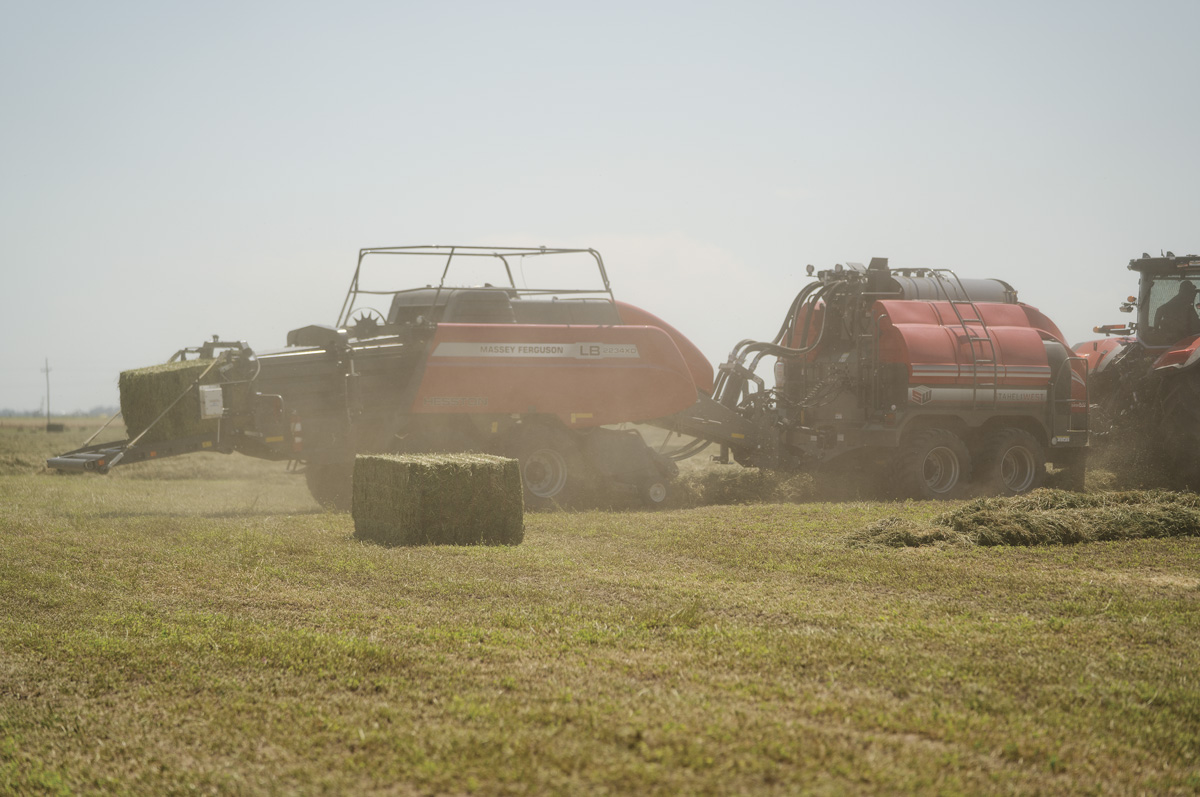
Advances in technology and automation are giving producers more control over consistency than ever before. Image courtesy of Massey Ferguson.
Versatility improves ROI by increasing annual utilization. When a machine is used for more hours across more seasons, ownership costs are spread over more productive time. That lowers cost per hour and reduces the need for specialized equipment that may sit idle.
Versatile equipment also simplifies labor management. Operators remain productive year-round without learning entirely new systems, while operations gain flexibility as acreage or harvest management strategies change.
Maintenance, downtime and system reliability
Another benefit of versatility and efficiency is its impact on maintenance. Relying on more capable machines reduces the overall maintenance load.
System reliability depends on ease of maintenance, access to parts and quick diagnostics. Aligned systems can simplify service by reducing unique procedures and parts inventories, helping keep equipment in the field when it matters most.
Reliable equipment protects ROI by reducing missed harvest windows that leads to optimum forage quality and limiting purchased feed needs while avoiding emergency labor needs. Fewer rushed repairs also lower stress and long-term operating costs.
Turning equipment decisions into measurable return on investment
Purchase price alone rarely reflects the true cost of owning and operating hay equipment. Cost per hour provides a clearer picture by accounting for depreciation, interest, fuel, repairs, maintenance, labor and downtime.
Tools such as the Kansas State University Machinery Cost Calculator allow producers to evaluate those costs using their own inputs. These calculations often reveal differences that aren’t obvious when equipment is compared one piece at a time.
No single machine determines profitability on its own. The most successful hay operations are built around systems that work together reliably from the first pass through the field to the feedbunk. In an environment shaped by tight margins and narrow windows, the goal isn’t to own the lowest-priced equipment but to build a hay system that delivers dependable performance and maximizes return from every acre and every hour in the field.