Alfalfa’s genetic yield potential is high, but insects, weeds and diseases begin reducing that potential long before a producer ever sees it reflected in a lighter bale. More than 100 insect species are known to feed on alfalfa, yet only a handful cause consistent economic damage.

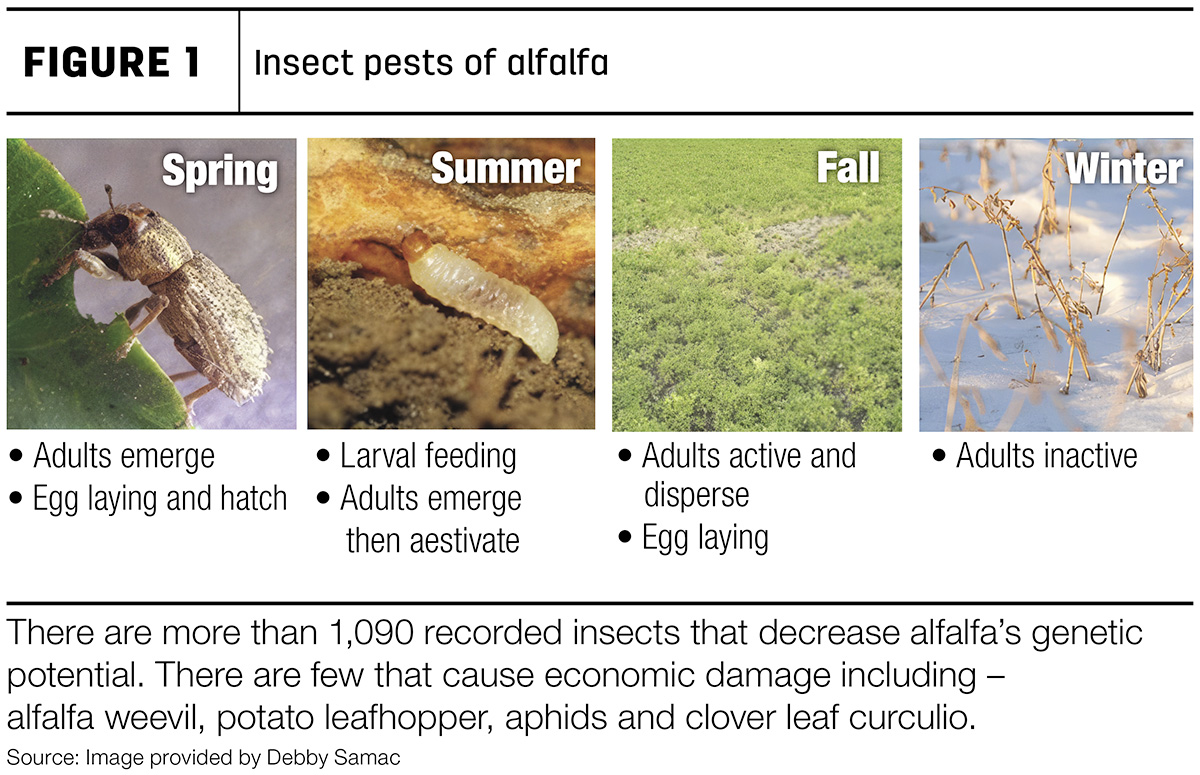
In February, Debby Samac, supervisory research geneticist with the USDA Agricultural Research Service Plant Science Research Unit in St. Paul, Minnesota, helped attendees of the Alfalfa Intensive Training Seminar understand which pests cause issues – and when – allowing producers to make timely, economical decisions that protect stand health and forage quality. She focused on four insect pests – alfalfa weevil, potato leafhopper, aphids and clover leaf curculio – and the weed management principles that most influence long‑term alfalfa stand success (Figure 1).
The National Alfalfa and Forage Alliance’s seminar was held in conjunction with the Wisconsin Custom Operators, Midwest Forage Association and University of Wisconsin Extension’s Midwest Symposium in Wisconsin Dells, Wisconsin.
Scouting and thresholds
Across all insect pests, the most important management tool is scouting.
“The first phase is to go out in the field and do some sweeps, look in the net to see if there are any weevils or other insects, and if you find some, go to the second phase to determine if spraying is required,” said Samac.
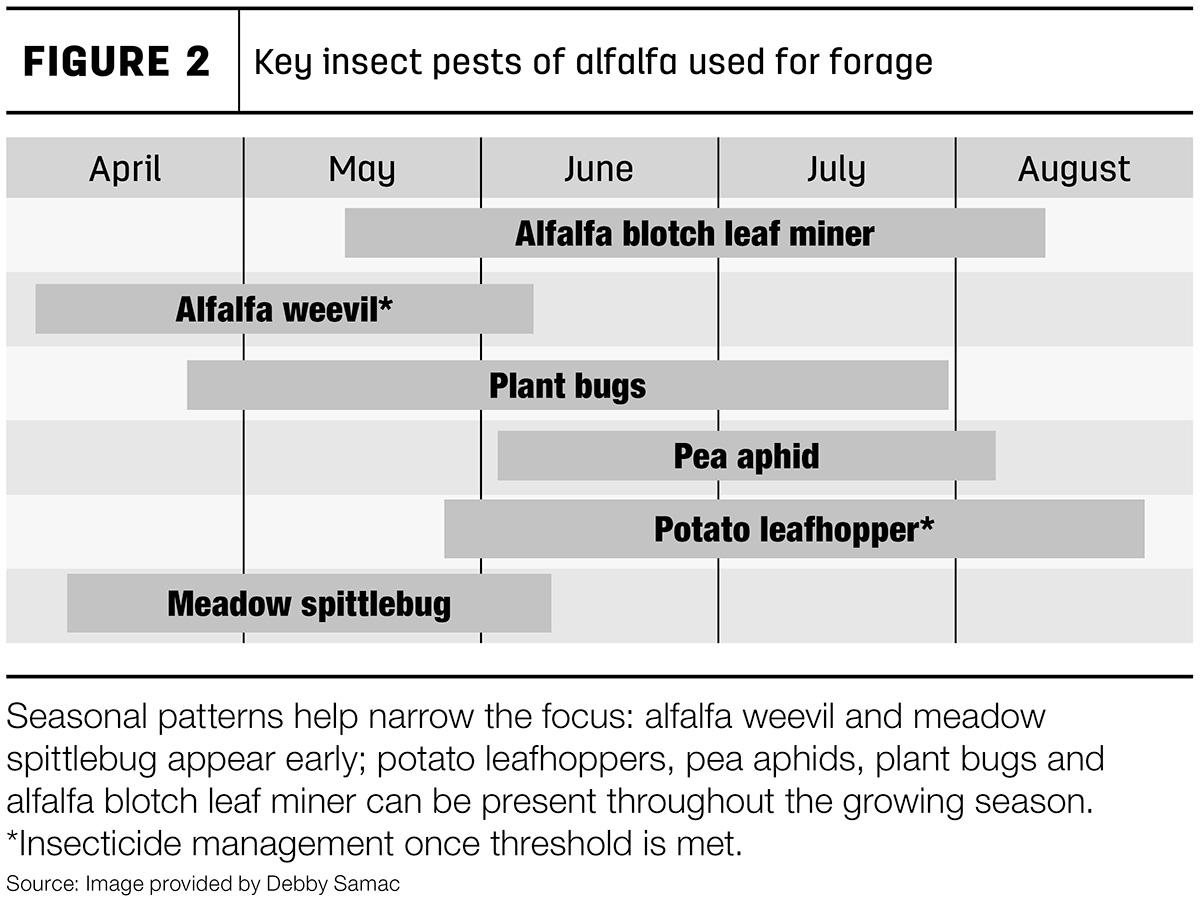
Thresholds of insect numbers for treatment are well established, but they only work when producers go into the fields. Edge-of-field monitoring from a vehicle is not effective. Seasonal patterns help narrow the focus: alfalfa weevil and meadow spittlebug appear early; potato leafhoppers, pea aphids, plant bugs and alfalfa blotch leafminer can be present throughout the growing season (Figure 2).
Because alfalfa also supports many beneficial insects – especially aphid predators – accurate identification and threshold‑based decisions prevent unnecessary insecticide use and preserve natural control.
Alfalfa weevil
Among alfalfa insects, none is more damaging than the alfalfa weevil. Larvae skeletonize leaves between the veins, leaving fields with a bleached, white cast when damage is severe. Although adults feed as well, the larval stages – easily recognized by their distinctive black head capsule – cause most of the injury.
Samac added that the alfalfa weevil has an interesting history in the U.S., having been introduced multiple times. Three biotypes exist: eastern, western and Egyptian. Genetic work shows the eastern and Egyptian types are closely related, while the western type is genetically distinct.
“This matters because the western biotype has developed significant pyrethroid resistance, and there are signs that resistant populations may be moving eastward,” said Samac.
Where pyrethroid resistance is confirmed, rotating insecticide modes of action is required. Research from Montana State University shows that switching to a different active ingredient for one season can restore pyrethroid efficacy in subsequent years. Annual rotation helps preserve the usefulness of all available chemistries.
Weevil activity begins when temperatures reach about 48°F. With only one generation per year, damage is concentrated on the first cutting.
Scouting follows a two‑step process: first, sweep to confirm presence; then collect 10 stems from five difference locations, hit the stems in a bucket and count larvae. Economic threshold tables – based on crop height, hay value and treatment cost – will guide spray decisions.
Samac also suggested cultural control options that include early harvest and rapid windrow pickup, since larvae continue feeding under windrows. Grass-alfalfa mixtures often show lower weevil pressure because grasses are not hosts.
“Biological control from parasitoid wasps historically kept weevil populations in check in the eastern U.S., but their effectiveness has declined for reasons still under investigation,” said Samac.
Potato leafhopper
Potato leafhopper is the dominant insect problem in the eastern and midwestern U.S. Unlike the weevil, the potato leafhopper does not overwinter locally. Instead, it migrates north each spring from the Gulf Coast, arriving in late spring or early summer, depending on weather and wind patterns. Populations can vary dramatically.
Both nymphs and adults feed by inserting their mouth parts into the phloem and extracting nutrients. New seedings are especially vulnerable, but the challenge is that damage is cumulative.
Samac said, “Even if the first cutting survives, toxins injected during feeding suppress regrowth and reduce yield in subsequent cuttings.”
Symptoms begin with a V‑shaped yellowing at leaflet tips, progressing to reddening and eventually necrosis – classic “hopper burn.” Damage is usually uniform across the field, though it often begins at field edges.
Potato leafhopper‑resistant alfalfa varieties have been a major success story. Resistance comes from glandular hairs on stems and leaves, introduced from nonsativa germplasm.
“These hairs physically impede feeding and trigger physiological responses that reduce leafhopper survival,” said Samac.
Scouting thresholds differ for resistant and susceptible varieties, but sweep nets remain the primary tool for decision‑making.
Aphids
Four aphid species commonly affect alfalfa: green pea aphid, spotted alfalfa aphid, blue alfalfa aphid and cowpea aphid. While more problematic in the West, they appear in the Midwest as well. Aphids cause yellowing, stunting, midday wilting and honeydew accumulation that grows mold.
Fortunately, natural predators – lady beetles, lacewings, parasitic wasps – provide strong biological control.
“Producers should avoid reacting too quickly,” said Samac. “Insecticide treatment is rarely needed, unless populations exceed roughly 100 aphids per sweep – resistant varieties are available for several species, which add another layer of protection.”
Clover root curculio
Clover root curculio receives far less attention than it deserves.
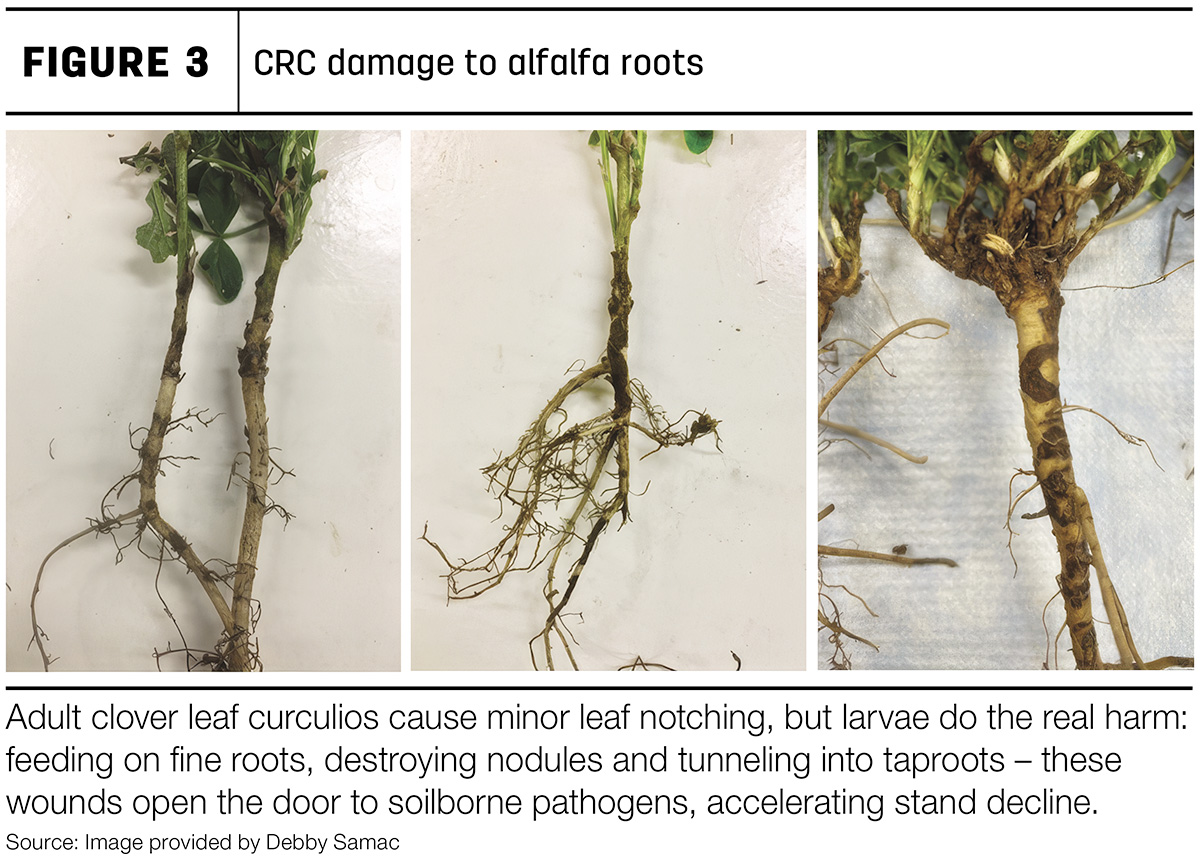
“As a plant pathologist, I will tell you, nearly every root sample pulled from an older stand shows some level of curculio damage,” said Samac. “Adults cause minor leaf notching, but larvae do the real harm: feeding on fine roots, destroying nodules and tunneling into taproots – these wounds open the door to soilborne pathogens, accelerating stand decline” (Figure 3).
No insecticides are registered for clover root curculio. Management relies on rotation – avoiding legumes before alfalfa – and selecting varieties with strong resistance to root diseases such as verticillium, fusarium and bacterial wilts.
Weed management
Weed control in alfalfa begins long before the first cutting.
“A dense, vigorous stand is the best defense, and that starts with establishment,” said Samac.
Weeds reduce forage quality, increase drying time, harbor insects and pathogens, affect overall biomass and in some regions, might introduce toxicity risks.
Key principles to control weeds in establishment of alfalfa, according to Earl Creech at Utah State University, include:
- Control perennial weeds before planting alfalfa
- Time planting to minimize weeds
- Plant weed-free seed
- Do something to control weeds
- Know weed identity and size
- Understand herbicide nuances
Samac also referenced the 2026 North Dakota Weed Control Guide.
“It provides herbicides for all crops, not just alfalfa – especially those with residual considerations for replanting – and it walks through many of the important herbicide nuances,” said Samac.
She also stressed the importance of using clean seed and understanding herbicide residuals. Residual carryover is a common cause of establishment failure. In one case, a corn herbicide with an 18‑month residual prevented alfalfa emergence entirely, leaving only curled, brittle seedlings that never formed a usable stand.
Herbicide timing is critical – preplant, preemergence and postemergence options exist, but each has a narrow application window and specific crop growth requirementsabels vary by state and must be followed precisely.
Samac suggests another option – Roundup Ready alfalfa – which simplifies weed control and is widely used. However, spring glyphosate applications on alfalfa more than 4 inches tall, followed by a cold snap, have been linked to increased bacterial stem blight and significant first‑cut yield loss. Awareness of this interaction helps growers avoid unintended consequences.
Using genetic resistance remains the best tool for protecting alfalfa’s yield potential before those losses ever show up in the bale, added Samac.
“For insects, that means getting out in the field and scouting regularly – not from the pickup window, but with a sweep net in hand. For diseases, it’s recognizing when plants don’t look right, knowing which pathogens are common in your area and leaning on accurate identification.”