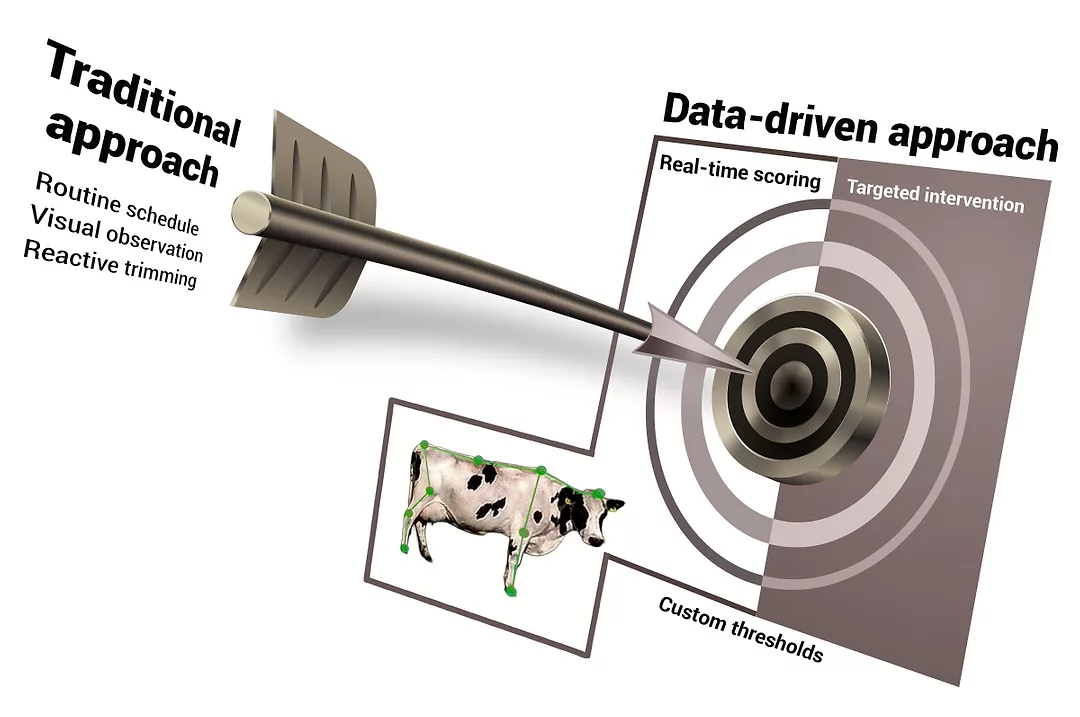
For decades, hoof health programs relied on routine schedules and human observation. Cows were trimmed at set points in lactation or flagged by employees who noticed visible signs of lameness. While that approach worked, it depended heavily on individual experience – and subtle mobility changes were often missed.

Artificial intelligence (AI) mobility scoring shifts that model from subjective observation to continuous objective monitoring. Cameras and software assess how cows walk and assign mobility scores across the herd, creating a consistent benchmark for intervention.
But the real value is not simply identifying lame cows. It is in how dairies act on the data.
Progressive dairies are moving beyond detection and using lameness insights to guide daily management decisions, allocate labor more efficiently and intervene earlier – before mild issues become costly cases.
Rethinking the trim list
One of the most immediate operational changes is how farms build and manage trim lists.
Instead of trimming cows strictly on routine schedules, one can prioritize animals based on real-time lameness scores. Early in the adoption process, thresholds are often set conservatively to keep trim volumes manageable. As overall lameness improves, thresholds can be refined to target smaller, more specific cow groups.
Many dairies now customize trim criteria based on:
- Lactation number
- Days in milk
- Reproductive status
- Milk production
For example, older cows naturally exhibit a wider gait than first-lactation animals, so intervention thresholds can be adjusted accordingly. Some farms choose to delay trimming shortly after calving or account for temporary gait variation during estrus.
The result is precision trimming. Cows that need attention receive it sooner, while healthy cows avoid unnecessary handling and time in the chute.
Over time, many herds report trimming fewer cows – not because hoof health is ignored but because interventions are more targeted. That reduces labor, animal stress and time spent handling cows that do not need treatment.
Earlier intervention improves the bottom line
Lameness management becomes financially significant when it shifts from reacting to severe lameness to addressing early mobility changes.
University research and large-scale analyses of Council on Dairy Cattle Breeding (CDCB) data show that AI lameness detection can reduce lameness, improve reproduction and milk yield, and support genetic progress. Cows monitored and managed proactively experience lower lameness rates and are more likely to return to pregnancy earlier in lactation.
Across herds, a 10% reduction in lameness is a common benchmark when lameness monitoring is paired with consistent intervention protocols. That improvement can translate to approximately $140 per cow per year when factoring in:
- Increased milk production
- Improved reproductive performance
- Reduced veterinary expense
- Lower treatment and labor costs
Lameness often carries hidden costs – delayed breeding, extended days open, chronic cases that cause cows to underperform and premature culling. Addressing mobility earlier reduces those downstream financial pressures.
For many dairies, the shift from reactive trimming to data-driven intervention represents a management change with measurable economic return.
Standardizing decision-making across employees
On most farms, staff have a wide range of experience and skill levels, which can be a challenge for hoof health programs. Training employees to detect subtle signs of lameness takes time, and consistency can vary among observers. AI mobility scoring reduces that subjectivity.
Instead of relying solely on visual assessment, employees work from optimized trim lists that can integrate into existing herd management software. Teams continue to use familiar workflows – sorting cows after milking, identifying animals in headlocks or pulling from pens – but with clearer guidance on which cows require attention.
This consistency is especially valuable for farms with more employee turnover. Protocols become standardized rather than experience-dependent, helping maintain performance even as teams change.
Data only drives results when you act on it. Reviewing lameness trends, adjusting intervention thresholds and responding quickly to spikes keep the system aligned with your herd goals – rather than letting insights go unused.
A broader operational ripple effect
Consistent lameness management produces benefits that extend beyond individual cows.
Healthier cows remain productive longer, reducing replacement pressure and improving overall herd efficiency. Earlier lameness intervention lowers the risk of chronic cases that linger and consume resources. More stable hoof health also supports stronger reproductive performance and more predictable production curves.
Large-scale analyses of lameness datasets have demonstrated that susceptibility to lameness shows heritable patterns across generations. Incorporating lameness data into breeding decisions creates the opportunity to select for stronger hoof health, leading to long-term genetic progress.
At the industry level, improved longevity and efficiency reduce greenhouse gas emission intensity per pound of milk produced. Strong welfare outcomes also strengthen dairy’s position with processors and consumers, who are increasingly evaluating production practices.
What begins as a hoof health initiative can evolve into a broader management and industry-wide advantage.
What’s next for mobility data?
As lameness monitoring becomes more integrated into daily management, the next phase of mobility data is already emerging.
While mobility scoring remains the foundation, some AI systems now provide additional insights, including automated body condition scoring (BCS).
Nutrition decisions based on consistent BCS data create another opportunity for economic impact. Adjusting rations or grouping strategies based on condition scores can improve milk efficiency, reduce overconditioning and support reproductive performance.
As with lameness, the value lies in turning objective data into consistent action.
AI mobility tools have moved well beyond simple detection. For progressive dairies, the opportunity now lies in converting objective insight into consistent action – and measurable ROI.
References omitted but are available upon request by sending an email to the editor.
How to choose an AI lameness system
As AI lameness tools become more widely available, evaluate solutions carefully to ensure long-term value.
Consider these key questions:
- Is the system backed by research and data? Validation across multiple herds, industry organizations and universities increases confidence that results will translate into measurable improvement.
- How actionable is the output? Does the system integrate with existing herd management software to create optimized trim lists and intervention protocols?
- Can it adapt to your management strategy? Customizable thresholds by lactation stage, days in milk or reproductive status increase precision.
- What level of ongoing support is provided? Ongoing trend monitoring, threshold adjustments and proactive guidance can significantly influence ROI. Ask about the team that supports these key steps.
- What hardware and maintenance requirements are involved? Consider installation complexity, additional equipment and total cost of ownership.
- Does the system offer additional actionable insights? Beyond lameness, tools such as automated body condition scoring may create further management and financial opportunity.