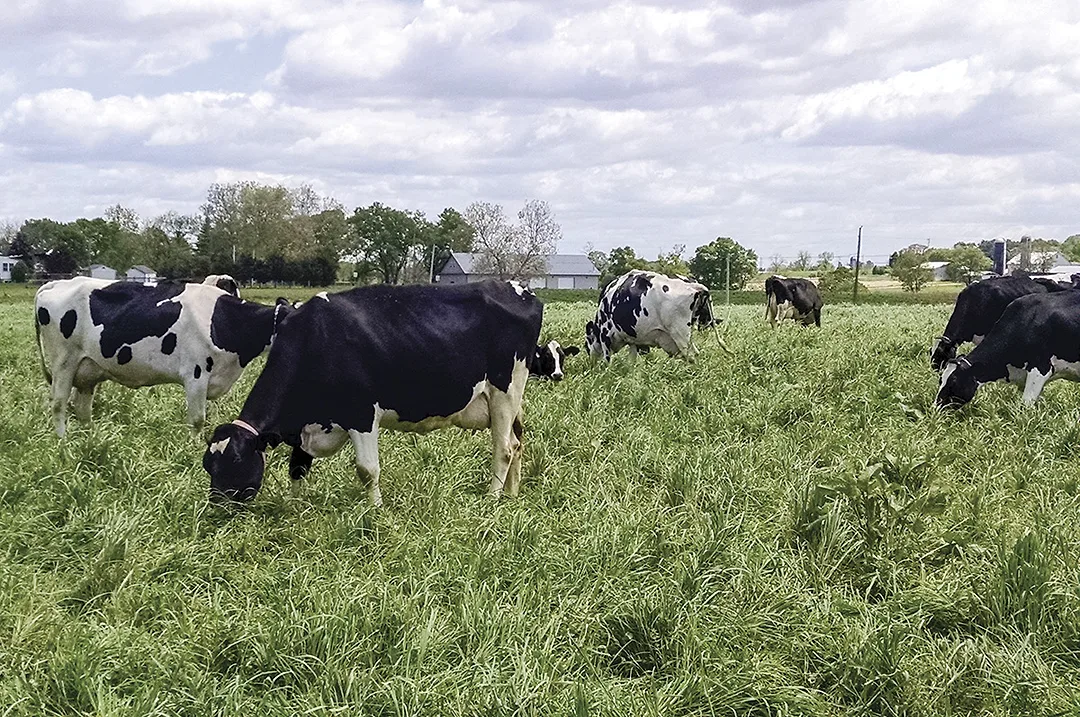
Numerous factors influence decisions in grazing systems. Cattle numbers, land availability, soil types, weather conditions and animal productivity are some of the key variables directly affecting pasture management for dairy cows.


In grazing systems, the decision of when to graze and how much to harvest often considers the economic trade-offs between maximizing milk production per animal and per acre. For instance, increasing the stocking density (number of cows/area) and the grazing intensity may contribute to maximizing the total amount of forage harvested; however, it could also limit the productivity of individual cows due to decreased forage quality. Additionally, data collection in grazing systems has long relied on manual, intensive and time-consuming activities.
With the rapid ascension of precision technologies, farmers now have the potential to generate information and improve grazing management more efficiently. In this article, we discuss novel grazing strategies with the potential to improve cow and land productivity, with a focus on grazing intensity and cow behavior.
Sward height, defined as the length of the plants from the ground to the top of the leaf canopy, is a measure commonly used for pasture evaluation. The sward height is a direct measure of light interception, which is correlated with forage production (pounds per acre). Light interception refers to the amount of solar radiation that is intercepted by the forage canopy, with research showing that optimum forage production is achieved when 95% of the light is intercepted. Exceeding 95% light interception at pre-grazing does not promote net gains in forage production but substantially decreases forage quality due to greater accumulation of aging material and lignification of basal plant structures. Sward height corresponding to 95% light interception has been extensively studied, and general recommendations for different forage species are available in the literature.
In addition to height, density or volume (estimated as the forage mass pounds per square foot or pounds per cubic foot, respectively) also affect the availability of forage and grazing behavior. Cows grazing pastures with high versus low forage density show marked differences in biting activity and number of feeding stations – both representative of short-term grazing behavior. It is important to note that cows have preference and motivation during grazing, and forage quality and availability are key determinants for optimum feed intake in grazing systems. Low-quality swards are expected to reduce grazing efficiency as cows waste time sorting for the most nutritive plant structures (leaves versus stems and aging material). In this sense, grazing intensity plays a role in forage quality and intake, which can be easily determined by post-grazing height.
For long-term pasture productivity and persistency of cool-season grasses, a practical goal is to aim for post-grazing height of 1.6 to 2 inches because most of the water-soluble carbohydrates needed for plant regrowth are stored below this point. In rotational (intermittent) systems, post-grazing heights could be managed around 50% of the pre-grazing height. For example, for many tall-growing cool-season grasses, such as orchardgrass, pre- and post-grazing heights would be 8 to 10 and 4 to 5 inches, respectively. This practice would likely decrease grazing interval and may improve forage quality; however, this may not be critical for overall system and cow productivity compared with targeting residues at 1.6 to 2 inches.
Recent research has evaluated the effects of two post-grazing heights on forage production and lactational performance in dairy cows maintained in a strip-grazing system of tall fescue (Lolium arundinaceum) across nearly an entire lactation. Pre-grazing height was 9.3 and 8.7 inches, whereas post-grazing heights were 3 and 6 inches for conventional (control) and moderate grazing (treatment), respectively. Sward height depletion was 66% and 35% of pre-grazing height, period of stay was 2.9 and 3.9 days per strip, and number of grazing cycles was 3.3 and 8.3 for control and treatment strategies, respectively. Area used was lower (2.9 and 4 acres) and stocking rate (1.4 and 1 cow per acre) was greater in conventional than moderate grazing systems.
Overall, cows managed in a moderate grazing system (highest sward height) had increased milk production (72.8 versus 67.2 pounds per day energy-corrected milk; ECM) and earlier recovery of body condition score in the lactation compared with cows managed in a conventional grazing system. Additionally, higher post-grazing sward reduced feed use per unit of milk produced. The drawback was that the stocking rate was 29% lower for the higher sward height group, leading to decreased milk and ECM yields per acre compared with the lower post-grazing sward height. Despite a numerical difference ($1,245 versus $1,092 per acre per 215 days), income over feed costs did not statistically differ between treatments in that study. Clearly, moderate grazing positively affected individual cow performance, but these benefits were offset by lower land productivity.
Different grazing intensities and management are expected to modulate cow behavior and productivity. Farms with limited acreage may choose to be more aggressive with the stocking density and utilize lower sward heights to maximize production per acre. Other farms may have the opportunity to utilize lower stocking densities and higher post-grazing sward heights, taking advantage of faster regrowth and higher-quality forage to increase individual cow production. Alternatively, some farms may choose to group cows based on production merit and manage these groups using different grazing approaches.
As for many biological responses, the optimum balance between individual cow and land productivity may fall somewhere in the middle. It is important to note, however, that these decisions can only be made on farms that have adequate recordkeeping and data collection. “Measure to manage” is key for dairy farms that want to remain profitable and improve their performance in grazing systems.
References omitted but are available upon request by sending an email to the editor.