First detected in U.S. dairy cattle in 2024, highly pathogenic avian influenza (H5N1) quickly proved to be a costly problem. One of the first infected herds studied showed that 32% of cows were affected within 45 days, resulting in a 7% milk yield decline overall with some days’ production losses reaching 22%. The financial losses on this herd totaled nearly $80,000 – roughly $500 per affected cow – with 92% of that loss coming from reduced milk output (Rodriguez et al., 2025, J. Dairy Sci.).
While the per-cow cost is comparable to other major production diseases such as mastitis, the impacts of H5N1 are compressed into a shorter and more intense time period.
With no cure currently available, early detection is the most powerful tool, as waiting for obvious disease signs increases losses. Identifying early physiological changes, especially at scale, offers a practical opportunity for producers to protect herd health, safeguard employees and reduce production losses.
How Early Detection Can Change Outcomes
While there is still much to learn about H5N1 in dairy cows, we do know it can spread quickly through shared milking equipment, feed and dairy personnel moving between barns. Therefore, it’s agreed that the sooner an infected animal is identified, the sooner it can be isolated to keep the virus from moving between cows, farms or into nearby poultry or wildlife.
Early detection can also:
- Support cow welfare and recovery. While the death rate is low, many infected animals experience a loss of appetite, drop in production or develop fever and lethargy. Early intervention provides the chance for supportive care that minimizes losses and prevents prolonged suffering.
- Protect milk safety. Early diagnosis ensures contaminated milk is withheld from the supply chain to help maintain consumer trust, which is critical for market stability.
- Reduce human transmission risk. Human H5N1 infections linked to dairy cattle have been documented, primarily in farmworkers. Quick detection limits exposure, reduces the risk of the virus adapting to mammals and helps safeguard farm personnel.
An editorial in a special issue of the JDS Communications reinforced the importance of communication and collaboration in the management of emerging diseases like H5N1 stating that effectiveness depends on timely information flow and a coordinated response – not waiting until disease is unmistakable.
The Role of Monitoring on Modern Dairies
Precision dairy technologies were not designed to diagnose influenza, but they are well suited to detect deviations from normal cow behavior and production patterns. Changes in rumination, activity, temperature and milk yield consistency can serve as an early warning signal that cows are experiencing systemic stress or illness. When combined with milk testing, observation, veterinary evaluation and enhanced biosecurity practices, these early signals allow producers to react more quickly.
H5N1 + Technology on an Ohio Dairy: Insights from Cornell University Researchers
A group of researchers from Cornell University studied the impact of an H5N1 outbreak on a 3,800-cow dairy in Ohio, focusing on the risk factors associated with clinical disease and the consequences of infection on production. The dairy was using technology from Afimilk for herd management, including the Afimilk MPC (milking point controller) and milk meter in the parlor, and AfiCollar with the feed efficiency service for rumination, activity and feed intake monitoring. The rumination, eating and milk production data collected with these technologies would prove to be crucial for the findings of this study.
In this study, H5N1 diagnosis was confirmed using PCR milk testing. However, researchers found that the health sensor data actually told the story earlier. Cornell researchers found that Afimilk technology caught subtle shifts in rumination activity and milk yield in sick cows five to seven days before veterinary diagnosis (Charts 1 and 2) – often long before a cow looked sick.
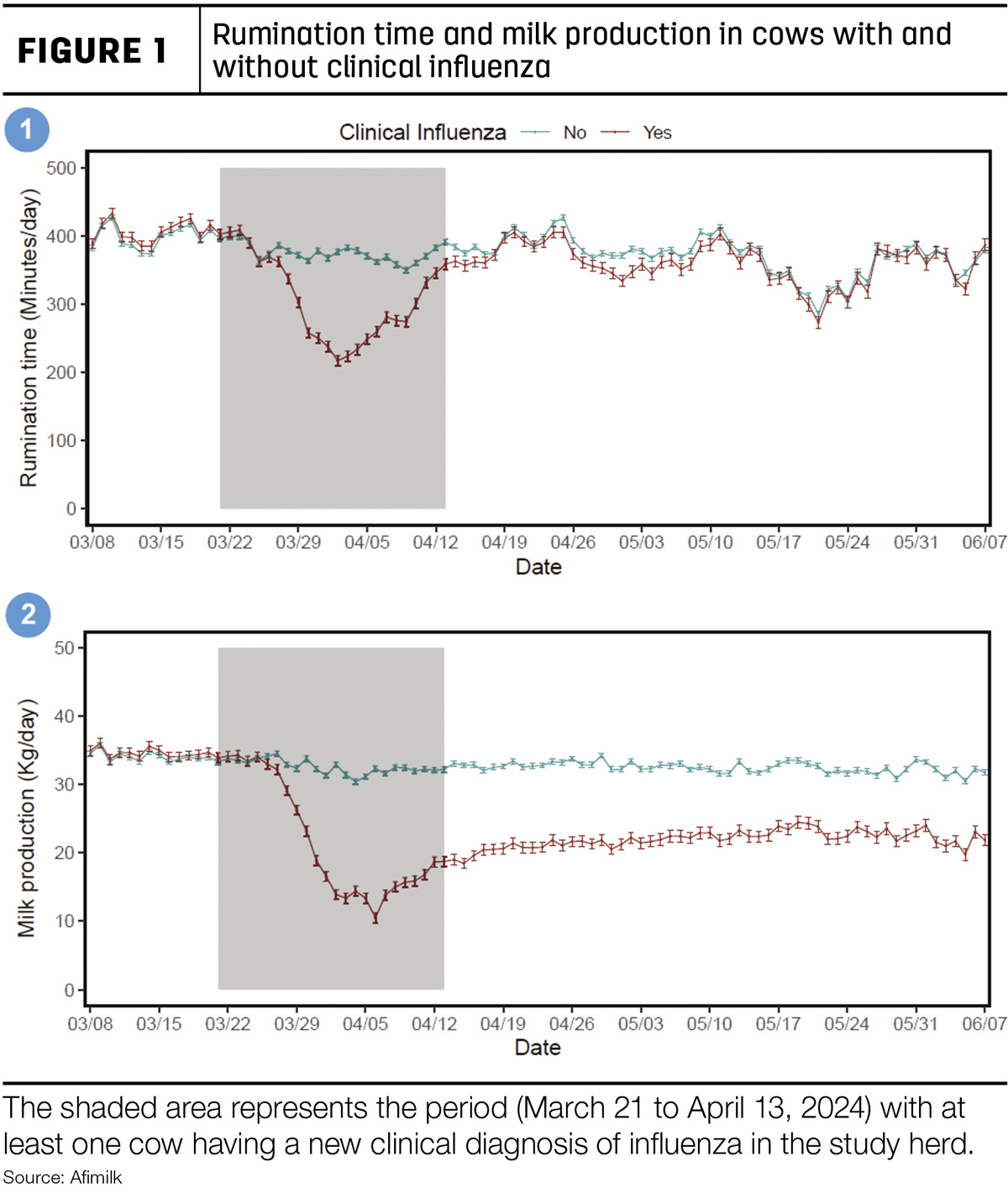
These findings provoked researchers to state that “farms utilizing monitoring systems should closely track individual cow rumination times and milk production, as decreases in these parameters can serve as early warning indicators” of H5N1.
There were a number of key findings that Afimilk technology helped to uncover:
- Individual cow rumination and dry matter intake changes were seen five to seven days prior to clinical diagnosis with AfiCollar and AfiCollar Feed Efficiency data.
- Milk production started dropping considerably five days before diagnosis and reached its lowest point two days after clinical influenza diagnosis. Within two weeks of clinical H5N1 detection, milk production in clinically affected animals decreased by nearly 73%.
- The risk of clinical influenza diagnosis increased as lactation progressed.
Due to these declines, Cornell researchers estimated the total cost of the influenza outbreak on this Ohio dairy to be $932 per clinically affected cow.
Limit Risk with Technology-based Early Detection
H5N1 is a high-stakes challenge for today’s dairy farms. An early warning could mean the difference between a contained case and a herd-wide outbreak. Earlier diagnosis allows for faster isolation, targeted testing and quicker implementation of biosecurity protocols to help producers limit losses and protect both their herd, their personnel and their profitability.
*Peña-Mosca, F., Frye, E.A., MacLachlan, M.J. et al. The impact of highly pathogenic avian influenza H5N1 virus infection on dairy cows. Nat Commun 16, 6520 (2025).